


Overcharging a Marine Battery: Risks and Prevention
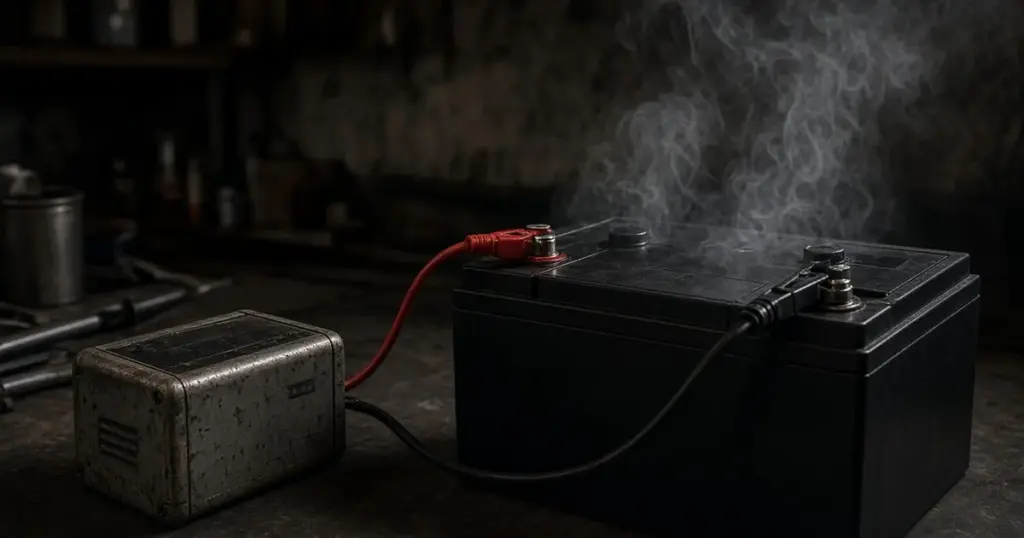
Overcharging is one of the most common ways boat batteries are damaged, and it’s also a safety hazard. It can happen quietly, from a charger left on the wrong setting or an alternator regulator that fails high. This guide explains the signs, causes and fixes.
What overcharging means
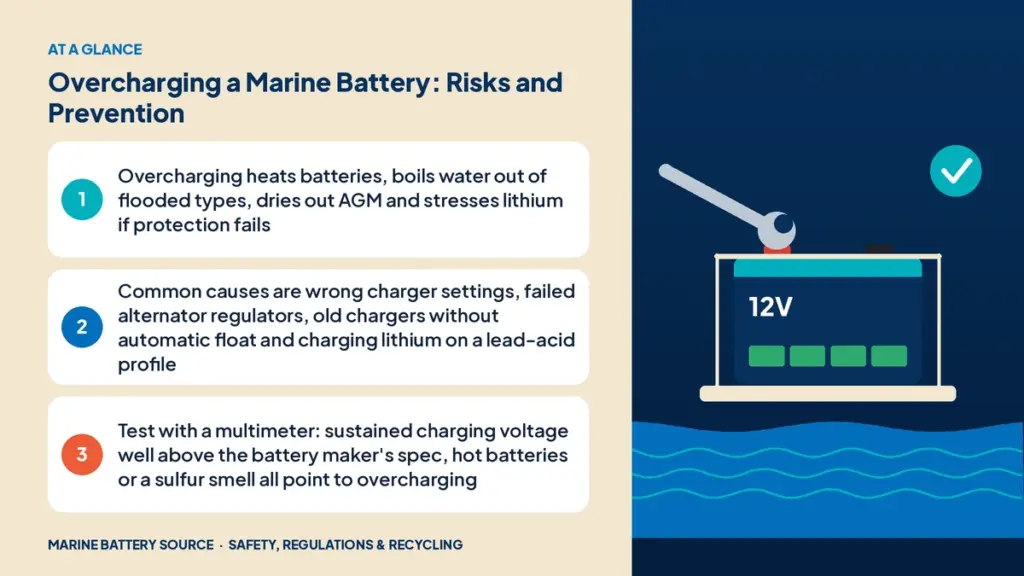
Every battery has a charging voltage it’s designed for. Charging beyond that voltage, or holding a high voltage for too long, is overcharging. What happens depends on chemistry:
- Flooded lead-acid: excess current splits water into hydrogen and oxygen. The battery gasses heavily, loses water, heats up and can expose and damage its plates. See battery hydrogen gas and ventilation.
- AGM: gas builds faster than the battery can recombine it, so the valves vent. The battery dries out and loses capacity, and severe overcharging can cause swelling.
- LiFePO4 lithium: the BMS should disconnect charging if cell voltages rise too high. If the charger is wrong and protection fails, cells can be stressed and damaged. That’s why the BMS and the right charger both matter.
Signs of overcharging
- Battery hot to the touch after charging
- Sulfur or “rotten egg” smell near flooded or AGM batteries
- Rapid water loss in flooded batteries
- Electrolyte spray or wet battery tops
- Swollen or bulging case
- Charging voltage that stays high for hours
- Lights and electronics that seem unusually bright, or bulbs burning out often, when the engine is running
- Lithium battery BMS cutting off charging repeatedly
Common causes
- Wrong charger profile. An AGM or lithium battery on a flooded profile, or a charger set for a higher voltage than the battery needs.
- Old chargers without automatic float. Some older or very basic chargers keep pushing current indefinitely.
- Failed alternator voltage regulator. If the regulator fails high, the engine can push excessive voltage into every battery it charges.
- Equalizing the wrong batteries. Equalization is only for flooded batteries that the maker says can be equalized. Never equalize AGM or lithium.
- Charger too large for a small battery. Very high current into a small battery can overheat it.
- Temperature. Lead-acid charging voltages should be lower in hot weather. Chargers without temperature compensation can overcharge in hot compartments, a real issue on Florida boats in summer.
- A failing battery. A battery with a shorted cell draws excess current from a normal charger and overheats.
How to test
You need a digital multimeter.
- Resting voltage: with the battery disconnected from chargers and loads for several hours, measure voltage. A healthy 12V flooded battery reads about 12.6–12.7V when full.
- Charging voltage: with the charger running, measure across the battery terminals. Compare with the battery maker’s specs. As a general guide, engine charging systems typically run around 13.8–14.6V on 12V systems. Lithium makers list their own ranges; Battle Born lists 14.2–14.6V.
- Float voltage: once the charger switches to float, the voltage should drop to the maker’s float setting for lead-acid. If it stays at absorption voltage for many hours, the charger may not be switching stages.
- Engine charging: with the engine running at cruising rpm and the batteries mostly charged, measure at the battery. A voltage that keeps rising above the normal range suggests a regulator problem.
How to fix it
- Set the charger correctly for each bank’s chemistry.
- Replace chargers that can’t switch stages or don’t offer the right profile.
- Have the alternator regulator tested if engine charging voltage is high.
- Add temperature compensation if your charger supports a temperature sensor.
- Use a DC-DC charger for lithium banks charged from an alternator, to control charging precisely.
- Replace damaged batteries. A swollen, hot or badly gassing battery should be removed and recycled.
If a battery is overheating now
- Turn off the charger or engine.
- Ventilate the area and keep sparks away.
- Don’t touch a very hot or swollen battery; let it cool.
- Once it’s cool, disconnect it, negative first.
- Have the charging system and battery checked before using either again.
Mixed-chemistry boats
Many boats now run an AGM or flooded start battery alongside a lithium trolling or house bank. That’s fine, but each bank needs its own correct charging. A multi-bank onboard charger should let you set each bank’s profile separately, or you can use separate chargers. When the engine charges both, a DC-DC charger between the start battery and the lithium bank keeps each at the right voltage. Combining mixed chemistries on one charger output is a common cause of overcharging one bank and undercharging the other.
Undercharging is a problem too
Overcharging gets the headlines, but chronic undercharging is just as damaging to lead-acid batteries, causing sulfation and lost capacity. The goal is the right voltage, for the right time, for each chemistry.
What surveyors and standards say
Surveyors look at charger installation and condition, and ABYC’s A-31 standard covers battery chargers and inverters. See the ABYC battery standards overview and what a marine survey checks on batteries.
Fire risk
Overheated batteries, chargers and connections are fire risks. See boat electrical fire prevention, and keep protective gear on hand for battery work; see battery handling safety gear.
Recycling damaged batteries
Overcharged batteries that are swollen or leaking must be recycled properly. See marine battery recycling.
More reading
The marine battery safety guide covers safe charging and installation for every battery type.
Products that help
- EPOCH 12V/36V onboard lithium charger
- EPOCH 4-bank 12V charger
- EPOCH dual-output DC-DC charger
- Browse marine chargers.
Frequently asked questions
Can you overcharge a boat battery?
Yes. Wrong charger settings, failed alternator regulators and old chargers can all overcharge batteries.
What are the signs of an overcharged battery?
Heat, a sulfur smell, water loss, swelling and charging voltage that stays high.
What voltage is too high for a 12V battery while charging?
It depends on chemistry. Compare with the battery maker’s specs; engine charging typically runs around 13.8–14.6V.
Can a lithium battery be overcharged?
The BMS should prevent it, but use a LiFePO4 charger so you aren’t relying on the BMS alone.
Can I equalize an AGM battery?
No. Equalization is only for flooded batteries the maker says can be equalized.