


ABYC Battery Standards: A Plain-English Overview
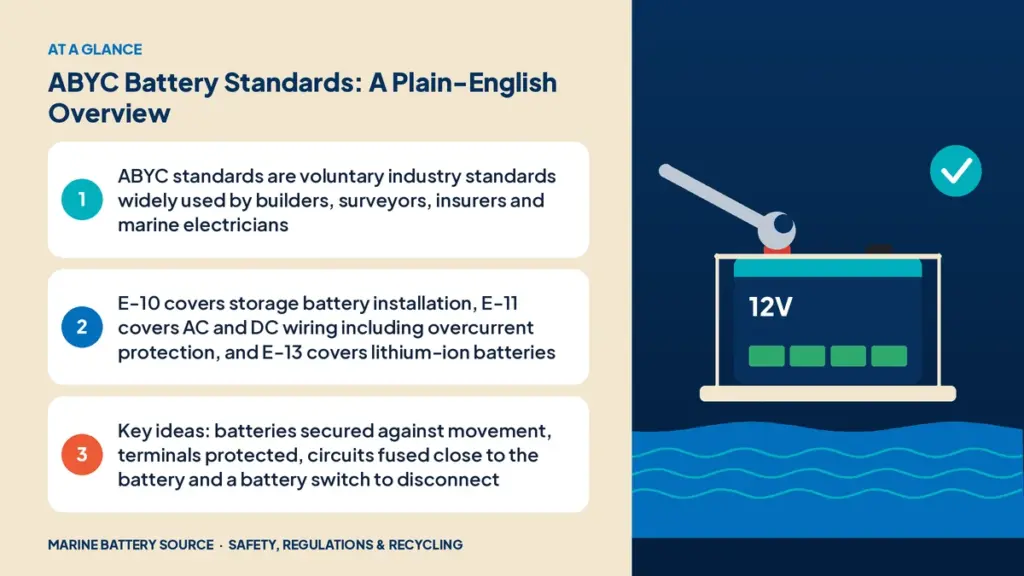
If you’ve had a boat surveyed or worked with a marine electrician, you’ve probably heard “ABYC” mentioned. The American Boat and Yacht Council publishes technical standards for boat design, construction and repair, including how batteries should be installed and wired. This overview explains what the main battery-related standards cover, in plain terms. It isn’t a substitute for the standards themselves; the official documents are available from ABYC, and requirements change between editions.
What ABYC standards are
ABYC standards are voluntary consensus standards developed by industry experts. They aren’t law in themselves, but they matter in practice:
- Many boat builders follow them.
- Marine surveyors use them as a benchmark when inspecting boats.
- Insurers and lenders often rely on survey findings based on them.
- Some U.S. Coast Guard regulations cover similar ground, and certain ABYC standards align with federal rules.
For owners, following ABYC practice is a good way to make an installation safe and survey-friendly. See what a marine survey checks on batteries.
The main battery-related standards
| Standard | Covers |
|---|---|
| E-10 Storage Batteries | Installing lead-acid and similar batteries: location, securing, terminals, ventilation |
| E-11 AC and DC Electrical Systems on Boats | Wiring, overcurrent protection, battery switches, conductor sizing |
| E-13 Lithium Ion Batteries | Installation and system requirements for lithium-ion batteries |
| A-31 Battery Chargers and Inverters | Charger and inverter installation |
E-10: securing the battery
One of the best-known E-10 requirements is that an installed battery shouldn’t move more than one inch in any direction when a pulling force of 90 pounds, or twice the battery’s weight, whichever is less, is applied through its center of gravity. The test is applied vertically, fore and aft, and side to side. In practice, that means a tray or box plus a strap or bracket that holds the battery firmly. Coast Guard regulations for many gasoline-powered boats contain a similar requirement; see Coast Guard battery requirements.
E-10: terminal protection
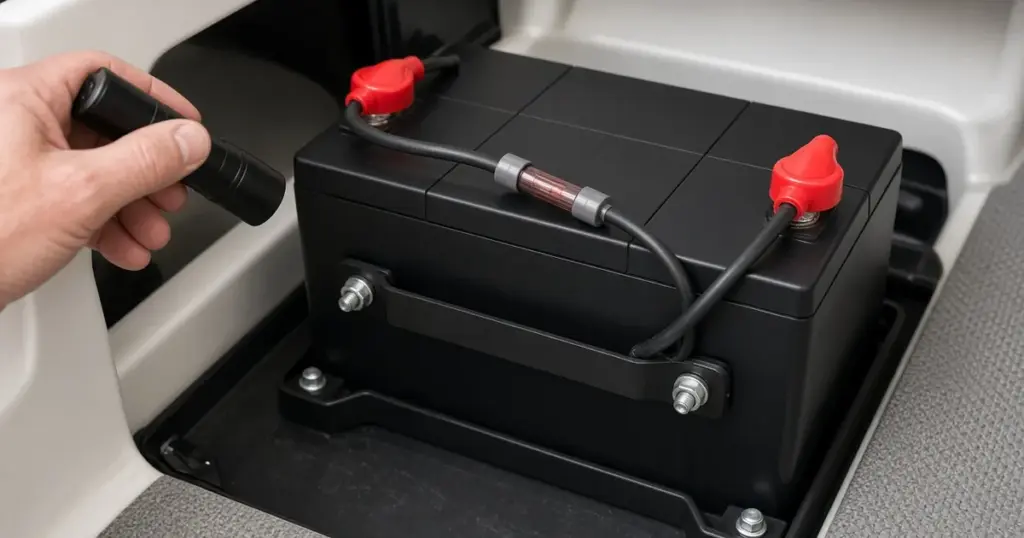
E-10 calls for protecting the ungrounded (usually positive) terminal from accidental contact, such as a dropped tool. Accepted methods include a terminal boot or non-conductive shield, a covered battery box, or a compartment designed only for batteries. Batteries with both side and top terminals need shielding for each.
E-10: location and ventilation
E-10 addresses where batteries can go and how they’re protected from heat, fuel system components and water. It also covers ventilation, because flooded lead-acid batteries release hydrogen while charging. Battery boxes and compartments should allow gases to escape and should contain spilled electrolyte. See battery hydrogen gas and ventilation.
E-11: overcurrent protection
E-11 requires ungrounded conductors to have overcurrent protection, a fuse or circuit breaker, close to the power source. The general rule is within seven inches of where the conductor connects to the battery, measured along the conductor, with exceptions. Cranking motor conductors are exempt, and conductors fully enclosed in a sheath or conduit can have the protection farther away, within limits. This is why terminal-mounted fuses like MRBF fuses are so common.
E-11: battery switches
E-11 includes requirements for battery switches, so batteries can be disconnected. In the edition we reviewed, a battery switch is required in the positive conductor from each battery or bank above a certain cranking rating, with exceptions for dedicated trolling motor batteries that have overcurrent protection and a separate disconnect. Some loads, such as bilge pumps and certain electronics with memory, may be connected on the battery side of the switch with their own protection. Switch ratings must handle the cranking current of the largest engine served. Learn more in marine battery switch basics.
E-11: conductor sizing and voltage drop
E-11 includes tables for sizing wire based on current, length and allowable voltage drop. A common design target is 3% voltage drop for critical circuits, such as navigation lights and electronics, and 10% for less critical loads. Undersized wire causes heat, poor performance and fire risk.
E-13: lithium-ion batteries
As lithium batteries have become common, ABYC developed E-13 for lithium-ion battery installations. Topics include the battery management system’s protective functions, how the system responds to faults, charging source compatibility, overcurrent protection sized for lithium’s high short-circuit current, and installation location. If you’re converting to lithium, it’s worth having a marine electrician familiar with E-13 review your plan.
A-31: chargers and inverters
A-31 covers installing battery chargers and inverters, including overcurrent protection on DC output conductors and labeling. Built-in charger safety features matter here, so use marine-rated chargers. Overcharging is a common cause of battery damage; see overcharging a boat battery.
What this means for a typical owner
You don’t need to own the standards to follow their spirit:
- Secure every battery so it can’t move.
- Cover positive terminals.
- Fuse every positive conductor close to the battery, except the cranking cable.
- Install a battery switch to disconnect banks.
- Size wire for the load and the length.
- Ventilate flooded batteries and keep sparks away.
- Use chargers matched to the battery chemistry.
- Follow the battery maker’s installation instructions.
Older boats
Many older boats were built before current standards. A survey may flag items like missing terminal boots, unfused circuits, loose batteries or undersized wire. These are usually inexpensive to fix and worth doing for safety, insurance and resale.
When to hire a professional
For simple battery replacements, careful owners can follow these principles. For lithium conversions, inverter installations, rewiring or anything involving AC shore power, an ABYC-certified marine electrician is a smart investment.
More reading
Start with the marine battery safety guide. Before disposing of old batteries, read marine battery recycling.
Products that help
- Battle Born marine-rated MRBF terminal fuse
- Battle Born MRBF fuse block
- EPOCH power distribution block
- Dakota Lithium group 24 battery tray
Frequently asked questions
Are ABYC standards required by law?
They’re voluntary industry standards, but builders, surveyors and insurers use them widely. Some Coast Guard rules cover similar requirements.
How far from the battery should a fuse be?
E-11’s general rule is within seven inches along the conductor, with exceptions for cranking cables and enclosed conductors.
How secure does a battery need to be?
E-10 limits movement to one inch under a pulling force of 90 pounds or twice the battery’s weight, whichever is less.
Is there an ABYC standard for lithium batteries?
Yes, E-13 covers lithium-ion batteries.
Do I need terminal boots?
E-10 calls for protecting the ungrounded terminal, with a boot, shield, covered box or dedicated compartment.