


Comparing Marine Batteries by Price per kWh

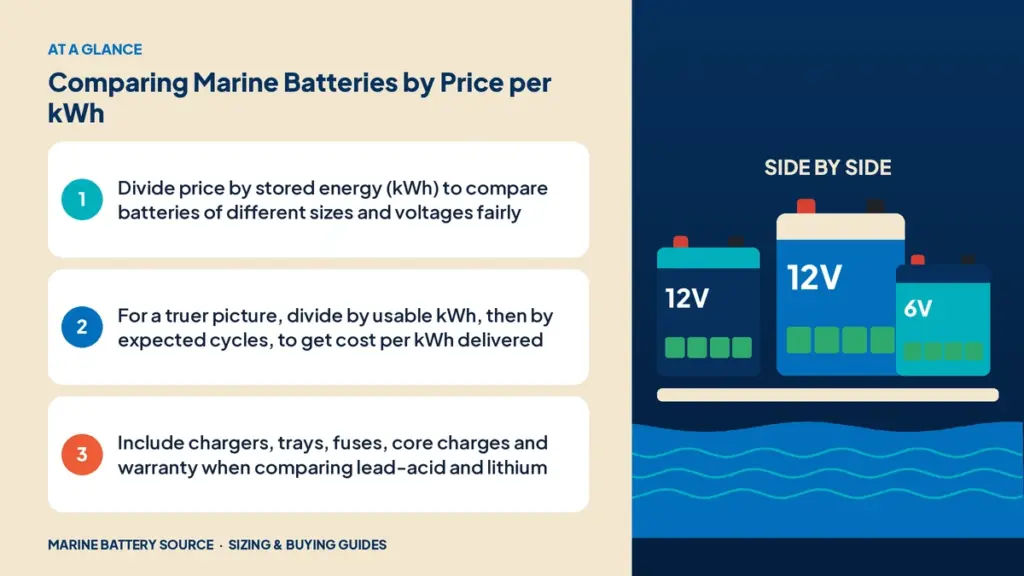
Battery prices can be hard to compare. A 12V 100Ah lithium battery, a 36V 50Ah lithium battery and a pair of 6V golf-cart batteries are all different shapes, voltages and chemistries. Comparing price per kWh, and then per kWh actually delivered over the battery’s life, makes the decision much clearer. This guide shows the method. The example numbers below are illustrative only, not our current prices; check product pages for those.
Step 1: Price per rated kWh
Price per kWh = price ÷ rated kWh
Rated kWh = amp-hours x nominal voltage ÷ 1,000. Use 12.8V for 12V LiFePO4 and 12V for 12V lead-acid. See amp-hours to watt-hours and kWh for the conversion.
Example (illustrative): a 12V 100Ah lithium battery stores 1.28 kWh. If it cost $600, that’s about $469 per rated kWh.
Step 2: Price per usable kWh
Rated energy isn’t what you get. Multiply by usable depth of discharge:
- Lead-acid and AGM: about 50%.
- Lithium: about 80–90% for routine use; some makers list 100%.
Price per usable kWh = price ÷ (rated kWh x usable fraction)
| Battery (illustrative prices) | Rated kWh | Usable fraction | Usable kWh | Price | Price per usable kWh |
|---|---|---|---|---|---|
| Lead-acid group 27, 105Ah | 1.26 | 50% | 0.63 | $200 | ~$317 |
| AGM group 31, 100Ah | 1.20 | 50% | 0.60 | $350 | ~$583 |
| Lithium 12V 100Ah | 1.28 | 90% | 1.15 | $600 | ~$522 |
On a per-usable-kWh basis, the gap between lead-acid and lithium is much smaller than the sticker prices suggest.
Step 3: Price per kWh delivered over life
Batteries wear out. To compare total value, divide by expected cycles:
Cost per kWh delivered = price ÷ (usable kWh x expected cycles)
Cycle life depends on chemistry, depth of discharge, temperature and care. Lithium listings in our store state figures like 3,000–5,000 cycles (Battle Born), 4,000+ cycles (EPOCH Essential) and 5,000 cycles to 80% capacity (Dakota Lithium). Lead-acid deep-cycle batteries typically deliver hundreds of cycles at 50% DoD. Use conservative numbers for your own use. Heat, deep discharges and poor charging all shorten life, so if your batteries live in a hot Florida console, lean toward the low end.
| Battery (illustrative) | Usable kWh | Assumed cycles | Lifetime kWh | Price | Cost per kWh delivered |
|---|---|---|---|---|---|
| Lead-acid group 27 | 0.63 | 400 | 252 | $200 | ~$0.79 |
| Lithium 12V 100Ah | 1.15 | 3,000 | 3,450 | $600 | ~$0.17 |
Even with a conservative cycle count, lithium usually delivers energy at a much lower cost over its life, provided you actually use those cycles.
When the lifetime math doesn’t apply
If you only use your boat a few weekends a year, you may never reach the lithium battery’s cycle life before age, accidents or a boat sale end its service. In that case, the battery’s calendar life and warranty matter more than cycles. Lead-acid can be the better value for:
- Starting batteries, which are only lightly cycled.
- Boats used rarely.
- Owners planning to sell the boat soon.
Include the whole system
Add the costs that come with each choice:
- Charger: lithium needs a LiFePO4 profile; you may need a new charger.
- DC-DC charger: often recommended for charging lithium from an alternator.
- Trays and hold-downs: a new size may need a new tray.
- Fuses: a terminal fuse or fuse block close to the battery.
- Core charge: lead-acid and AGM batteries often carry a core charge, refunded or waived when you return the old battery. When you book our installation, we take your old battery away and waive the $18 core charge.
- Watering supplies and time for flooded batteries.
Compare warranties
A longer warranty lowers your risk. In our store, lithium warranties range from 5 years (Battle Born base models) and 6 years (EPOCH Eco) to 8 years (Lithium Rhino) and 11 years (EPOCH Essential and Dakota Lithium). Interstate lead-acid models list 6 to 36 months of free replacement depending on model, and Interstate lithium lists 36 to 60 months. Read each maker’s terms.
Compare weight, too
Weight isn’t a price, but it has value on a boat: better performance, less fuel, easier handling and safer lifting. Lithium typically weighs half as much as lead-acid for the same rated capacity, and far less per usable kWh.
A quick comparison worksheet
| Battery A | Battery B | |
|---|---|---|
| Price | ||
| Amp-hours x nominal voltage = rated kWh | ||
| Usable fraction | ||
| Usable kWh | ||
| Price per usable kWh | ||
| Expected cycles (conservative) | ||
| Cost per kWh delivered | ||
| Extra system costs | ||
| Warranty | ||
| Weight |
Example decision
A bass angler uses a 36V trolling bank about 60 days a year, cycling it deeply each time. Over 8 years, that’s roughly 480 deep cycles, beyond the typical life of a lead-acid bank but well within a lithium battery’s rating. Lithium’s higher price is likely to pay off. A weekend pontoon owner who uses a start battery and a stereo a few times a month may be better served by AGM.
Don’t forget resale and upgrades
A lithium battery can often move to your next boat, which extends its value. A lead-acid bank is usually replaced with the boat’s next owner. If you plan to keep your batteries through a boat upgrade, factor that in.
More reading
Learn the underlying numbers in depth of discharge and battery C-rate, and see how to read a battery spec sheet. To size the bank you’re pricing, read how many batteries does my boat need. The marine battery buying guide and the lithium buyer’s guide cover the rest, and BCI group sizes covers fit.
Products mentioned
- EPOCH 12V 100Ah Eco
- EPOCH 12V 314Ah Eco
- Trojan 27TMX
- Browse lithium and AGM and lead-acid batteries.
Frequently asked questions
How do I calculate battery price per kWh?
Divide the price by rated kWh: amp-hours times nominal voltage, divided by 1,000.
Is lithium cheaper per kWh than lead-acid?
Per rated kWh, usually not. Per usable kWh delivered over its life, lithium is often much cheaper.
What usable fraction should I use?
About 50% for lead-acid and AGM, and 80–90% for lithium.
Should I include the charger in the cost?
Yes. If you need a new charger or DC-DC charger for lithium, include it.
When is lead-acid the better value?
For starting batteries, boats used rarely, or when you don’t expect to use many cycles.