


Trolling Motor Losing Power? Battery-Side Causes

A trolling motor that starts the morning strong and fades by lunch, or one that suddenly loses thrust in the middle of a drift, costs you fish. The cause might be the battery bank, the wiring, the plug, the breaker or the motor itself. This guide walks through how to tell which, starting with the most common causes.
Two patterns of power loss
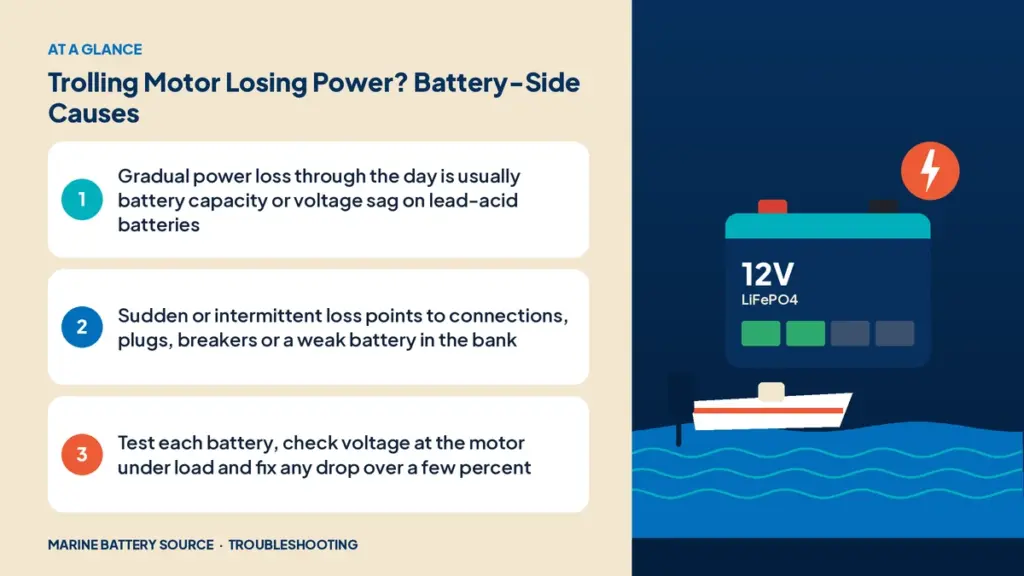
- Gradual fade over the day: usually battery capacity or the normal voltage sag of lead-acid batteries as they discharge. Can also be a battery bank that’s too small for your use.
- Sudden or intermittent loss: usually a connection problem, a tripping breaker, a failing plug, a weak battery in a series bank, or a lithium BMS limiting current.
Cause 1: Not enough battery capacity
If your day uses more amp-hours than the bank can deliver, the motor will fade. Lead-acid batteries lose voltage steadily as they discharge, and most trolling motors slow down as voltage drops. Using more than about half of a lead-acid battery’s rating also shortens its life.
Fix: estimate your daily use and size the bank to match, or move to lithium for more usable capacity. Our trolling motor power system guide covers sizing in detail.
Cause 2: A weak battery in a series bank
In a 24V or 36V bank, one weak battery drags the whole bank down. Under load, the weak battery’s voltage collapses first, and the motor loses power even if the others are fine.
Fix: charge the bank fully, let it rest, then measure each battery individually. Load test each one. If one is much weaker, the bank is unbalanced. Replace the weak battery, ideally the whole bank if the others are old.
Cause 3: Voltage drop in the wiring
Undersized or corroded wiring loses voltage under the high current a trolling motor draws. You’ll see good voltage at the batteries and lower voltage at the motor.
Test: with the motor running on high, measure voltage at the batteries and at the motor’s plug or leads. A difference of more than a few percent of system voltage means too much resistance.
Fix: clean and tighten connections, replace corroded lugs and upgrade undersized cable. See replacing battery cables on a boat.
Cause 4: Plug and receptacle problems
Bow trolling motor plugs live in spray and rain. Corroded or loose pins create heat and resistance, and intermittent contact causes sudden loss of power.
Check: look for green corrosion, burned or melted pins and a loose fit. Feel the plug after running on high; if it’s hot, it’s failing.
Fix: replace the plug and receptacle with marine-rated parts sized for the motor’s current.
Cause 5: Circuit breaker tripping
Trolling motors should be protected by a breaker or fuse near the battery. A breaker that’s too small, or one that’s aging, can trip under heavy load, especially on hot days.
Fix: confirm the breaker matches the motor manufacturer’s recommendation and replace it if it trips below its rating.
Cause 6: Lithium BMS current limits
A lithium battery that’s too small for the motor may hit its BMS current limit when the motor pulls hard, causing a cutback or shutdown. Some batteries also limit output when very cold or hot.
Fix: check the battery’s continuous current rating against the motor’s maximum draw. A larger battery, like the EPOCH 36V 100Ah LiFePO4, gives more current headroom than a small pack.
Cause 7: Charging problems
If the batteries never get fully charged, every day starts short. Check that the charger reaches full charge on every bank and that it’s set to the right profile. If your charger shows faults, see lithium battery won’t charge for lithium-specific issues.
Cause 8: The motor itself
- Weeds or fishing line wrapped around the prop shaft
- A damaged prop
- Worn brushes on older brushed motors
- Water intrusion in the lower unit
- Controller faults
Clear the prop first. It’s the most common motor-side cause.
Step-by-step diagnosis
- Clear the prop and check for line around the shaft.
- Charge fully and check each battery’s resting voltage.
- Run the motor on high and measure voltage at the batteries.
- Measure at the motor with it still running. Compare.
- Feel the plug, breaker and connections for heat after a run.
- Load test each battery if voltage sags at the batteries.
- Check the charger reaches full on every bank.
Lead-acid vs lithium behavior
| Lead-acid | LiFePO4 | |
|---|---|---|
| Voltage through the day | Falls steadily | Stays nearly flat |
| Motor speed | Slows as voltage falls | Stays consistent |
| End of charge | Gradual fade | Sudden stop at BMS cutoff |
| Usable capacity | About half for long life | Most of rating |
With lithium, the motor holds speed until the battery is almost empty, then stops. That feels like sudden loss, but it’s the battery reaching cutoff. A battery monitor helps you see it coming.
Upgrading the bank
Switching from three lead-acid batteries to a single 36V lithium battery removes series connections, saves weight and keeps thrust steady. Options include the EPOCH 36V 50Ah for lighter use. Pair it with a lithium charger like the EPOCH 36V 15A charger. Shop trolling motor batteries.
Related problems
If the motor won’t turn on at all, see trolling motor won’t turn on. If the boat’s start battery is also struggling, see boat won’t start, just clicks. For a general approach, read boat electrical problems troubleshooting and the marine battery troubleshooting guide.
Frequently asked questions
Why does my trolling motor lose power after an hour?
Usually the battery bank is too small for your use, or lead-acid voltage is dropping as it discharges. A weak battery in a series bank can also cause it.
Can bad wiring make my trolling motor weak?
Yes. Undersized or corroded wiring drops voltage under load. Measure voltage at the batteries and at the motor while running.
Why does my trolling motor cut out suddenly?
Common causes are a loose or corroded plug, a tripping breaker, a lithium BMS reaching its limit or cutoff, or a failing battery.
Will lithium fix my trolling motor losing power?
If the cause is lead-acid voltage sag or capacity, lithium usually helps. It won’t fix wiring or plug problems.
How do I check for a weak battery in a 36V bank?
Charge fully, rest, then measure and load test each 12V battery separately.