


Boat Electrical Problems: Troubleshooting from the Battery Out
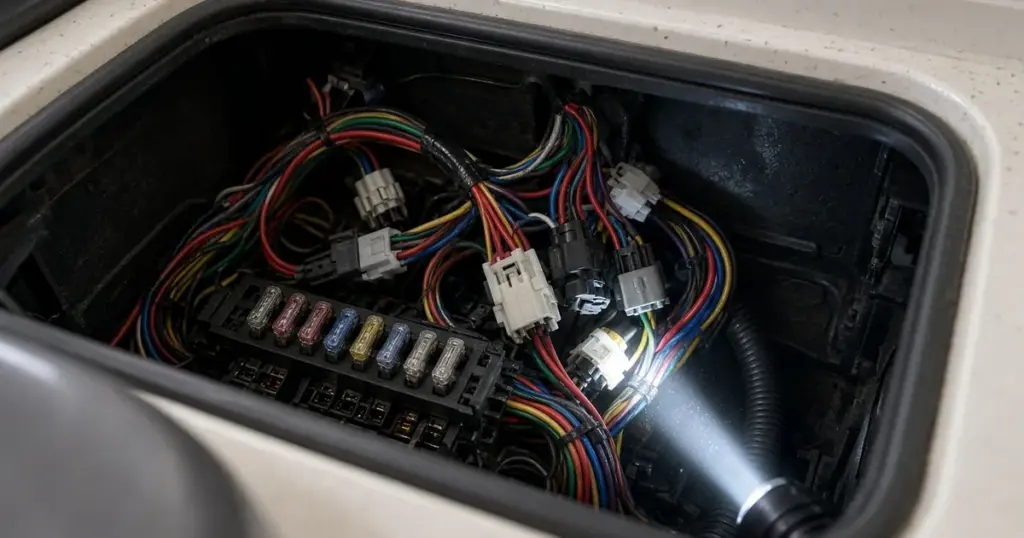
Boat electrical problems range from the mildly annoying, like a fish finder full of noise, to the trip-ending, like an engine that only clicks. The causes are often simpler than they look. Salt, vibration and moisture attack connections far more often than they destroy components. This pillar guide gives you a method for tracking down almost any DC electrical problem on a boat, and links to detailed guides for the most common ones.
A method that works
- Define the problem precisely. What doesn’t work, when, and under what conditions?
- Check the battery first. Is it charged and healthy?
- Check power at the load. Is voltage reaching the device?
- Check under load. Does voltage hold when current flows?
- Work backward from the load to the battery, connection by connection.
- Fix the cause, not just the symptom.
Tools: a multimeter, a test light, basic hand tools and a wiring diagram if you have one.
Start with the battery
Many electrical problems are really battery problems. Charge the battery and test it. If it’s weak, nothing downstream will work right. The marine battery troubleshooting guide covers how to diagnose the battery itself.
The four parts of every circuit
- Source: the battery or bank.
- Protection: fuses and breakers.
- Conductors and connections: cables, terminals, busbars, switches, plugs.
- Load: the device.
A fault in any part causes problems. Check each in turn.
The voltage-drop test
This is the most important test in boat electrical work. With the load running:
- Measure from the battery positive to the load’s positive terminal.
- Measure from the load’s negative terminal to the battery negative.
- Each reading is the voltage lost in that side of the circuit. Small is good; large means resistance.
Move the probe along the circuit until the drop appears. That’s your bad connection. Voltage drop under load covers this in depth.
Common problems and where to start
Engine clicks but won’t crank
Usually a weak battery, a bad connection on the starter circuit or a failing solenoid. See boat won’t start, just clicks.
Trolling motor won’t turn on
Check the circuit breaker, the plug and receptacle, the battery voltage and the motor’s own controls. See trolling motor won’t turn on.
Trolling motor loses power during the day
Often battery capacity, a weak battery in a series bank, or voltage drop in the wiring. See trolling motor losing power.
Batteries in a bank don’t match
One battery in a bank reads differently, gets hotter or fails early. See unbalanced battery bank.
Charger shows a fault
Read the fault light, check AC power, fuses and battery connections. See battery charger fault lights.
Lithium battery won’t charge
Often a BMS cutoff, a temperature limit or a charger that can’t detect the battery. See lithium battery won’t charge.
Fish finder interference
Noise on the display when the trolling motor runs usually comes from shared power, shared grounds or cable routing. See fish finder interference from the trolling motor.
Corroded or damaged cables
Green crust, stiff cables or heat at connections means it’s time for new cables. See replacing battery cables on a boat.
Dim lights and slow pumps
Low battery, voltage drop or corroded grounds. Start with the voltage-drop test.
Electronics reset when the engine starts
The cranking dip pulls voltage below what the electronics tolerate. Separate start and house batteries, or check the start battery and cables.
Blown fuses
A fuse that keeps blowing means too much current: a short, a failing motor or pump, or a fuse that’s too small for the load. Don’t upsize the fuse beyond what the wire is rated for.
Grounds and negative connections
Bad grounds cause strange problems: gauges that read wrong, electronics that misbehave, noise and dim lights. Check the main negative cable, the engine ground, the negative busbar and every ground connection on the affected circuit. Clean, tighten and protect.
Switches and relays
Battery switches can corrode internally. Check for voltage drop across the switch under load. Automatic charging relays and solenoids can fail open or closed.
Moisture and corrosion
Salt and moisture are the root cause of many boat electrical problems. Look in the bilge, behind the helm and at bow plugs. Use tinned wire, sealed connectors and terminal protection. Clean connections as part of regular maintenance.
Wire size
Undersized wire causes voltage drop and heat. If a circuit has high voltage drop with clean connections, the wire may be too small for the current and length. Use wire sized for the round-trip length and current, to a 3% drop target for critical loads.
Fuse placement
Every positive wire should be protected by a fuse or breaker close to the power source, sized to protect the wire. A Battle Born MRBF fuse block protects multiple circuits right at the battery.
Distribution
Fewer, better connections are best. A busbar or distribution block, like the EPOCH heavy-duty power distribution block, replaces stacked lugs on battery posts and makes troubleshooting easier.
When the battery is the real problem
If testing shows the battery is the weak link, replace it with one matched to the job: a cranking battery for starting, a deep-cycle or lithium battery for trolling and house loads. Options include the Interstate 27M-XHD for starting and the EPOCH 36V 50Ah for trolling motors.
Troubleshooting log
Keep notes: symptom, readings, fix. Over time, you’ll see patterns that make future problems faster to solve.
When to call a professional
- AC shore power problems
- Burned wiring or repeated fuse failures you can’t trace
- Engine charging system faults beyond basic checks
- Lightning damage
Find fuses, blocks and trays in our marine battery accessories.
Frequently asked questions
What causes most boat electrical problems?
Corroded or loose connections and weak batteries cause the majority. Salt, moisture and vibration are the root causes.
How do I find a bad connection on my boat?
Do a voltage-drop test with the load running, moving the probe along the circuit until you find where voltage is lost.
Why do my boat electronics reset when I start the engine?
The cranking dip pulls voltage too low. Separate start and house batteries, or check the start battery and cables.
Why does my boat keep blowing the same fuse?
A short, an overloaded or failing device, or a fuse that’s too small. Don’t upsize beyond the wire’s rating.
Should I use tinned wire on my boat?
Yes. Tinned copper resists corrosion far better than bare copper in a marine environment.