


Keeping Battery Compartments Dry and Ventilated
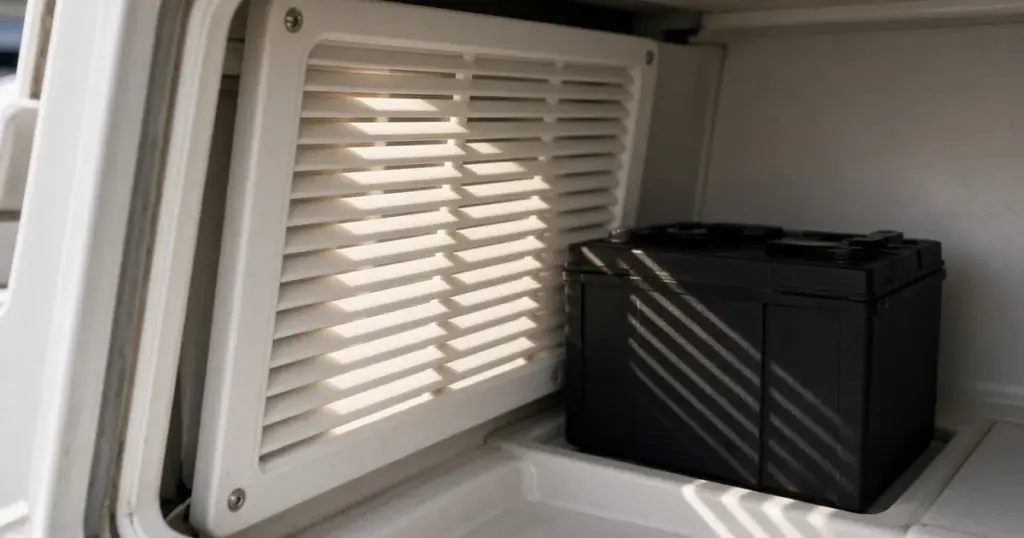
Battery compartments are often an afterthought on boats: a locker under the console, a box in the stern, a space beside the engine. But how that space is ventilated affects safety, corrosion and battery life. Flooded batteries release hydrogen, all batteries produce heat when charging or under heavy load, and humid, salty air speeds corrosion. This guide covers battery compartment ventilation on boats.
Why ventilation matters
Hydrogen gas
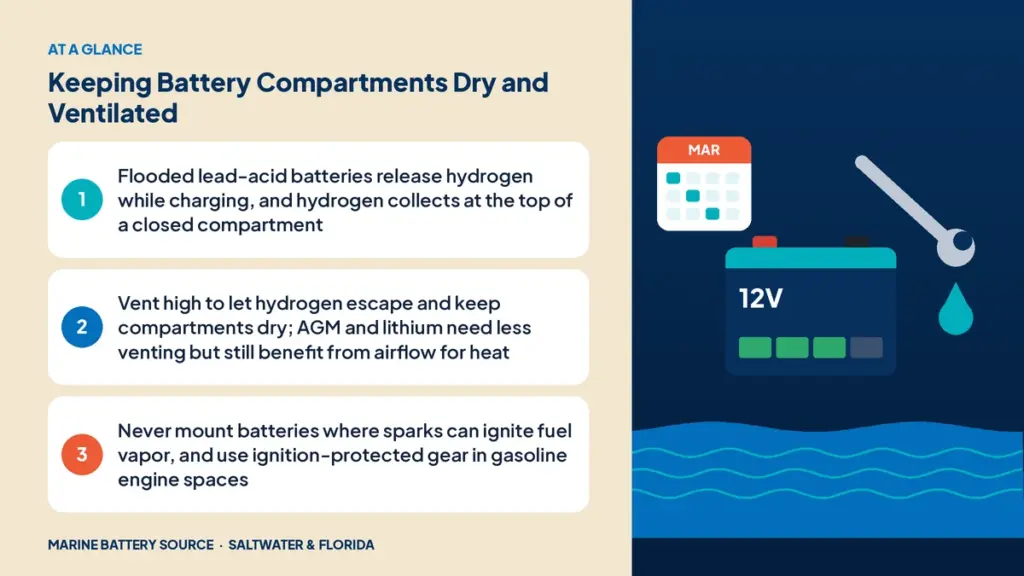
Flooded lead-acid batteries release hydrogen and oxygen during charging, especially near the end of the charge and during equalization. Hydrogen is lighter than air and highly flammable. In a closed compartment, it can build up near the top and be ignited by a spark from a switch, relay or loose connection.
Heat
Batteries warm up during charging and heavy discharge. In hot climates or compartments near engines, heat shortens battery life significantly. Every 15°F above about 77°F can roughly halve a lead-acid battery’s life.
Moisture and corrosion
Damp, salty air in a closed compartment speeds corrosion on terminals, cables and switches. Ventilation helps dry the space.
Which batteries need ventilation
- Flooded lead-acid: yes, definitely. They vent hydrogen during normal charging.
- AGM and gel: sealed and recombine most gas internally, but can vent if overcharged or faulty. Some ventilation is still recommended.
- Lithium (LiFePO4): don’t vent gas in normal use. Ventilation is mainly for heat management.
Ventilation guidelines
- Vent high: hydrogen rises, so put an outlet at or near the top of the compartment.
- Supply low: a lower inlet lets fresh air enter and push gases out.
- Keep vents clear of gear, cushions and debris.
- Protect vents from spray with louvers or cowls so water doesn’t enter.
- Don’t vent into enclosed living spaces.
ABYC guidance calls for battery compartments to be ventilated to prevent hydrogen accumulation, and for batteries not to be installed directly above or below fuel system components where practical.
Gasoline engine spaces
Gasoline vapors are heavier than air and collect low in the bilge. Batteries and electrical equipment in gasoline engine compartments must not create sparks that could ignite vapors:
- Use ignition-protected switches, relays, chargers and fuses
- Run the bilge blower before starting the engine
- Keep batteries in boxes or with terminal covers
- Don’t install non-ignition-protected equipment in these spaces
Battery boxes
Vented battery boxes are common on small boats. They contain spills and protect terminals while allowing gas to escape through vents in the lid. Make sure the box vent isn’t blocked and the box is secured. See our saltwater corrosion guide for how boxes help in salty environments.
Heat management
- Keep batteries away from engines and exhausts
- Shade compartments from direct sun where possible
- Add ventilation to consoles and lockers that bake in the sun
- Consider lithium, which tolerates heat better than lead-acid
See Florida heat and marine battery life.
Moisture management
- Keep compartments drained and dry
- Don’t let washdown water pool around batteries; see boat washdown battery safety
- Inspect for leaks from hatches and deck fittings
- Clean salt residue regularly
Wiring in battery compartments
Sparks are the ignition source for hydrogen. Reduce the risk:
- Keep connections tight to avoid arcing
- Fit terminal covers
- Use sealed, marine-grade switches and relays
- Don’t connect or disconnect chargers at the battery while charging
- Inspect wiring regularly; see boat wiring corrosion inspection
Charging safety
Most hydrogen is released near the end of charging and during equalization. Make sure compartments are ventilated before and during charging, especially in enclosed spaces. Smart chargers that properly control absorption and float voltage reduce gassing. Overcharging increases it.
Console and seat-base compartments
Many center consoles, bay boats and pontoons put batteries inside the console or under a seat. These spaces often have small openings and get hot in the sun. Check that the console has some airflow path, keep the access door seal in good condition so spray stays out, and avoid stuffing the space with gear that blocks vents. If you smell a sharp odor or see heavy corrosion after charging, increase ventilation or switch to sealed batteries.
Signs of poor ventilation
- Rotten egg smell (hydrogen sulfide from overcharged flooded batteries)
- Heavy corrosion on terminals and nearby metal
- Batteries consistently hot
- Condensation in the compartment
Lithium and ventilation
Lithium batteries don’t vent hydrogen in normal operation, which makes them easier to install in tight or enclosed spaces. They still need airflow to manage heat during heavy charging or discharge. Batteries like the EPOCH 12V 105Ah LiFePO4 are sealed and suitable for most marine compartments. Browse our lithium marine batteries.
Corrosion and stray current
Poorly ventilated, damp compartments contribute to corroded wiring, which can lead to stray current. See stray current and galvanic corrosion. Protect terminals with dielectric grease or terminal spray; see dielectric grease on battery terminals.
Adding ventilation to an existing compartment
If your battery compartment has no vents:
- Identify a high point for an outlet and a low point for an inlet.
- Choose marine vents with louvers or covers to keep spray out.
- Cut openings carefully, avoiding wiring and structure.
- Seal the cut edges of cored decks or bulkheads with epoxy.
- Install vents with marine sealant.
- In enclosed spaces, consider a small ignition-protected fan.
AGM and gel in enclosed spaces
AGM and gel batteries are often chosen for enclosed spaces because they don’t vent under normal conditions. However, if a charger fails and overcharges them, they can vent through pressure-relief valves. A smart charger with temperature compensation reduces the risk. Still provide some ventilation, and never seal an AGM in an airtight box. AGM options like the Interstate 31M AGM are popular where flooded batteries would need more venting.
For routine care, see our marine battery maintenance guide.
Frequently asked questions
Do boat battery compartments need ventilation?
Yes, especially for flooded lead-acid batteries, which release hydrogen while charging. All batteries benefit from airflow to manage heat and moisture.
Do AGM batteries need ventilation?
They vent much less than flooded batteries, but some ventilation is still recommended in case of overcharging or failure.
Do lithium batteries need ventilation?
They don’t vent gas in normal use, but airflow helps manage heat.
Where should battery vents be located?
An outlet high in the compartment for hydrogen to escape, and an inlet low for fresh air.
Can I put a battery in the engine compartment?
Yes, if it’s properly secured and protected, and all electrical equipment in gasoline engine spaces is ignition-protected.