


Stray Current and Galvanic Corrosion on Boats
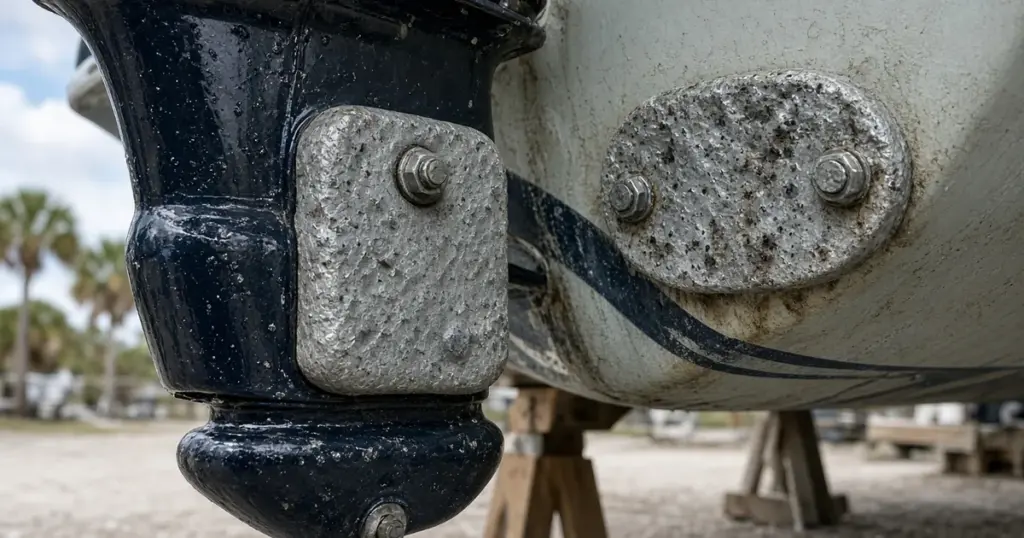
Corrosion below the waterline can destroy a lower unit, prop or through-hull fitting in a single season. Two different processes cause most of it: galvanic corrosion and stray current corrosion. They look similar but have different causes and fixes. Understanding them helps you protect expensive underwater metal and spot wiring problems before they cause damage. This guide explains stray current and galvanic corrosion on boats.
Galvanic corrosion
How it works
When two different metals are electrically connected and immersed in an electrolyte like seawater, they form a battery. The less noble metal (the anode) corrodes, while the more noble metal (the cathode) is protected. For example, an aluminum outboard lower unit connected to a stainless prop shaft will corrode faster than either would alone.
The galvanic series
Metals rank from most noble to least noble in seawater. A simplified order:
- Graphite, titanium, stainless steel (passive)
- Bronze, copper
- Lead, tin
- Steel, cast iron
- Aluminum
- Zinc
- Magnesium
The farther apart two metals are, the faster the less noble one corrodes.
Sacrificial anodes
Zinc, aluminum or magnesium anodes (“zincs”) are deliberately less noble than the boat’s other underwater metals. They corrode first, protecting the rest. Use the right anode material for your water:
- Zinc: saltwater
- Aluminum: salt and brackish water
- Magnesium: freshwater
Stray current corrosion
How it works
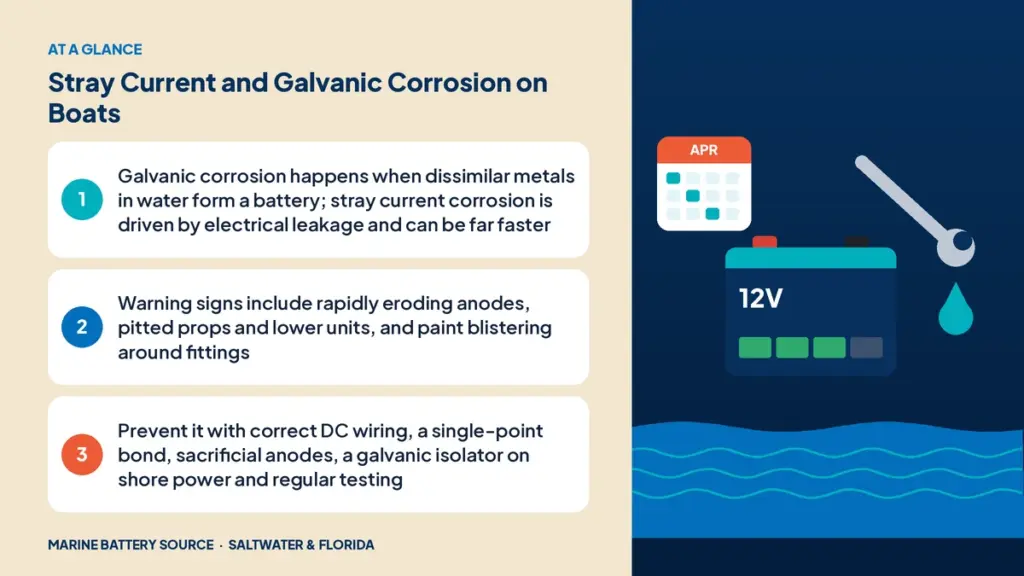
Stray current corrosion happens when DC current leaks from the boat’s electrical system into the water through underwater metal. Wherever current leaves metal and enters the water, that metal corrodes rapidly. Unlike galvanic corrosion, stray current corrosion is driven by an external power source, the battery, so it can be dozens of times faster.
Common causes
- Chafed or damaged wiring touching metal in the bilge
- Wet connections in the bilge, such as a bilge pump splice sitting in water
- Incorrect grounding, like a DC load grounded to a through-hull or engine block instead of the negative bus
- Faulty accessories leaking current
- A neighboring boat or dock with faulty wiring (AC or DC), which can also affect your boat through shore power
Warning signs
- Anodes wearing out unusually fast, in weeks instead of months
- Anodes not wearing at all (they may not be connected)
- Pitted or eroded props, shafts and lower units
- White powder or bubbling paint around underwater fittings on aluminum
- Through-hulls turning pink or crumbling (dezincification of brass and bronze)
- Corrosion that appears suddenly after electrical work
Testing
Reference electrode test
A silver/silver chloride reference electrode and a multimeter measure the voltage of the boat’s underwater metals relative to the water. Readings outside the expected range indicate under-protection, over-protection or stray current. Marine electricians and corrosion specialists do this routinely.
Stray current test
- Disconnect shore power.
- With everything off, measure current between the battery negative post and the disconnected negative cable. Any current you can’t account for is either a parasitic load or a leak worth tracing.
- Turn circuits on one at a time and watch the reference electrode reading; a jump points to the faulty circuit.
Prevention
Correct DC wiring
- Every DC load returns to the negative bus through its own wire. See boat wiring corrosion inspection.
- No current-carrying connection to through-hulls, the hull or the engine block except the main engine negative.
- Keep splices and connections above the bilge water line.
- Use tinned copper wire and sealed connections.
Bonding
A bonding system connects underwater metals to each other and to the DC negative at a single point. This keeps them at the same potential and lets the anodes protect them. Bonding wires should carry no load current.
Anodes
- Inspect them regularly.
- Replace when about half consumed.
- Make sure they have a clean, tight connection to the metal they protect.
- Use the right material for your water.
Shore power
- Install a galvanic isolator or isolation transformer to block small DC currents from traveling through the shore power ground wire.
- Inspect shore cords and plugs regularly.
Dock awareness
If corrosion starts after you move to a new slip, the problem could be a neighboring boat or the dock’s wiring. Test with your shore power disconnected.
Battery and wiring connections
Battery-related causes of stray current include frayed cables in the bilge, a corroded negative cable leaking current, or an accessory wired directly to a through-hull. Clean, protected battery connections help. See dielectric grease on battery terminals and corrosion-resistant battery hardware.
Ventilation and moisture
Wet battery compartments and bilges encourage corrosion of wiring and connections, which can lead to current leaks. See battery compartment ventilation.
Hot climates
Warm water speeds up all corrosion. Boats kept in warm saltwater need more frequent anode checks and inspections. See Florida heat and marine battery life.
When to call a professional
If anodes disappear in weeks, props pit quickly or corrosion appears after electrical work, have a marine electrician perform a corrosion survey. Stray current problems can cause thousands of dollars of damage in a short time.
A simple seasonal routine
- Monthly: look at anodes during haul-outs or with a dive inspection for boats in the water.
- Each season: inspect bilge wiring and connections for corrosion and chafe.
- Annually: check the bonding system, galvanic isolator and shore cord.
- After any electrical work: check anode wear at the next haul-out and look for changes.
Lithium batteries and corrosion
Battery chemistry doesn’t change how stray current corrosion works. A lithium battery like the EPOCH 12V 105Ah LiFePO4 can drive a leak just as a lead-acid battery can. What lithium does change is fault current: a short to a wet fitting can draw more current, so proper fusing matters. A terminal fuse like the marine-rated 300A battery fuse protects the main cable. Find fuses and distribution hardware in our marine battery accessories.
For broader saltwater protection, see saltwater corrosion prevention for marine batteries.
Frequently asked questions
What’s the difference between galvanic and stray current corrosion?
Galvanic corrosion comes from dissimilar metals in water forming a natural battery. Stray current corrosion is driven by electrical leakage from the boat’s or dock’s wiring and is usually much faster.
How do I know if my boat has stray current?
Anodes wearing unusually fast, sudden pitting of props and lower units, or corrosion after electrical work are common signs. A reference electrode test confirms it.
Do zincs stop stray current corrosion?
They help against galvanic corrosion but can be overwhelmed by stray current. Fixing the wiring fault is the real solution.
What anode should I use in freshwater?
Magnesium is typically recommended for freshwater. Aluminum works in salt and brackish water, and zinc in saltwater.
Can shore power cause corrosion?
Yes. Small DC currents can travel through the shore power ground. A galvanic isolator or isolation transformer helps prevent this.