


How to Water Flooded Deep-Cycle Batteries
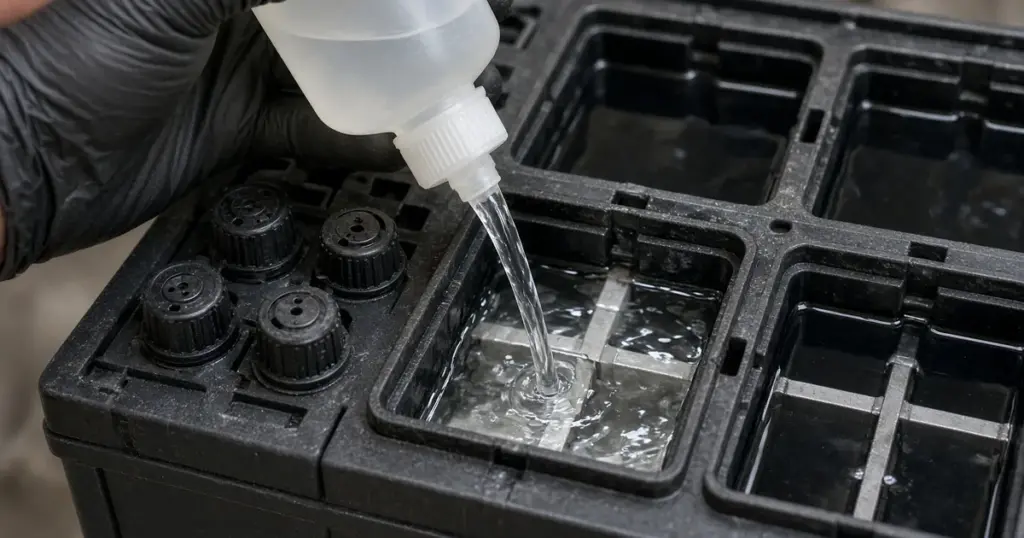
Flooded lead-acid batteries lose water every time they charge. The charging process splits some water into hydrogen and oxygen gas, which vents out through the caps. If the electrolyte level drops below the top of the plates, the exposed plate material dries out, sulfates and is permanently damaged. Keeping flooded batteries properly watered is simple, cheap and one of the best ways to extend their life. This guide explains how to add water to flooded marine batteries.
Which batteries need water
Only flooded (wet cell) lead-acid batteries with removable vent caps need water. You’ll recognize them by the caps on top, usually one per cell (six caps on a 12V battery). AGM and gel batteries are sealed and should never be opened. Lithium batteries need no water at all.
Many deep cycle marine batteries are flooded, including popular models like the Interstate SRM-27 and Interstate SRM-31. Check your battery’s label to confirm its type.
How often to check
- Monthly during the boating season
- Every two weeks in hot weather or heavy use (daily charging)
- Before and after storage
- After equalizing, which uses more water
Batteries charged frequently, such as trolling batteries charged every night, lose water faster.
Safety
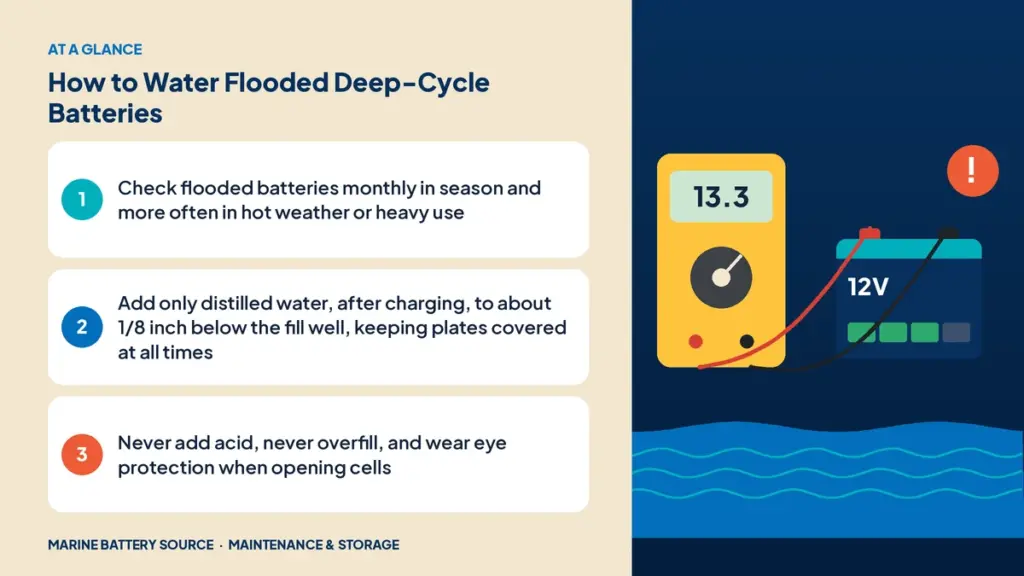
- Wear safety glasses and gloves. Electrolyte is sulfuric acid.
- Remove jewelry.
- Ventilate the area. Hydrogen gas can collect around the battery.
- No sparks or flames.
- Have water and baking soda nearby to neutralize spills.
What you need
- Distilled water (never tap water, which contains minerals that damage the battery)
- A battery filler bottle or funnel
- A flashlight
- Rags
When to add water
Add water after charging, not before. Electrolyte expands during charging. If you fill before charging, the electrolyte can overflow, spilling acid and lowering its strength.
The exception: if the plates are exposed before charging, add just enough water to cover the plates, then charge, then top up to the correct level.
How much water to add
Look inside each cell with a flashlight. Most batteries have a fill well (a plastic ring or split ring below the cap opening). Fill to:
- About 1/8 inch below the bottom of the fill well, or
- About 1/4 to 1/2 inch above the top of the plates if there’s no fill well indicator.
Never fill to the top of the cap opening.
Step-by-step watering
- Fully charge the battery.
- Let it rest for an hour or so.
- Remove the vent caps. Place them on a clean rag.
- Inspect each cell with a flashlight.
- Add distilled water slowly to each cell that needs it, to the correct level.
- Replace the caps securely.
- Wipe up any spills on the battery top with a rag dampened in baking soda solution, then rinse and dry.
Watering systems
Single-point watering systems connect all cells with tubing and fill them from one point, often with automatic shutoff valves. They’re popular for house banks and golf cart batteries and make watering faster and cleaner, especially in tight compartments.
Handling a spill
If electrolyte spills on the battery, deck or your skin, act quickly. Rinse skin with plenty of clean water. Sprinkle baking soda on spills on the boat until the fizzing stops, then rinse and dry the area. Check nearby metal fittings and wiring for damage later, since acid residue keeps corroding if it isn’t fully neutralized.
Common mistakes
- Using tap water. Minerals contaminate the electrolyte and shorten battery life.
- Overfilling, which causes overflow and corrosion during charging.
- Filling before charging.
- Adding acid. Only water is lost during charging; adding acid unbalances the electrolyte. Only add acid if electrolyte was spilled, and then only under professional guidance.
- Letting plates become exposed.
- Forgetting to check after equalizing. See equalizing flooded batteries.
What high water use means
If a battery uses much more water than usual, it may be overcharging. Check:
- Charger voltage and profile
- Alternator regulator output
- Battery temperature (heat increases water loss)
Consistently high water use can also signal a failing battery. Use a hydrometer to check each cell; see the troubleshooting guide.
Cleaning while you water
Watering is a good time to clean terminals and the battery top. See how to clean boat battery terminals.
Watering before storage
Before winter storage, charge fully, top up water, and use a maintainer. See winter storage for marine batteries.
Should you switch to sealed batteries?
If watering is a hassle, or batteries are hard to reach, AGM or lithium batteries eliminate it. Compare the trade-offs in AGM vs flooded battery maintenance and lithium battery maintenance. Browse our lithium marine batteries.
For the full routine, see our marine battery maintenance guide.
Watering hard-to-reach batteries
Batteries tucked under consoles or deep in compartments are easy to neglect. A few tips:
- Use a filler bottle with a long, flexible spout and an automatic shutoff.
- Use a small mirror and a headlamp to see the fill level.
- Consider a single-point watering system that lets you fill from an accessible spot.
- Slide the battery out on its tray if possible.
If a battery is so hard to reach that you rarely check it, that’s a strong argument for a sealed AGM or lithium replacement.
How water loss relates to charging
Water loss happens mainly during the final stages of charging, when the battery is nearly full and the charger is pushing absorption or equalization voltage. A properly set smart charger minimizes gassing by dropping to a lower float voltage once the battery is full. An old or manual charger that holds a high voltage for too long will boil off water quickly. Hot weather adds to the problem, since warm batteries gas more at the same voltage. Chargers with temperature compensation adjust their voltage to reduce this; see our marine battery chargers.
Frequently asked questions
What kind of water do I put in a marine battery?
Distilled water only. Tap water contains minerals that damage the battery.
Should I add water before or after charging?
After charging, unless the plates are exposed. Then add just enough to cover them, charge, and top up.
How full should a battery cell be?
About 1/8 inch below the bottom of the fill well, or about 1/4 to 1/2 inch above the plates.
How often should I check battery water?
Monthly in season, and every two weeks in hot weather or heavy use.
Do AGM batteries need water?
No. AGM batteries are sealed and should never be opened.