


Installing Battery Trays and Hold-Downs
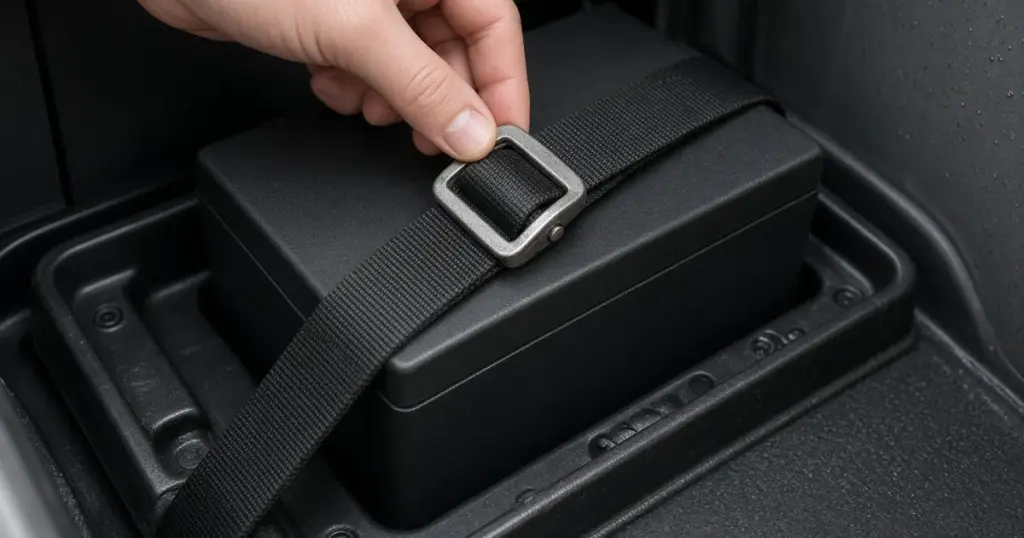
A boat battery that breaks loose is more than an inconvenience. Fifty or sixty pounds of battery sliding around a compartment can crack its case, short its terminals against metal, rip cables loose and spill acid. On a fast boat in a chop, it can happen in seconds. A proper hold-down is required by industry standards and is one of the simplest safety steps in any battery install. This guide covers marine battery hold-downs: what’s required, which type to use and how to install it.
What the standard says
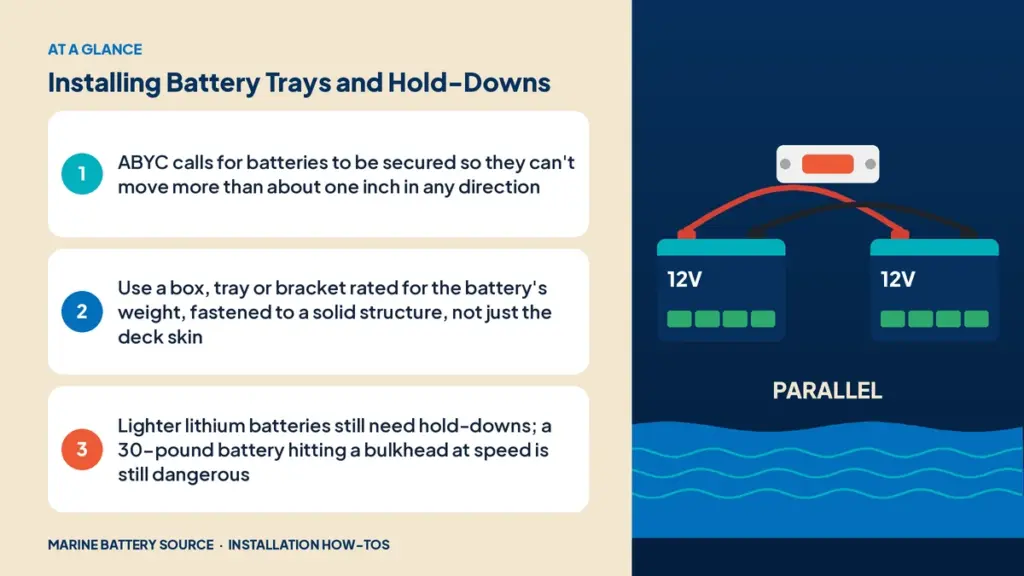
ABYC guidance calls for batteries to be secured so they don’t move more than about one inch in any direction when a pulling force is applied, roughly twice the battery’s weight. The mounting should also keep the battery from tipping and protect the terminals from contact with metal parts. Most surveyors and insurers expect this.
Why hold-downs matter
- Prevents shorts from terminals touching metal fittings or fuel tanks.
- Protects cables from being pulled loose or chafed.
- Prevents case damage from impacts.
- Avoids spills of electrolyte from flooded batteries.
- Protects the boat’s balance by keeping heavy weight in place.
Types of hold-downs
Battery boxes
Plastic boxes with a lid and a strap that passes under or through the base. Common on small boats and for trolling batteries. The box protects terminals and contains spills. Make sure the strap is fastened to the hull, not just around the box.
Trays with straps
An open tray screwed or bolted to the deck, with a strap or bar over the top of the battery. Good airflow and easy access. Many lithium batteries come with or offer matching trays, like the EPOCH tray for 12V 300Ah batteries and the EPOCH group 31 tray.
Bolt-down brackets
Metal or composite brackets that clamp the battery base or top to the structure. Used for heavy batteries and house banks, such as the EPOCH 8D mounting bracket.
Through-bolt mounts
Some lithium batteries have mounting points built into the case, allowing them to be bolted directly to a mounting plate.
Choosing the right hold-down
- Match the hold-down to the battery’s size and weight.
- Consider access for checking terminals and electrolyte.
- Make sure the strap or bracket doesn’t press on the terminals.
- Use corrosion-resistant hardware: stainless steel or marine-grade plastic.
Installation steps
- Choose the location. Low, near the centerline, ventilated and accessible.
- Check the mounting surface. Fasten to stringers, bulkheads or a backing plate, not thin deck skin. If needed, add a marine plywood or composite mounting board bonded to the structure.
- Position the tray or box and mark the holes.
- Drill and seal. Use marine sealant in every hole to keep water out of the core.
- Fasten with stainless screws or through-bolts.
- Set the battery in the tray or box.
- Install the strap or bracket and tighten it so the battery can’t move.
- Test. Push the battery firmly in every direction. It shouldn’t move more than about an inch.
Hold-downs for lithium batteries
Lithium batteries weigh much less than lead-acid, but they still need to be secured. A 30-pound battery slamming into a bulkhead at 40 mph can still crack the case or damage terminals. Lithium batteries often have different dimensions from the lead-acid batteries they replace, so the old tray may not fit. Use a tray designed for the new battery or add spacers so it’s snug.
For lithium trolling installs, see how to install a lithium trolling motor battery.
Hold-downs for trolling banks
Trolling banks of two or three batteries need each battery secured. Many bass boats have molded trays with straps. If you’re replacing three lead-acid batteries with a single 36V lithium, fill the empty space or add a tray so the new battery can’t shift. Trays like the Dakota Lithium marine battery tray are designed for this.
Terminal protection
The hold-down should also keep terminals protected:
- Fit terminal covers on the positive.
- Make sure no metal strap or fitting can contact the terminals.
- Route cables so they aren’t pinched by the strap.
Building a mounting platform
Sometimes there’s no good surface for a tray, especially when relocating a battery or adding a second one. A simple platform solves the problem:
- Cut a base from marine plywood or a composite board, sized for the tray plus a margin.
- Seal all edges and faces of plywood with epoxy so it won’t rot.
- Bond or bolt the platform to stringers or bulkheads, not to the hull skin alone.
- Mount the tray to the platform with stainless through-bolts and backing washers.
- Check that the finished platform keeps the battery above any bilge water.
A good platform spreads the load and gives your fasteners solid material to bite into. It also makes future battery changes easier, because you’re bolting into the platform instead of drilling new holes in the boat.
Hardware choices
Use 316 stainless screws and bolts where possible, with nylon lock nuts on through-bolts so vibration can’t loosen them. Avoid plain steel, which rusts quickly in a battery compartment. Nylon or polypropylene straps resist acid; avoid straps with steel buckles that can touch terminals.
Inspecting hold-downs
Check hold-downs:
- At the start of each season
- After rough trips or trailering on bad roads
- Whenever you check the battery
Look for loose screws, cracked trays, stretched straps and corrosion on metal parts.
Common mistakes
- Strap around the box only, not fastened to the hull.
- Screws into thin deck skin that pull out under load.
- Undersized tray for a larger replacement battery.
- Bungee cords instead of proper straps.
- No hold-down on lithium because it’s lighter.
Related installs
When installing a DC-DC charger or onboard charger, secure those too. See how to install a DC-DC charger and how to install an onboard battery charger.
When to call a pro
If mounting requires cutting into structure, adding a new platform or relocating heavy batteries, consider professional help. See DIY vs professional installation.
For the complete installation process, see how to install a marine battery, how to remove a boat battery and the marine battery wiring guide.
Frequently asked questions
How tight should a battery hold-down be?
Tight enough that the battery can’t move more than about one inch in any direction when you push on it.
Do lithium batteries need a hold-down?
Yes. They’re lighter but can still cause damage or shorts if they move.
Can I use a bungee cord to secure a boat battery?
No. Use a proper strap or bracket fastened to the boat’s structure.
Where should a boat battery be mounted?
Low, near the centerline, in a ventilated and dry compartment, with easy access for inspection.
Can I mount a battery on its side?
Flooded batteries must stay upright. Many AGM and lithium batteries can be mounted in other orientations; check the manufacturer’s instructions.