


Jon Boat Battery Setup: Simple, Light and Reliable

A jon boat is the definition of simple boating: a flat-bottom aluminum hull, a small outboard or trolling motor, and maybe a fish finder. The battery setup should be just as simple, light and reliable. This guide covers jon boat battery setups, from a single trolling battery to a two-battery layout with an electric-start outboard.
Common jon boat configurations
Trolling motor only
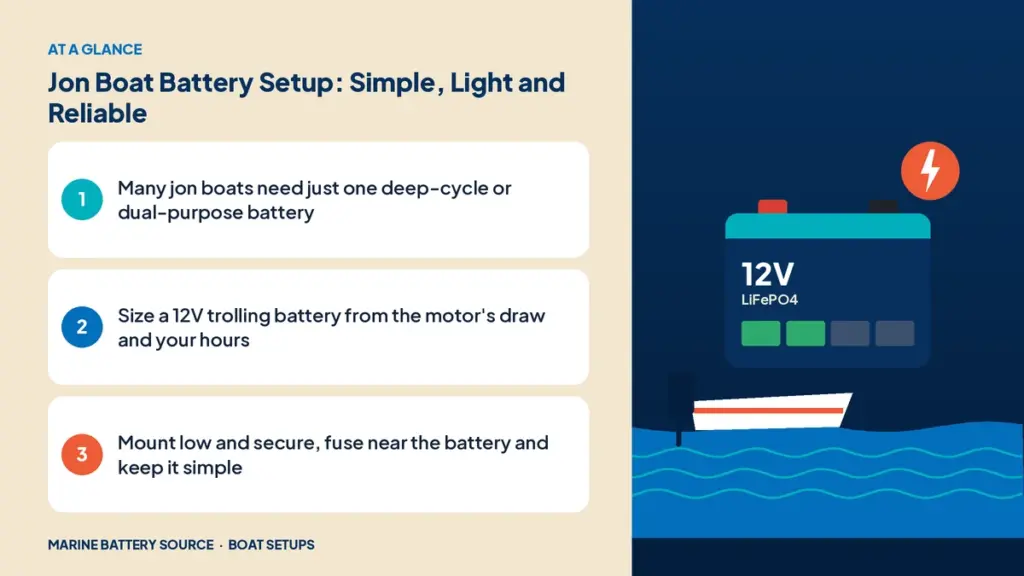
Many small jon boats run only a 12V transom-mount trolling motor. One deep-cycle battery powers it. This is the simplest setup there is.
Small outboard with pull start plus trolling motor
The outboard needs no battery to start. The trolling motor battery may also run a fish finder and lights.
Electric-start outboard plus trolling motor
Now you need starting power. Options:
- One dual-purpose battery for everything, if loads are light.
- Two batteries: a starting or dual-purpose battery for the outboard, and a deep-cycle battery for the trolling motor.
Sizing a 12V trolling battery
Estimate the motor’s average draw and your hours of use, then size for chemistry:
- Lithium: usable Ah needed ÷ 0.8.
- Lead-acid: usable Ah needed ÷ 0.5.
Example: a motor averaging 12A for 5 hours needs about 60Ah usable. That’s about 75Ah lithium or about 120Ah lead-acid. A 100Ah lithium battery covers it with margin. For more detail, see the kayak guide for very small setups or our pillar on choosing a trolling motor battery.
Lithium vs lead-acid on a jon boat
Jon boats are light, and battery weight affects how the boat sits, especially at the stern. Lithium’s weight savings matter:
- EPOCH 12V 100Ah Eco: 1.28 kWh, 21 lb, Group 24 size, 6-year warranty listed.
- Battle Born 75Ah 12V Group 24: 27 lb.
- Trojan 24TMX: a flooded deep-cycle battery, 1.13 kWh at the 20-hour rate and 47 lb, for budget setups.
Lead-acid costs less up front but gives roughly half its rated capacity in regular use, weighs more, and sags in voltage through the day.
Placement and trim
On a flat-bottom jon boat, weight placement changes how the boat rides:
- With a transom trolling motor and the angler in the stern, placing the battery forward of the stern seat helps balance.
- With a bow-mount motor, a forward battery shortens cable runs.
- Keep the battery near the centerline.
Mounting the battery
- Use a battery box with a strap, or a tray bolted to a seat or deck.
- Don’t let the battery slide around on the floor; aluminum hulls can be damaged and terminals can short.
- Keep terminals covered.
Our guide to small boat electrical basics covers battery boxes and mounting.
Wiring a simple jon boat
- Trolling motor: positive lead through a circuit breaker sized per the motor maker, mounted near the battery, then to the motor. Negative directly to the battery.
- Fish finder: a separate fused lead from the battery.
- Lights: a small fused circuit with a switch.
- Use tinned marine wire and crimped, heat-shrunk connections.
A small fuse block simplifies multiple accessories. Our center console guide covers more complex switching.
Charging
- Use a charger matched to the chemistry.
- An onboard charger is convenient if the boat is stored near power.
- A portable charger works fine for a single battery.
- Recharge after every trip, especially lead-acid.
Electric-start outboard considerations
If your outboard has an electric start, check its manual for the battery’s cranking and reserve requirements. Some small outboards have charging coils that put a little current back into the battery, but not enough to recharge a deeply used trolling battery. If one battery does both jobs, monitor it so you can still start the engine.
Cold weather and duck season
Many jon boats double as hunting boats in cold weather. Lithium batteries generally shouldn’t be charged below about 32°F unless heated. Lead-acid batteries lose capacity in the cold. See our guide to duck boat battery setups for details.
Maintenance for jon boat batteries
Jon boats often live outside on trailers or tied to a dock, which exposes batteries to rain, heat and long idle periods.
- Keep the battery covered in a box with a lid to keep rain and debris off the terminals.
- Disconnect or switch off the battery when the boat sits, so small loads don’t drain it.
- Check terminals monthly and clean any corrosion.
- Charge regularly. Lead-acid batteries lose charge sitting, and a discharged battery left in freezing weather can be ruined.
- Bring lithium batteries in during freezing weather if you need to charge them, unless they’re heated.
Upgrading over time
A common upgrade path for jon boat owners: start with a single lead-acid trolling battery, then switch to lithium when the first battery wears out, and add a small electronics battery or a second battery for an electric-start outboard as the boat’s role grows. Each step is simple, and the wiring stays easy to understand.
Typical jon boat setups
| Setup | Battery |
|---|---|
| 12V trolling only, half-day trips | One 50Ah to 100Ah lithium, or one Group 24 to 27 lead-acid deep-cycle |
| 12V trolling, full-day trips | One 100Ah lithium |
| Electric-start outboard + trolling | Starting or dual-purpose battery + deep-cycle trolling battery |
Comparing with other small boats
Jon boats share needs with bay boats in shallow water and with wake boats only in the most basic sense. See bay boat setups and wake boat setups for very different systems.
For the overview, read battery setups by boat type. Browse trolling motor batteries in the store.
Frequently asked questions
What battery do I need for a jon boat trolling motor?
A 12V deep-cycle battery sized from the motor’s draw and your hours of use. Many anglers use a 100Ah lithium battery for full days.
Can one battery run my jon boat’s trolling motor and outboard?
It can if loads are light and the battery meets the outboard’s starting needs, but separate batteries are more reliable.
Where should I put the battery in a jon boat?
Near the centerline, positioned to balance the boat with your weight, and secured in a box or tray.
Is lithium worth it for a jon boat?
For many owners, yes. It saves significant weight, holds steady voltage and lasts longer, though it costs more up front.