


Kayak Battery Setups for Fish Finders, Lights and Motors
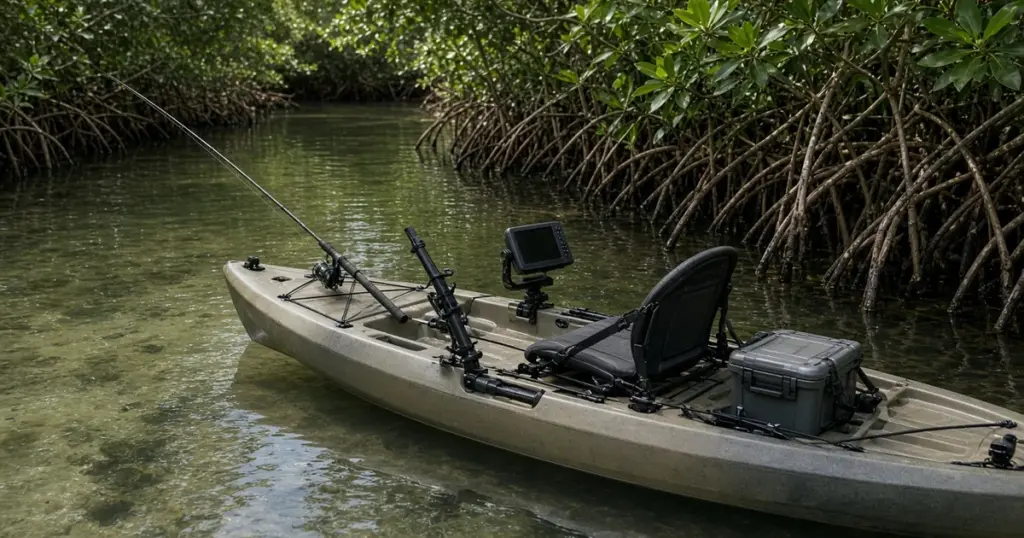
Kayak fishing has exploded, and so has the electronics on kayaks: fish finders, GPS units, lights, and sometimes motors or pedal-drive assist. All of it needs a battery that’s light, compact and able to survive constant splashing. This kayak battery guide covers how to size a battery, choose a chemistry, mount it safely and keep it charged.
What you need to power
Most kayak setups fall into one of three groups:
- Fish finder only. A small display and transducer, sometimes with GPS.
- Fish finder plus lights and accessories. Navigation lights, a bilge pump, or a camera.
- Motorized kayak. A trolling motor or electric drive, which needs far more energy than electronics.
Why lithium is the default for kayaks
Weight and space are everything on a kayak. A small LiFePO4 battery weighs a fraction of a sealed lead-acid battery of similar usable energy, and it holds its voltage steady so the fish finder doesn’t shut off as the battery drains. Lithium also tolerates deep discharge and has very low self-discharge between trips.
Small lithium batteries from the store include:
- Dakota Lithium 12V 10Ah Mini: 1.98 lb, 3.54 × 2.76 × 3.98 in.
- Battle Born 10Ah 12V Base Series: 2.65 lb.
- Battle Born 20Ah 12V Base Series: 5.7 lb.
- The Battle Born 30Ah 12V Base Series at 8.6 lb for bigger setups.
Dakota Lithium also makes kayak-specific accessories, such as its Yak Quik device system.
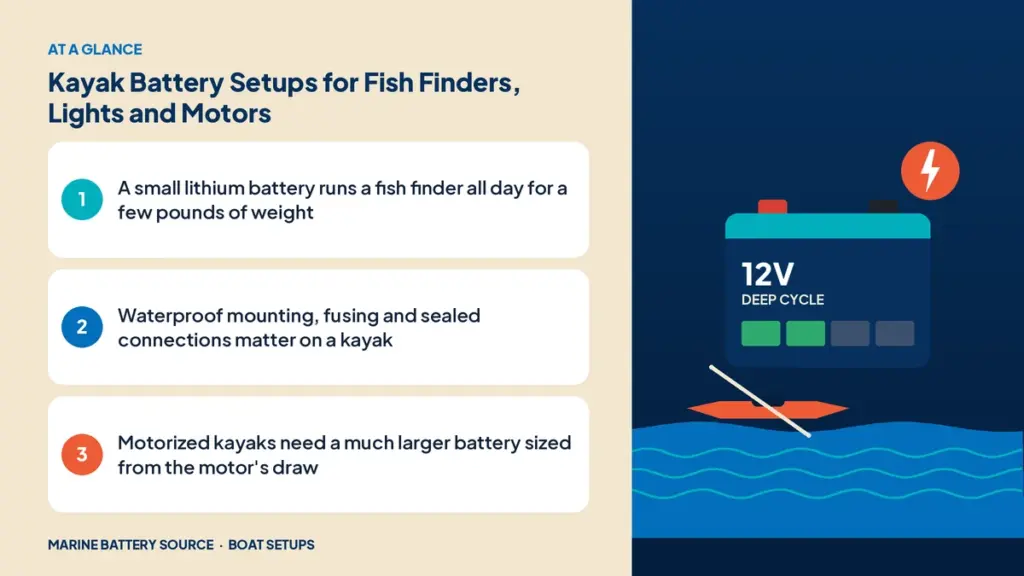
Sizing a fish finder battery
Find your fish finder’s current draw in the manual. Small units commonly draw well under an amp; larger units with bigger screens and advanced sonar can draw more.
Runtime ≈ battery Ah × 0.8 (for lithium) ÷ average current
Example: a fish finder drawing 0.8A, with a 10Ah lithium battery: 10 × 0.8 ÷ 0.8 = about 10 hours. Adding lights and a bilge pump raises the draw, so a 20Ah battery gives more margin. Check the manufacturer’s figures for your exact unit. For a deeper look, see our guide to choosing a fish finder battery.
Motorized kayaks
Kayak motors and drives draw far more current than electronics. A small 12V trolling motor might draw tens of amps at full speed. Size the battery from the motor maker’s draw figures and how long you’ll run it. A 50Ah or larger lithium battery is common; the EPOCH 12V 50Ah Essential weighs 14.3 lb. For heavier use, 100Ah batteries are an option, but weight increases. Our jon boat battery guide covers small 12V trolling setups that apply to motorized kayaks too.
Waterproofing and mounting
Kayaks are wet. Protect the battery and connections:
- Use a waterproof battery box or a dry storage compartment.
- Mount the battery low and centered to keep the kayak stable.
- Secure it so it can’t shift or come loose in a capsize.
- Keep terminals covered.
Wiring and fusing
Even small batteries can deliver enough current to melt wires in a short circuit.
- Install an inline fuse on the positive lead, as close to the battery as possible, sized for the fish finder or accessory per the maker’s instructions.
- Use marine-grade, tinned wire of the gauge the electronics maker recommends.
- Use waterproof connectors and heat-shrink terminals.
- Route wires away from pedal drives, rudders and moving parts.
- Add a waterproof switch if you want to cut power without opening the hatch.
Charging
Use a charger designed for lithium batteries, with a current suitable for the battery’s capacity. Small lithium batteries charge quickly with a modest charger. Rinse and dry the battery and box after saltwater trips before charging. Never charge a lithium battery below freezing unless it’s designed for it.
Saltwater kayaking
Salt is hard on terminals and connectors. After every saltwater trip:
- Rinse the kayak and dry the battery compartment.
- Inspect terminals and connectors for corrosion.
- Apply a light coat of dielectric grease or terminal protectant.
Storage between seasons
Lithium batteries have very low self-discharge, but follow the maker’s storage guidance, usually storing at a partial state of charge in a cool, dry place and disconnecting loads.
Checking your setup before a trip
A quick pre-launch check prevents most kayak electrical problems:
- Confirm the battery is charged; many lithium batteries have a button-activated gauge, or check voltage.
- Inspect the fuse holder and connectors for corrosion or looseness.
- Make sure the battery box latch and strap are secure.
- Power up the fish finder on the beach to confirm everything works.
- Pack a spare fuse in a waterproof bag.
Spending a minute on shore beats paddling back to fix a loose connection.
Common kayak battery mistakes
- No fuse, or a fuse far from the battery.
- Non-waterproof connectors that corrode in a few trips.
- Battery loose in the hull.
- Using a lead-acid charger on lithium.
- Choosing a battery too small for a motor.
Kayak vs other small boats
Kayaks share many traits with canoes and small skiffs. See small boat electrical basics for those. If you also fish from a bigger boat, compare with our bass boat, bay boat and center console guides.
A sample kayak setup
- Fish finder drawing about 1A, plus a navigation light at 0.2A.
- 20Ah lithium battery in a waterproof box behind the seat.
- Inline 5A fuse (or as the electronics maker specifies) at the battery.
- Waterproof connectors to the fish finder and light.
- Lithium charger at home.
That setup runs a full day with margin at roughly 5.7 lb of battery, using the Battle Born 20Ah as an example.
For the overview, read battery setups by boat type. Browse lithium batteries in the store.
Frequently asked questions
What size battery do I need for a kayak fish finder?
Divide the battery’s usable amp-hours by your fish finder’s average current. For many small units, a 10Ah to 20Ah lithium battery covers a full day.
Is lithium better than lead-acid for a kayak?
For most kayakers, yes. Lithium is much lighter, holds voltage steady and tolerates deep discharge.
How do I waterproof a kayak battery?
Use a waterproof battery box or dry hatch, waterproof connectors and heat-shrink terminals, and keep terminals covered.
What battery do I need for a kayak trolling motor?
Size it from the motor’s current draw and runtime. Many anglers use 50Ah to 100Ah lithium batteries for motorized kayaks.