


How to Measure Your Battery Compartment
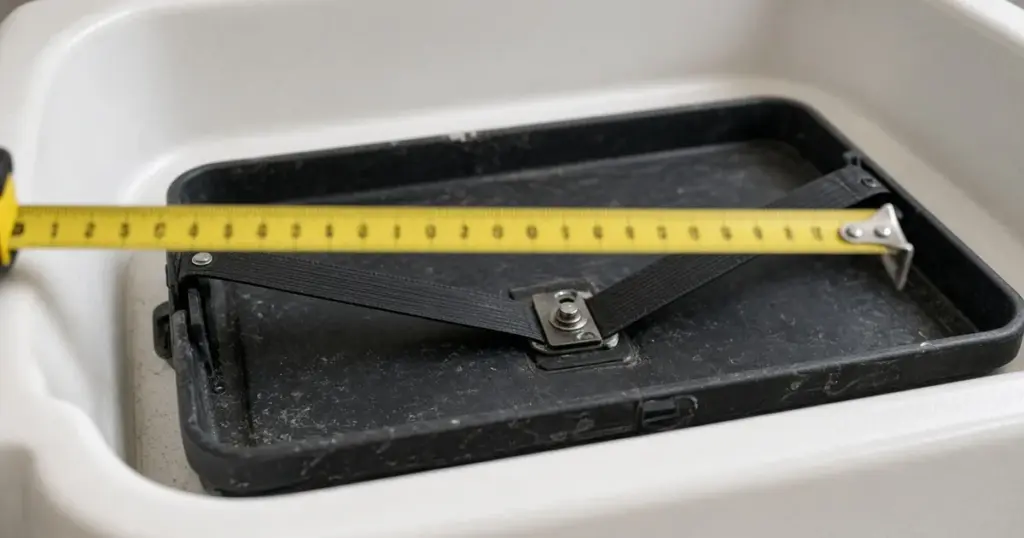
The most common reason a new battery doesn’t work out isn’t capacity or brand. It’s fit. A battery that’s half an inch too tall, has terminals on the wrong side or won’t take the hold-down strap means a return, a delay and a lost weekend. Measuring your battery compartment takes ten minutes and avoids all of that. This guide walks you through it.
What you’ll need
- Tape measure or folding rule
- Notepad or phone for notes and photos
- Flashlight
- Gloves and eye protection if you’ll be near the old battery
Step 1: Measure the space, not the old battery
The old battery tells you what fit before, but it may not be the largest battery that fits. Measure the box or tray itself:
- Length: inside, end to end, at the bottom of the box.
- Width: inside, side to side.
- Height: from the floor of the box to the lowest obstruction above it, such as a lid, hatch, seat base or deck.
Measure each dimension in two or three places. Boxes aren’t always square, and molded compartments can taper.
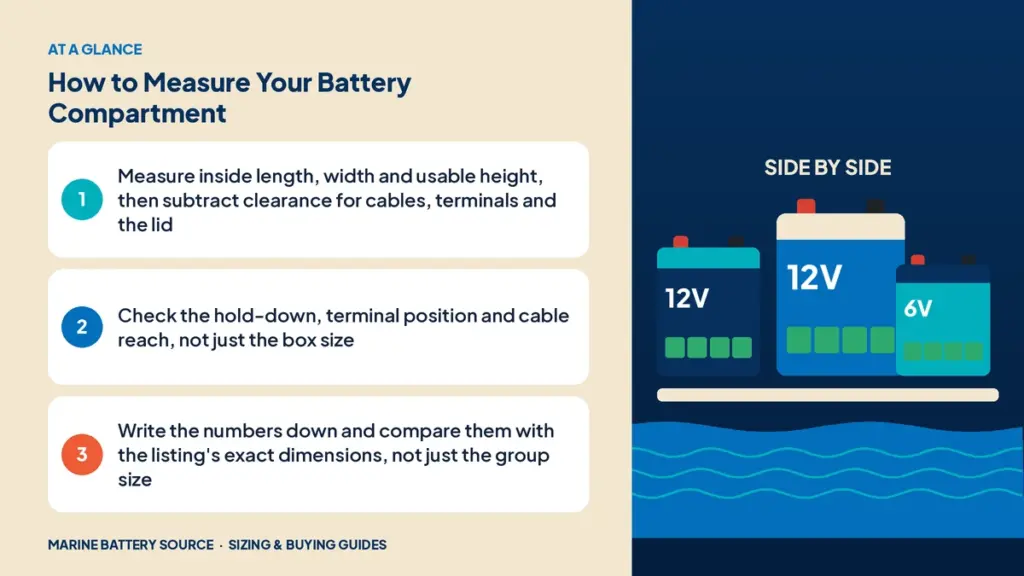
Step 2: Subtract clearance
You need room for more than the battery case.
- Terminals and cables: allow at least 1 to 1½ inches above the terminals for cable lugs and boots. Stud terminals with stacked ring lugs need more.
- Lid or hatch: a battery box lid must close without pressing on the terminals.
- Hold-down: straps and brackets take up space at the ends or across the top.
- Watering access: flooded batteries need room above the caps to check and add water.
- Ventilation: flooded batteries need airflow around them; don’t pack the space tight.
Step 3: Note terminal position and type
Look at where the positive and negative cables come from and how far they reach. Then note:
- Terminal layout: is the positive on the left or right when you face the battery from the cable side? Some group sizes come in both layouts.
- Terminal type: round posts, threaded studs or both. Many marine batteries have dual terminals.
- Cable reach: if a new battery has terminals in a different spot, will the cables reach without strain?
Take photos of the old battery’s top and its cable connections before removing anything.
Step 4: Check the hold-down
Every battery on a boat should be secured so it can’t move more than about an inch in any direction. Check what you have:
- A strap through the box?
- A bracket bolted to the tray?
- A molded tray that fits one specific size?
If you’re switching to a smaller or lighter battery, such as lithium, plan spacers or a new tray so it’s still held firmly.
Step 5: Compare with listings
Write your numbers down like this:
| Measurement | Space | Minus clearance | Max battery size |
|---|---|---|---|
| Length | 13.5 in | 0.5 in | 13 in |
| Width | 7.25 in | 0.25 in | 7 in |
| Height | 11 in | 1.5 in | 9.5 in |
Now compare with the exact dimensions on product pages, not just the group number. BCI group sizes have tolerances, and different makers’ batteries in the same group can vary.
Typical group size dimensions
As a starting point, here are typical BCI dimensions:
| Group | Approx. L x W x H |
|---|---|
| 24 | 10.3 x 6.8 x 8.9 in |
| 27 | 12 x 6.8 x 8.9 in |
| 31 | 13 x 6.8 x 9.4 in |
| GC2 | 10.3 x 7.1 x 10.9 in |
| 4D | 20.75 x 8.75 x 9.9 in |
| 8D | 20.75 x 11 x 9.9 in |
Height usually excludes terminals. In the example above, a group 31 would fit; a GC2 would be too tall.
Step 6: Think about weight and access
Measuring also tells you how hard the battery will be to install. A 60- to 70-pound lead-acid battery in a deep, narrow locker can be tough to lift out safely. Consider:
- Can you get both hands under it?
- Is there room to lift straight up?
- Would a lighter lithium battery make service easier?
Step 7: Measure for multiple batteries
For trolling banks and house banks, measure each battery location, plus the space between them for jumper cables. Series jumpers need short, direct runs. If you’re consolidating three 12V batteries into one 24V or 36V lithium battery, measure the largest single space, and plan where the freed space will go.
Measuring checklist
- ☐ Inside length, width and height in two or three places
- ☐ Clearance above terminals for cables and boots
- ☐ Lid or hatch clearance
- ☐ Hold-down type and position
- ☐ Terminal layout and type
- ☐ Cable reach to new terminal positions
- ☐ Watering and ventilation space for flooded batteries
- ☐ Photos of the old battery and connections
Before you remove the old battery
Turn off the battery switch and all loads. Disconnect the negative cable first, then the positive. Label the cables if there’s more than one battery. Lift with your legs, and get help with heavy batteries. When installing, connect positive first and negative last.
Common surprises
- Lithium batteries with different heights. Some lithium batteries in a group 24 or 31 case are taller or shorter than lead-acid. Check the listing.
- Taller GC2H batteries. A GC2H won’t fit where a GC2 barely fits.
- Cable lugs that don’t fit studs. Order the right ring terminals if switching to studs.
- Hidden obstructions. Fuel lines, wiring looms and fittings can get in the way of a slightly larger battery.
Still not sure?
Send us your measurements and a few photos through our contact page, and we’ll help you find batteries that fit.
More reading
Compare common sizes in what 24M, 27M and 31M mean and lithium battery group sizes. For large and tall batteries, see 4D and 8D batteries and GC2 golf-cart batteries. The full chart is in BCI battery group sizes explained. To choose the type of battery, see cranking vs dual-purpose vs deep-cycle and the marine battery buying guide.
Products mentioned
- Dakota Lithium group 24 battery tray
- EPOCH group 31 battery tray
- EPOCH tray for 12V 105Ah and 100Ah Eco
- Browse battery accessories.
Frequently asked questions
How much clearance do I need above battery terminals?
Allow at least 1 to 1½ inches for cable lugs and terminal boots, more for stacked lugs on studs.
Should I measure the old battery or the box?
Measure the box or tray. The old battery shows what fit, not necessarily the largest that fits.
Are all group 31 batteries the same size?
No. Group sizes have tolerances, and makers vary. Check each listing’s exact dimensions.
Does a lighter battery need a hold-down?
Yes. Every battery should be secured so it can’t shift in rough water.
What if my terminals are on the wrong side?
Check cable reach. If cables won’t reach without strain, choose a battery with the matching terminal layout.