


When to Replace a Marine Starting Battery
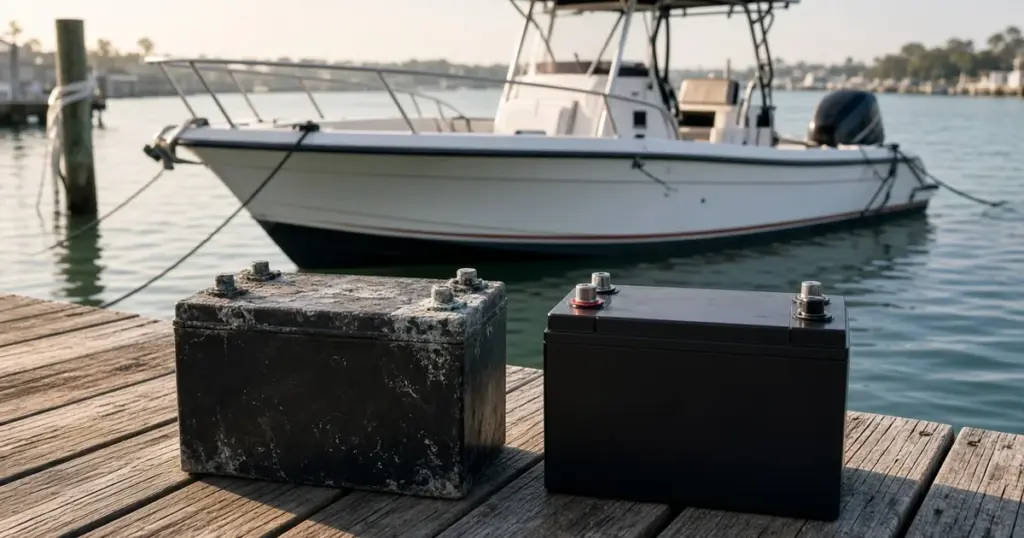
Starting batteries rarely fail on a convenient day. More often, the engine cranks a little slower each week until one morning it doesn’t start. Knowing when to replace a marine starting battery saves you from that moment. This guide covers the warning signs, how to test, what age and heat do, and how to choose the replacement.
Warning signs
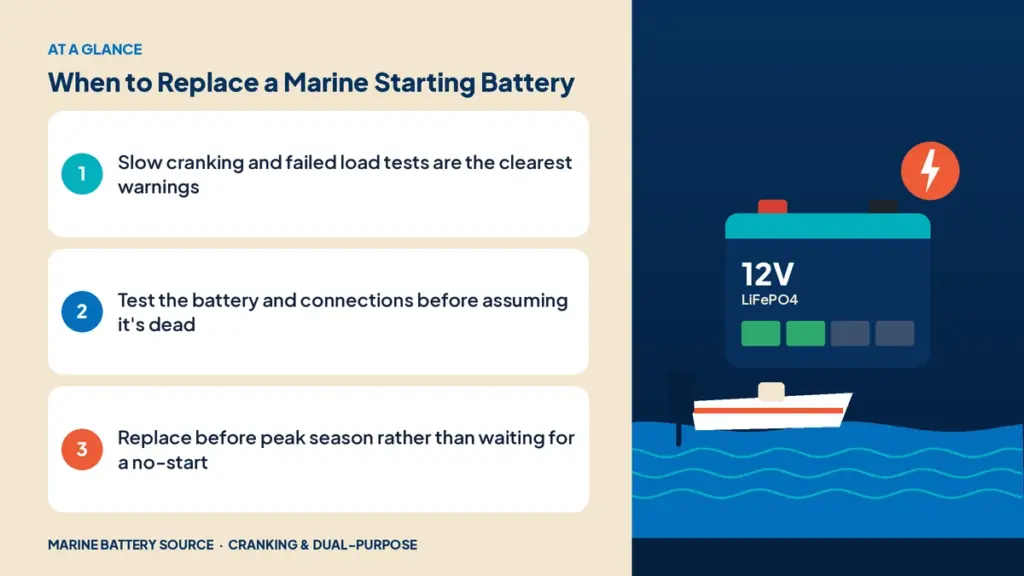
- Slow cranking, especially on cool mornings.
- Clicking or a single clunk when you turn the key.
- Engine electronics resetting or warning lights during cranking.
- Needing a jump more than once.
- A battery that won’t hold charge overnight or between trips.
- Physical damage: a swollen, cracked or leaking case.
- Heavy corrosion that keeps coming back.
Any one of these is reason to test. Several together usually mean replacement.
Rule out the connections first
Many “dead batteries” are actually bad connections. Before replacing:
- Inspect both terminals and cable ends for corrosion.
- Clean to bright metal and tighten to the battery maker’s torque spec.
- Check cables for swelling or green corrosion under the insulation.
- Check the battery switch for heat damage or looseness.
If cranking improves after cleaning, the battery may be fine.
Test the battery
Resting voltage
After the battery has rested several hours without charging or load, measure voltage at the terminals. For lead-acid and AGM batteries, a reading around 12.6V to 12.8V generally indicates full charge, while about 12.2V is roughly half. A fully charged battery that reads low after resting may have a failed cell. Voltage alone doesn’t show cranking ability, though.
Load test
A load test applies a heavy current and watches voltage. A battery that drops below the tester’s pass threshold is weak. Many parts stores offer free load testing.
Conductance test
Handheld conductance testers estimate available CCA without a heavy load. Compare the result with the battery’s rated CCA and, more importantly, with your engine’s minimum. When the estimate approaches the engine’s requirement, plan a replacement.
Lithium batteries
Lithium starting batteries are tested differently. Many have Bluetooth apps or BMS data that show state of charge and health. Follow the battery maker’s diagnostics; a conventional lead-acid load tester may not give meaningful results.
Age and climate
Battery life depends on chemistry, temperature, charging habits and use. Heat is especially hard on lead-acid batteries. A battery in a hot engine compartment in a warm climate may need replacing sooner than the same battery in a cool climate. Most batteries carry a date code; know how old yours is and test it more often as it ages. If you rely on one battery for starting and electronics, factor that extra cycling in too; see sizing a dual-purpose battery for electronics.
Physical red flags that mean replace now
Some problems don’t need a test to diagnose:
- A swollen or bulging case, which can indicate overcharging, heat damage or internal failure.
- Cracks or leaks, which let electrolyte escape and can damage the boat.
- A strong rotten-egg smell near a lead-acid battery while charging, a sign of severe overcharging or a failed cell. Stop charging, ventilate and inspect.
- Melted or deformed terminals, usually caused by a loose connection carrying high current.
Handle a damaged battery with gloves and eye protection, keep it upright, and recycle it promptly.
Charging system checks
If a new battery also goes flat, the battery may not be the problem. Check the engine’s charging output with the engine running: voltage at the battery should rise above its resting level. If it doesn’t, have the charging system inspected. Also check for parasitic draws by measuring current with everything switched off. A small, unexplained current draining the battery over a week can make a good battery seem bad.
Why proactive replacement pays
Replacing a weak battery at the start of the season costs the same as replacing it after it fails, minus the tow, the lost day and possibly a damaged starter from repeated weak cranking. If testing shows the battery is marginal before a big trip, replace it.
Choosing the replacement
- Check the engine spec. Minimum CCA or MCA and reserve capacity are in the manual.
- Match the group size and terminals to your tray and cables.
- Choose a chemistry. Flooded, AGM or cranking-rated lithium, depending on budget, maintenance preference and engine maker guidance. See AGM starting batteries for boats.
- Add margin if you boat in cold weather or run electronics from the battery.
Store examples
| Battery | Type | CCA | MCA | RC (min) |
|---|---|---|---|---|
| Interstate 24M-XHD | Starting, 24M | 800 | 1000 | 135 |
| Interstate 27M-XHD | Starting, 27M | 800 | 1000 | 182 |
| Interstate 34M-AGM | AGM dual purpose, 34M | 800 | 1000 | 125 |
Replacing the battery
- Turn off the battery switch and all loads.
- Disconnect the negative cable first, then the positive.
- Remove the hold-down and lift out the old battery, keeping it upright.
- Clean the tray and cable ends.
- Install the new battery in the same orientation.
- Connect the positive first, then the negative.
- Secure the hold-down and cover the positive terminal.
- Coat the terminals with a protectant.
Recycle the old battery
Lead-acid batteries are among the most recycled consumer products. Many retailers that sell batteries accept old ones, and many states require it. Never put a lead-acid battery in the trash.
Replacing related batteries
If the boat has a generator, check its starting battery at the same time; see generator starting batteries. On boats with paired batteries, consider replacing both if they’re the same age, especially if they’re paralleled.
Making the new battery last
- Recharge after each trip with a charger set to the correct profile.
- Keep electronics off the starting battery where possible.
- Isolate the battery with the switch when the boat sits.
- Keep it cool and ventilated.
- Test it before each season.
Cold weather often reveals a weak battery; read how temperature affects cranking. If you charge mostly from the engine, see charging on the water to ensure the battery is getting a full charge. For the complete picture, read choosing a boat starting battery and cranking vs dual-purpose vs deep-cycle batteries. Browse cranking batteries in the store.
Frequently asked questions
How often should I replace my boat’s starting battery?
There’s no fixed schedule. Test the battery each season and replace it when it no longer meets your engine’s cranking spec with margin, or shows warning signs.
Can a battery test fine but still fail?
A voltage reading alone can look normal on a weak battery. Load or conductance testing gives a better picture of cranking ability.
Should I replace both batteries at once?
If two lead-acid batteries are the same age and work together, replacing both avoids a new battery being dragged down by an old one.
What do I do with my old boat battery?
Recycle it. Most battery retailers accept old lead-acid batteries, and recycling is required in many places.