


Choosing a Starting Battery for Inboard and Sterndrive Engines
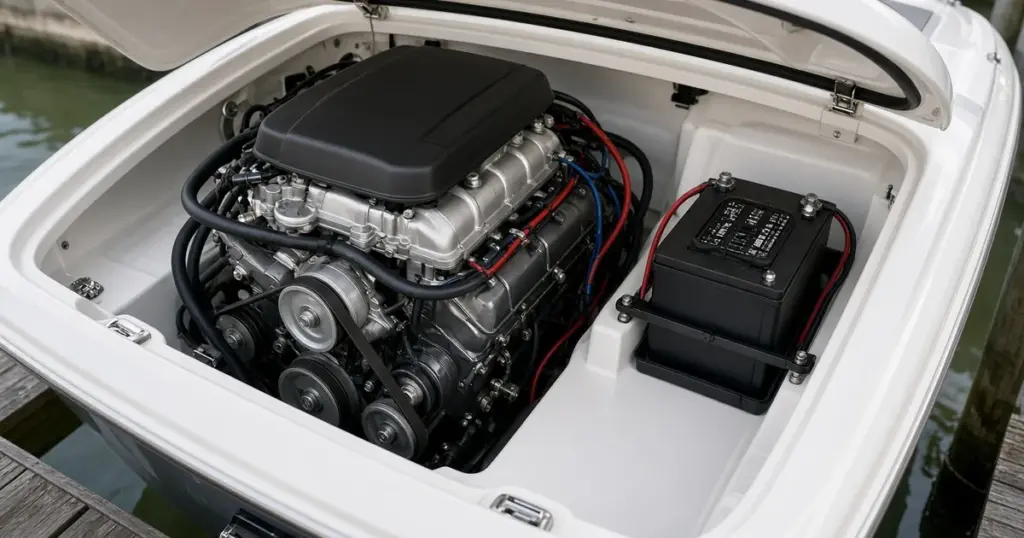
Inboard and sterndrive engines are common on runabouts, ski boats, cruisers and sportfish boats. They’re generally larger than small outboards, they often sit in warm engine compartments, and they may have more electronics demanding power at start. Choosing an inboard starting battery means meeting the engine’s spec, accounting for heat, and planning the electrical system around it. This guide walks through the details.
Start with the engine’s requirements
Engine manufacturers list battery requirements in the owner’s manual, usually including:
- Minimum cranking rating (CCA, MCA or both).
- Minimum reserve capacity.
- Sometimes recommended battery types or group sizes.
Gasoline sterndrives and inboards, and especially diesels, can have demanding starting loads. Large diesels in particular often require high cranking current, and some use 24V starting systems. Always confirm your engine’s voltage and requirements. Remember that MCA is measured at 32°F and CCA at 0°F, so compare batteries using the same unit your engine maker specifies.
Heat and the engine room
Batteries in engine compartments face heat that shortens lead-acid life. High temperatures speed up corrosion of the plates and water loss in flooded batteries. To reduce heat stress:
- Mount batteries as far from exhaust manifolds and hot surfaces as practical.
- Keep engine-room ventilation working.
- Consider AGM, which is sealed and handles heat reasonably well, though it still ages faster when hot.
- Inspect flooded batteries more often in hot climates and top up with distilled water as needed.
Ventilation and gasoline engines
Flooded lead-acid batteries release hydrogen during charging. On gasoline-powered boats, U.S. Coast Guard regulations require ventilation and blower systems for engine compartments because of fuel vapors. Battery installations should follow ABYC standards, including secure mounting, terminal protection and appropriate ventilation. Never create sparks near batteries or fuel lines.
Choosing a chemistry
Flooded
Lowest cost and widely available, with good cranking per dollar. Needs periodic watering and ventilation. A sound choice when budget matters and maintenance is easy.
AGM
Sealed, spill-resistant and vibration-resistant, with strong cranking. Popular on ski and wake boats and cruisers. Examples include the Interstate 31M-AGM with 925 CCA and 1190 MCA, and the Interstate 34M-AGM with 800 CCA in a compact Group 34M size. See our AGM starting battery guide.
Lithium
Cranking-rated lithium batteries save weight and offer low self-discharge, but engine-room heat, charging system compatibility and the engine maker’s guidance all need checking. Read lithium starting batteries; the same considerations apply to inboards.
Group sizes for inboards
Inboards and sterndrives commonly use Group 24, 27 or 31 batteries, with larger cruisers and diesels using 4D or 8D sizes. The Interstate SRM-4D lists 1314 CCA and 390 minutes of reserve capacity in a Group 4DM size, the kind of battery found on larger boats. Check tray dimensions, hold-downs and terminal type before buying.
Separate starting from house loads
On cruisers and larger inboard boats, the house loads (refrigeration, lighting, electronics, inverters) are large enough that they should come from a dedicated house bank. The starting battery stays reserved for the engine. A battery switch, automatic charging relay or DC-DC charger lets the engine charge both. Read why you should separate starting and house batteries.
Generator starting
Boats with generators often have a separate generator starting battery. Generator makers specify their own battery requirements, and keeping that battery separate means a drained house bank never stops you from running the generator to recharge it.
Twin inboards
Twin-engine boats usually give each engine its own starting battery, with a parallel or emergency switch that can combine them if one fails. Our twin and triple engine battery guide covers switching options that also apply to twin inboards.
Charging
Inboard alternators typically charge the starting battery and, through a switch or relay, the house bank. A shore-power charger keeps everything topped up at the dock. Match charger profiles to each battery’s chemistry. If you mix chemistries, such as an AGM starting battery and a lithium house bank, use charging equipment designed to handle both.
Cable runs and voltage drop
On many inboard boats, the batteries sit close to the engine, which keeps starting cables short. On others, batteries live in a separate compartment or under a cockpit hatch. Every extra foot of cable and every connection through a battery switch adds resistance. During cranking, when current is highest, that resistance lowers the voltage reaching the starter.
If an engine cranks slowly with a battery that tests healthy, measure voltage at the battery and at the starter while cranking. A large difference points to cables, lugs or the switch rather than the battery. Clean and tighten connections, and replace any cable that shows green corrosion under the insulation.
Choosing between two good options
If you’re torn between a flooded battery and an AGM of the same size, think about access and climate. If the battery is hard to reach for watering, or the boat lives in a hot climate where flooded batteries lose water quickly, AGM’s sealed design is worth the extra cost. If the battery is easy to reach and you’re diligent about maintenance, a quality flooded battery offers excellent value.
Maintenance checklist
- Inspect terminals and cables for corrosion and tightness each month during the season.
- Check flooded battery electrolyte levels regularly, more often in hot weather.
- Keep battery tops clean and dry.
- Test cranking capacity before the season.
- Verify hold-downs are secure.
When to replace
Replace a starting battery when testing shows it no longer meets the engine’s requirements with margin, or when you notice slow cranking, especially in cool weather. A jet ski or PWC follows similar rules on a smaller scale; see the PWC battery guide.
For the full process, see choosing a boat starting battery and our comparison of battery types. Browse cranking batteries in the store.
Frequently asked questions
What battery do I need for an inboard engine?
A marine starting or dual-purpose battery that meets your engine maker’s minimum cranking and reserve capacity, in a group size that fits your tray.
Can I put an AGM battery in my engine compartment?
Yes. AGM batteries are sealed and widely used in engine compartments. Keep them away from direct heat sources and ensure the compartment is ventilated.
Do diesel inboards need bigger batteries?
Diesels often need high cranking current, and some use 24V starting systems. Check the engine’s manual for its requirements.
Should my inboard starting battery also run accessories?
On larger boats, it’s better to keep the starting battery for the engine and run accessories from a separate house bank.