


Tournament Season Prep: Battery Checks Before Your First Event

A dead trolling battery at 1 p.m. on tournament day can cost you a check. Tournament anglers push batteries harder than almost anyone: long days, heavy spot-lock use, multiple graphs, livewells running for hours, and back-to-back days with only a night to recharge. This guide covers how to get your batteries ready before the season and keep them strong through it.
Before the first event: test everything
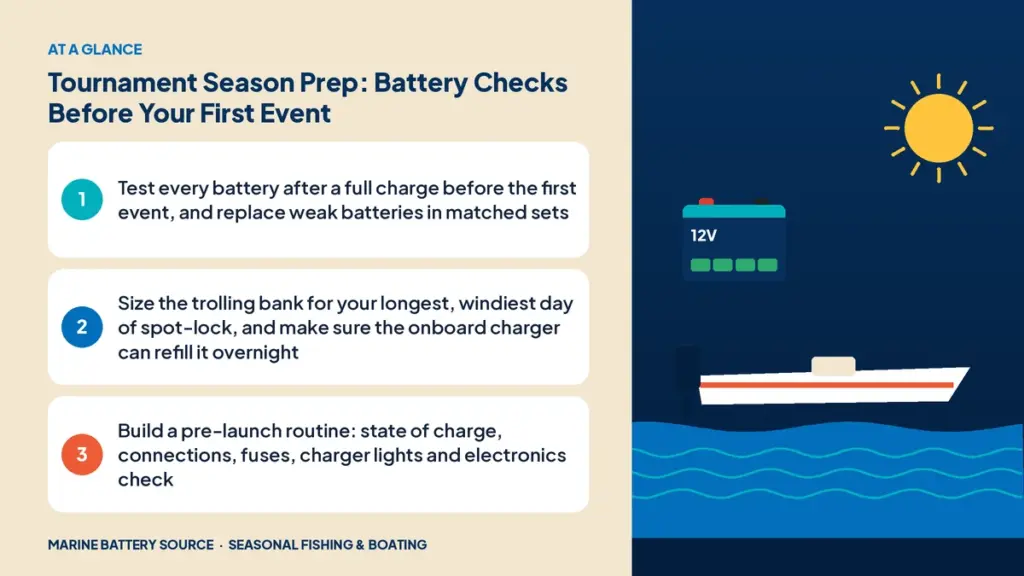
- Fully charge every battery with your onboard charger, and confirm the charger finishes each bank.
- Rest and measure. After a few hours off the charger, a healthy 12V flooded battery reads about 12.6–12.7V, AGM about 12.8V and LiFePO4 about 13.3–13.4V.
- Load test the start battery. It should stay above about 9.6V at half its CCA for 15 seconds.
- Test trolling batteries under load or check their capacity with a monitor or app. A battery that sags well before its partners is failing.
- Check the dates. Batteries several seasons old deserve a closer look.
Replace in matched sets
In a 24V or 36V bank, every battery carries the same current. One weak battery drags down the bank and wears out faster. If one battery fails, replace the whole bank with identical batteries of the same age. If you’re switching to lithium, consider a single 24V or 36V battery to avoid matching issues entirely.
Size the trolling bank for your hardest day
Think about your longest, windiest day: eight hours or more, heavy spot-lock in wind and current, and runs between spots. A 36V motor can easily average 20–30A on a day like that.
| Average draw (36V) | 8 hours uses | Lead-acid bank needed (50% use) | Lithium needed (~90% use) |
|---|---|---|---|
| 15A | 120Ah | ~240Ah | ~135Ah |
| 20A | 160Ah | ~320Ah | ~180Ah |
| 25A | 200Ah | ~400Ah | ~220Ah |
A standard bank of three group 31 lead-acid batteries offers about 100Ah at 36V, or about 50Ah if you stop at half. That’s why tournament anglers moved to lithium so quickly. Single-case 36V options in our store include the EPOCH 36V 100Ah and Lithium Rhino 36V 120Ah. For very heavy use, two 36V batteries in parallel, if the maker allows, or a DC-DC charger to add charge on the run can extend the day.
The start battery matters too
Your start battery runs the engine, and often your graphs, livewells and jack plate. A weak start battery means slow cranking at take-off or, worse, a no-start at a far spot. A group 31 AGM like the Interstate 31M-AGM (925 CCA) or a dual-purpose lithium like the EPOCH 12V 172Ah (approximately 1,000 CCA equivalent) are common choices. Check your engine maker’s guidance for lithium starting batteries.
Electronics power
Big graphs, live sonar and multiple units can draw significant current. Many anglers add a dedicated electronics battery to reduce interference from the trolling motor and keep the start battery reserved for starting. A small lithium battery, like a group 24 lithium, is a popular choice.
The charger: your overnight pit crew
On multi-day events, your onboard charger has one night to refill everything.
- Make sure each bank is charged with the right profile.
- Check that the charger’s output can refill your bank overnight. A 36V 100Ah lithium battery that’s 80% empty needs about 80Ah. A 15A charger refills that in roughly 5–6 hours.
- Look for fault lights before you leave the ramp.
- Use a quality extension cord and check the outlet at your hotel or campground.
Charge on the run
A DC-DC charger lets your outboard top up the trolling battery while you run between spots. EPOCH’s 12V-to-36V DC-DC charger and dual-output 12V/36V charger are designed for this. On a day with long runs, it can add meaningful capacity.
Connections and fuses
Heavy current magnifies small problems. Before the season:
- Clean and tighten every terminal.
- Inspect trolling motor plug and leads for heat damage.
- Check the trolling motor breaker or fuse.
- Replace corroded series jumpers.
- Torque lithium terminals to the maker’s spec.
Pre-launch routine on tournament morning
- ☐ State of charge on every battery
- ☐ Charger finished overnight, no fault lights
- ☐ Battery switch on
- ☐ Electronics boot normally
- ☐ Trolling motor runs on all speeds
- ☐ Livewell pumps and aerators run
- ☐ Spare fuses on board
During the day
- Check state of charge at midday.
- Pace spot-lock use in wind if you’re running low.
- Use the big motor to reposition instead of fighting wind on the trolling motor for long periods.
- Keep electronics brightness reasonable on long days.
After each day
Plug in as soon as you’re back. Lead-acid batteries left partly discharged overnight sulfate. Lithium batteries recover quickly with a full charge.
Travel events
For events away from home, pack a small battery kit: spare fuses for the trolling motor and accessories, a multimeter, terminal wrenches, zip ties, electrical tape and a heavy-duty extension cord. If you’re staying where shore power is unreliable, note how long your charger needs and plan to plug in as soon as you’re off the water.
More reading
Read the seasonal battery calendar for year-round care, summer battery tips for heat, and fall fishing tips for the late season. Trip planning is covered in fishing trip power planning, and inshore anglers should read redfish and snook season power. Gift ideas for the angler who has everything are in gifts for boaters. For off-season care, see winter storage.
Products mentioned
- EPOCH 36V 100Ah
- Lithium Rhino 36V 120Ah
- EPOCH 12V 172Ah dual purpose
- EPOCH 12V-to-36V DC-DC charger
- EPOCH 12V/36V onboard charger
Frequently asked questions
How much battery do I need for a tournament day?
Estimate your average draw times hours. A 36V motor averaging 20A for 8 hours uses about 160Ah.
Should I replace all my trolling batteries at once?
Yes. Series banks need matched batteries of the same age.
Can I charge my trolling battery while running?
Yes, with a DC-DC charger fed by the outboard’s charging system.
Do I need a separate electronics battery?
It helps reduce interference and protects the start battery, especially with multiple large graphs.
How long does it take to recharge a 36V lithium battery overnight?
Replacing 80Ah with a 15A charger takes roughly 5–6 hours.