


Group 24 Marine Batteries: Fit, Capacity and Options
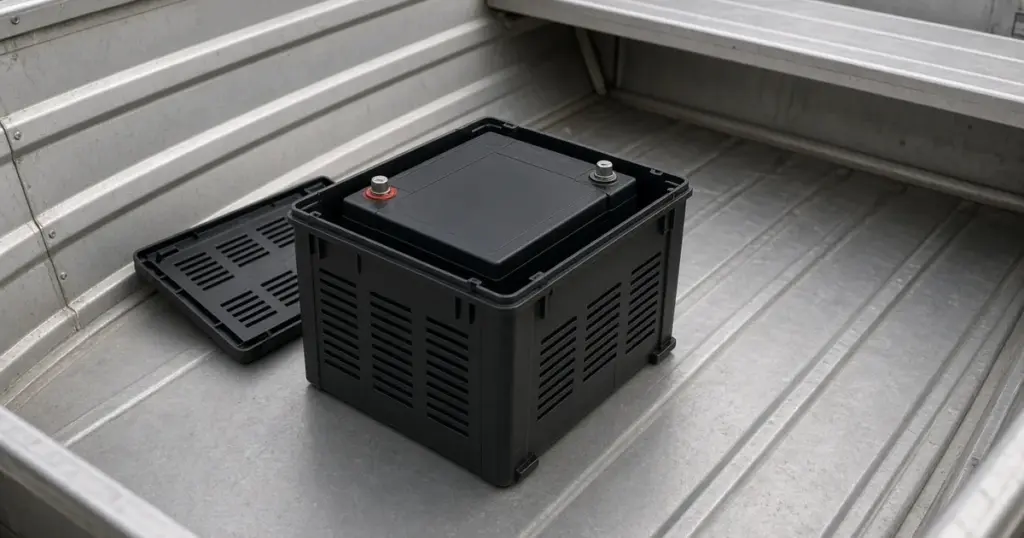
The group 24 is one of the most common marine battery sizes. It’s compact enough for small boats, strong enough to start most mid-size outboards, and available in starting, dual-purpose, deep-cycle and lithium versions. This guide covers what a group 24 battery is, what to expect from its ratings, and which models suit different boats. Check product pages for exact dimensions and current specs.
Group 24 size
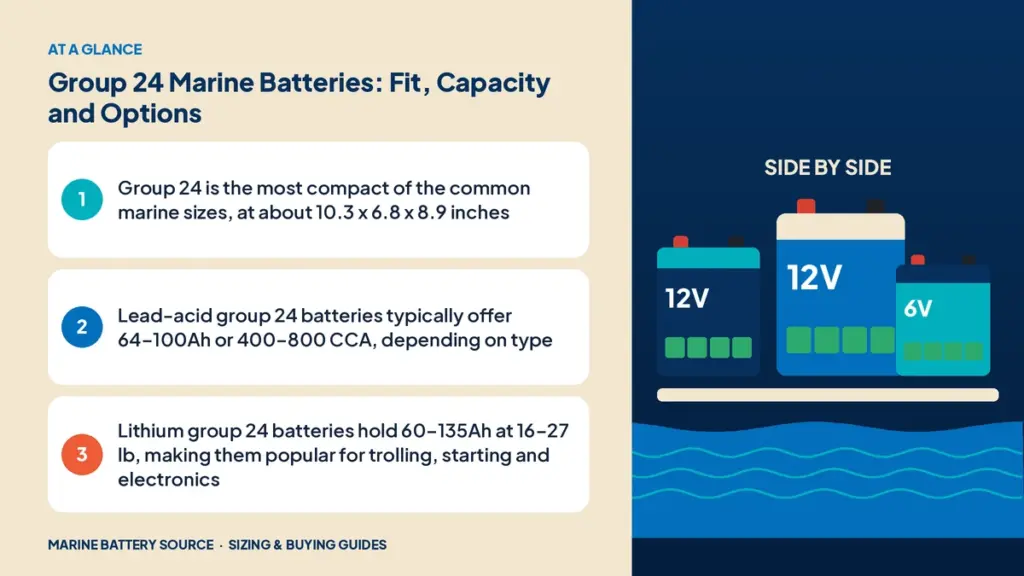
A group 24 battery is about 10.3 inches long, 6.8 inches wide and 8.9 inches high, according to typical BCI dimensions. Terminals add some height. It’s the shortest of the common group 24/27/31 family, which is why it fits on small boats with limited space. Marine versions are often labeled 24M and may have dual terminals.
Types of group 24 batteries
| Type | What it’s for | Example in our store |
|---|---|---|
| Starting | Engine cranking | Interstate 24M-XHD (800 CCA, RC 135) |
| Dual purpose (flooded) | Starting plus light accessories | Interstate HD24-DP (64Ah, 405 CCA) |
| Dual purpose (AGM) | Sealed, starting plus accessories | Interstate 24M-AGM-A (70Ah, 750 CCA) |
| Deep cycle (flooded) | Trolling and house | Trojan 24TMX (85Ah, 47 lb), Trojan SCS150 (100Ah, 50 lb), Interstate SRM-24 (81Ah) |
| Deep cycle (AGM) | Sealed deep cycle | Trojan 24-AES (76Ah, 54 lb) |
| Enhanced flooded | Durable vented deep cycle | Interstate 24M-EFB (77Ah, 590 CCA) |
| Lithium deep cycle | Light, high usable capacity | EPOCH 12V 100Ah Eco (21 lb), EPOCH 12V 105Ah (22.1 lb), Battle Born 75Ah (27 lb) |
| Lithium dual purpose | Starting plus deep cycle | Dakota DL+ 60Ah (1,000 CCA, 16.5 lb), DL+ 135Ah (1,000 CCA, 27.2 lb), Interstate Li24MDP |
Typical ratings
In lead-acid, group 24 deep-cycle batteries in our store list 76–100Ah at the 20-hour rate and 137–150 minutes of reserve capacity. Starting batteries list 400–800 CCA. For long life, use only about half of a lead-acid battery’s rated capacity. So a 85Ah group 24 deep-cycle battery gives roughly 40–45Ah usable per trip.
Lithium group 24 batteries list 60–135Ah, and you can use most of it. A 105Ah lithium battery gives roughly 85–100Ah usable, more than double a lead-acid group 24, at less than half the weight.
Which boats suit a group 24?
- Small outboard boats: a group 24 starting or dual-purpose battery handles most outboards up to mid-size. Check your engine maker’s minimum CCA.
- Jon boats and skiffs: a group 24 dual-purpose battery can start the engine and run a fish finder and livewell.
- Kayaks and small trolling setups: a group 24 lithium battery powers a 12V trolling motor all day at a fraction of lead-acid weight.
- Electronics batteries: a dedicated group 24 lithium can isolate sonar and graphs from trolling motor noise.
When a group 24 isn’t enough
If you run a 12V trolling motor hard all day, a lead-acid group 24 may not last. Options:
- Move to a group 27 or 31 lead-acid battery, if it fits.
- Switch to a group 24 lithium battery for roughly double the usable energy.
- Add a second battery in parallel.
For larger outboards with high cranking needs, a group 27 or 31 starting battery may be needed. See group 27 marine batteries and group 31 marine batteries.
Lead-acid vs lithium in a group 24
| Lead-acid group 24 | Lithium group 24 | |
|---|---|---|
| Weight | 47–54 lb | 16.5–27.2 lb |
| Usable energy | About half of rating | Most of rating |
| Maintenance | Watering for flooded types | None |
| Voltage under load | Sags as it discharges | Stays steady |
| Upfront cost | Lower | Higher |
| Cold charging | Fine | Needs heating or above-freezing temperatures |
For starting-only use, a lead-acid or AGM group 24 is economical. For deep cycling, lithium usually costs less per trip over its life.
Installation tips
- Use a group 24 tray or box with a hold-down strap. Dakota Lithium sells a group 24 marine tray.
- If you’re switching from lead-acid to a lighter lithium battery, make sure it’s still held firmly. Use spacers if the new case is slightly smaller.
- Fuse accessory circuits close to the battery.
- Set your charger to the correct profile: flooded, AGM or lithium.
- Coat terminals with a protectant spray, especially on saltwater boats.
Charging a group 24
For lead-acid, a 10A charger is a good match for most group 24 batteries, recharging overnight. Lithium batteries accept faster charging; check each listing’s maximum charge current. Engine charging from an outboard works for lead-acid and AGM. For lithium, confirm compatibility with your engine and consider a DC-DC charger.
How long does a group 24 last?
Lead-acid group 24 batteries typically last a few seasons, depending on care, depth of discharge and heat. Keep them charged and avoid deep discharges. Lithium batteries list thousands of cycles; EPOCH’s 12V 100Ah Eco lists 4,500+ and Dakota’s DL+ models list 5,000 cycles to 80% capacity. Warranties vary: Interstate’s group 24 lead-acid models list 12–24 months, while lithium models list 3 to 11 years depending on the brand.
Common mistakes
- Buying by group size alone. Two group 24 batteries can have very different capacity and cranking ratings. Check the specs, not just the size.
- Using a starting battery for trolling. Starting batteries have thin plates that wear out quickly under deep discharge.
- Ignoring terminal type. Some group 24 batteries have posts, others studs, others both. Make sure your cable ends fit.
More reading
Compare sizes in group 24 vs 27 vs 31, and see BCI battery group sizes explained for the full chart. For lithium options, read lithium battery group sizes. The marine battery buying guide covers choosing type and capacity.
Products mentioned
Frequently asked questions
What are the dimensions of a group 24 battery?
Typically about 10.3 x 6.8 x 8.9 inches. Check the product listing for the exact size.
How many amp-hours is a group 24 marine battery?
Lead-acid deep-cycle models in our store list 76–100Ah. Lithium group 24 models list 60–135Ah.
Can a group 24 battery run a trolling motor?
Yes. A lithium group 24 works well for a 12V motor. A lead-acid group 24 suits light use.
Is 24M the same as group 24?
Yes, 24M is the marine version, often with dual terminals.
How much does a group 24 battery weigh?
Lead-acid models in our store weigh 47–54 pounds. Lithium models weigh 16.5–27.2 pounds.