


Lithium Battery Won’t Charge? Temperature and Charger Checks
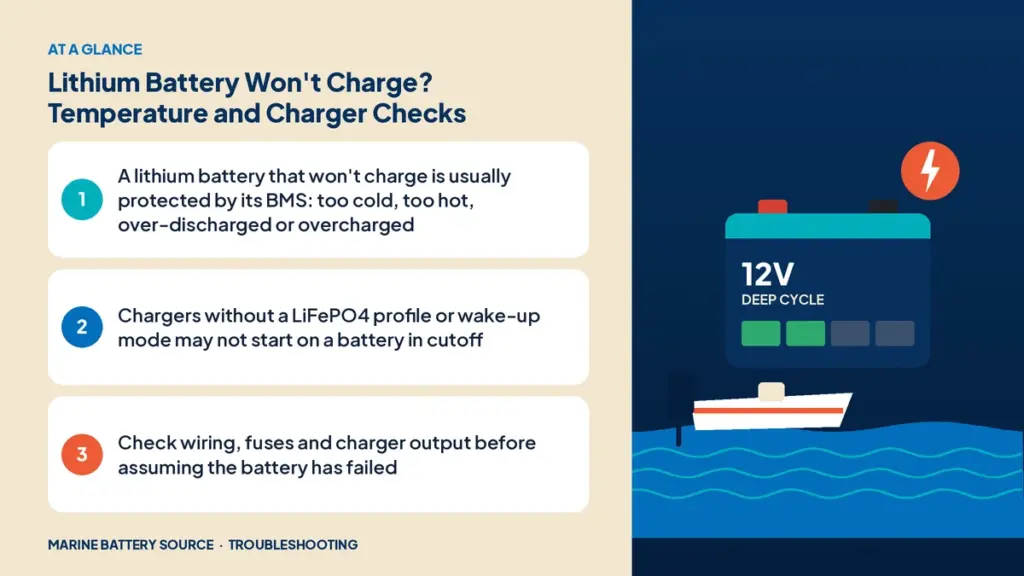
You plug in the charger and nothing happens, or the charger runs but the lithium battery never fills. LiFePO4 batteries are reliable, but their battery management system (BMS) protects them in ways that can block charging. Most of the time the battery is fine, and the fix is straightforward. Here’s how to find the cause.
Cause 1: BMS low-voltage cutoff
If the battery was run down until the BMS disconnected, it may read zero or near zero at the terminals. Many chargers need to see battery voltage before they’ll start, so they won’t charge a battery in cutoff.
Fix: use a lithium charger with a wake-up or recovery function. Some batteries reset when a charger is connected; others need a specific procedure. Check the manual. The EPOCH 12V 15A lithium charger is designed for LiFePO4 batteries.
Cause 2: Too cold
Most LiFePO4 batteries won’t accept charge below about freezing. The BMS blocks charging to protect the cells.
Fix: let the battery warm up, or use a battery with internal heating, like the Dakota Lithium 12V 135Ah heated. Heated batteries warm themselves before charging.
Cause 3: Too hot
In hot compartments, the BMS may stop charging until cells cool. Ventilate the compartment and avoid high-current charging in extreme heat.
Cause 4: Wrong charger profile
A lead-acid charger may:
- Stop before lithium is full
- Push voltages lithium doesn’t want, causing BMS cutoff
- Try to equalize, which isn’t appropriate for lithium
Fix: set the charger to LiFePO4 or replace it with a lithium-compatible charger.
Cause 5: BMS high-voltage cutoff
If charging voltage exceeds the battery’s limit, the BMS disconnects. The charger may then see the battery vanish and report a fault. This often happens with multiple charging sources (alternator plus shore charger plus DC-DC) running at once, or a charger with a high setting.
Fix: confirm each charging source’s voltage settings and follow the battery maker’s limits.
Cause 6: Wiring and fuses
- Blown fuse between the charger and battery
- Loose or corroded terminals
- Reverse polarity (the charger may refuse)
- High voltage drop on long or thin cables
Measure voltage at the charger output and at the battery. If they differ a lot, check the wiring. See voltage drop under load and replacing battery cables on a boat.
Cause 7: Alternator charging
Lithium batteries accept high current, which can stress alternators, and some alternator setups don’t charge lithium properly.
- A DC-DC charger between the start battery and the lithium bank limits current and applies the right profile.
- If the lithium bank isn’t charging while running, check the DC-DC charger’s status, fuses and input voltage.
The EPOCH dual-output 12V/36V DC-DC charger charges two banks from the engine.
Cause 8: Charger can’t detect the battery
Some chargers need a minimum voltage to begin. A battery in cutoff, or a series bank with one battery in cutoff, may not register.
Cause 9: Series and parallel banks
In multi-battery lithium banks, one battery’s BMS may cut off while others don’t, stopping the whole string. Charge each battery individually if needed, then reconnect. Follow the maker’s limits for series and parallel connections.
Step-by-step diagnosis
- Measure battery voltage. Zero or very low suggests BMS cutoff.
- Check temperature. Is the battery below freezing or very hot?
- Check the charger profile.
- Check the charger output voltage and fault lights. See battery charger fault lights.
- Check fuses and wiring.
- Check the battery’s app for BMS status, if it has one.
- Try a known-good lithium charger.
- Contact the manufacturer if it still won’t charge.
Charging from solar or a second charger
Some boaters add a solar controller or carry a portable charger. If more than one source charges the same lithium battery, the combined voltage or current can push the battery to a BMS limit. Make sure each source has a LiFePO4 profile, that their absorption voltages are compatible and that their combined current is within the battery’s maximum charge rate.
The charger says “full” but the battery isn’t
Lithium batteries hold nearly the same voltage across most of their range, so a charger that ends its cycle early can look full when it isn’t. If run times are short, check the absorption voltage and time against the battery maker’s recommendations, and use the battery’s app or a shunt monitor to confirm the actual state of charge. A charger designed around lead-acid may switch to float before a lithium battery is truly full.
When the battery has failed
Rarely, a lithium battery fails: a damaged cell, a failed BMS or physical damage. Signs include a BMS that won’t reset with a proper charger, swelling or heat. Contact the manufacturer; many lithium batteries have long warranties.
Preventing charging problems
- Use a lithium-compatible charger.
- Don’t run the battery to BMS cutoff; use a monitor.
- Avoid charging below freezing without heating.
- Keep wiring tight and correctly sized.
- Use a DC-DC charger for alternator charging.
- Check charger settings after any change.
Related problems
A lithium start battery that clicks may be in cutoff; see boat won’t start, just clicks. A trolling motor that loses power suddenly may be hitting BMS limits; see trolling motor losing power. For complete trolling setups, see the trolling motor power system guide. For general troubleshooting, read boat electrical problems troubleshooting and the marine battery troubleshooting guide.
Shop marine battery chargers.
Frequently asked questions
Why won’t my lithium battery take a charge?
Common causes are BMS cutoff from over-discharge, cold temperatures, the wrong charger profile or a wiring problem.
How do I wake up a lithium battery?
Use a lithium charger with a wake-up or recovery mode, or follow the manufacturer’s reset procedure.
Can I charge a lithium battery below freezing?
Not unless it has internal heating or the manufacturer allows it. The BMS usually blocks it.
Will a lead-acid charger damage my lithium battery?
It may not charge it fully or may trigger the BMS. Use a charger with a LiFePO4 profile.
Why does my lithium battery charge on shore power but not from the engine?
The alternator setup may not suit lithium, or the DC-DC charger has a fault. Check its status and fuses.