


Snowbird Boat Storage: Leaving Batteries for Months in Florida
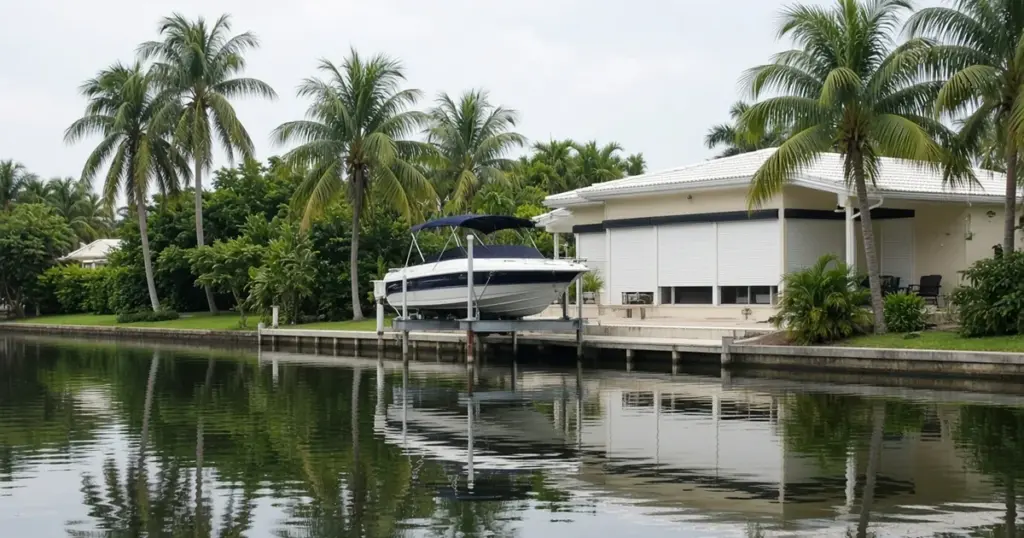
Snowbirds split the year between homes, and their boats often sit for months. A Florida boat may sit through a hot, stormy summer while the owner is up north, or a northern boat may sit through winter while the owner is in Florida. Either way, batteries left without a plan come back dead, damaged or worse. This guide covers how to store boat batteries while you’re away so they’re ready when you return.
Step 1: Where will the boat be?
Your plan depends on where the boat sits.
- In the water (slip or mooring): the bilge pumps need power, so the batteries stay connected to the automatic bilge pump circuit.
- On a lift: check the lift’s guidance. Bilge pumps may not be needed, but rain can collect in the boat if drains clog.
- On a trailer or in dry storage: batteries can be fully disconnected or removed.
- In a rack (dry stack): follow the marina’s rules; many require batteries disconnected.
Step 2: Choose maintain or disconnect
Maintain on shore power
If the boat has reliable shore power and stays in the water:
- Leave a smart charger with a maintenance mode running.
- Turn the main battery switch off, leaving only the bilge pump circuit.
- Make sure the charger is set to the correct profile for each battery.
- Ask someone to check the boat periodically, since chargers can fault and shore power can trip.
The EPOCH 4-bank marine charger can maintain multiple banks.
Disconnect
If the boat is on land or has no reliable shore power:
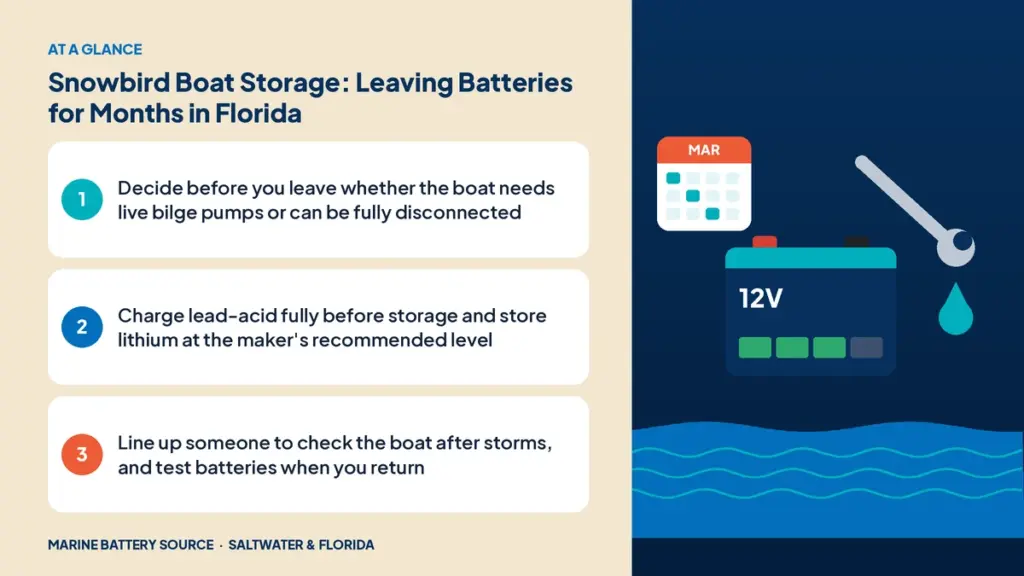
- Charge batteries fully (lead-acid) or to storage level (lithium).
- Disconnect the negative cable on each battery.
- Or remove the batteries and store them in a cool, dry, ventilated place.
State of charge for storage
- Flooded and AGM: store fully charged. They self-discharge over time, faster in heat. A lead-acid battery that drops too low sulfates and loses capacity. Recharge every few months if possible, or keep on a maintainer.
- Lithium (LiFePO4): many manufacturers recommend storing at partial charge, often around 50–70%, and disconnected. Self-discharge is low, so a lithium battery can sit for months. Check your battery’s manual.
Heat in Florida summers
Snowbirds leaving Florida for the summer face months of heat. Heat speeds self-discharge and aging. To reduce it:
- Store removed batteries indoors, off concrete floors and out of direct sun.
- Cover the boat and leave vents open for airflow.
- Choose a shaded storage spot if possible.
Our Florida heat and marine battery life guide and battery compartment heat guide cover heat in more detail.
Hurricane season
Snowbirds who leave in spring miss most of hurricane season, but the boat doesn’t. Before you go:
- Write a storm plan and share it with your marina or a trusted person.
- Arrange for someone to carry it out, including unplugging shore power and checking bilge pumps.
- Read hurricane prep for boat batteries.
Northern winters
If the boat stays up north while you’re in Florida, winter storage rules apply: fully charge lead-acid batteries so they don’t freeze, store lithium at the recommended level and avoid charging lithium below freezing unless it has built-in heating, like the Dakota Lithium heated 12V 135Ah.
Bilge pumps while you’re away
For boats in the water, bilge pumps are the critical load:
- Confirm the automatic float switch circuit works with the main switch off.
- Test the pump and float before leaving.
- Clear cockpit drains and scuppers.
- Consider a high-water alarm.
A bilge pump that runs constantly because of a leak can drain the battery, and then the boat. Someone should check after heavy rain.
Before you leave checklist
- ☐ Decide: maintain or disconnect
- ☐ Charge batteries (full for lead-acid, storage level for lithium)
- ☐ Main switch off, bilge circuit live if in the water
- ☐ Shore power and charger checked, or batteries disconnected
- ☐ Bilge pumps and float switches tested
- ☐ Drains and scuppers cleared
- ☐ Terminals clean and protected
- ☐ Storm plan written and shared
- ☐ Contact person arranged
When you return
- Look for water in the bilge and battery compartments.
- Check batteries for swelling, leaks or corrosion.
- Measure voltage before reconnecting.
- Reconnect and charge fully.
- Load test lead-acid batteries; check lithium state of charge.
- Test bilge pumps, nav lights and electronics.
If a lead-acid battery measures very low after storage, it may have sulfated. Charge it and test. If it fails, replace it.
Parasitic drains
Even with the main switch off, some boats have loads wired directly to the battery: stereo memory, bilge pump float switches, CO detectors, battery monitors and some chargers. Over several months, small drains add up. Before you leave, check what stays connected with the switch off. A simple test is to measure the current between the negative post and the negative cable with everything off. If it’s higher than expected, find the source before you go, or disconnect the battery entirely if the boat is on land.
Removing batteries for storage
If you remove batteries, label each cable before disconnecting so reinstalling is easy. Store batteries on a wooden shelf or plastic tray, not directly on a concrete floor in a damp garage. Keep them away from heaters, flames and anything that could fall on the terminals.
Local tips
Tampa Bay boaters with lifts and canal homes should read the Tampa Bay boat battery guide. Flats anglers can find setup advice in Florida flats fishing power. For the yearly rhythm, see the seasonal boat battery calendar.
Salt
Salt keeps corroding terminals while you’re gone. Clean and protect terminals before you leave. See saltwater corrosion prevention.
Is lithium better for snowbirds?
Lithium’s low self-discharge and tolerance for partial charge make it easier to store. A lithium house or trolling battery like the EPOCH 12V 105Ah can sit disconnected for months with little loss. Browse lithium marine batteries.
Frequently asked questions
Should I leave my boat battery connected while I’m away?
If the boat is in the water and needs bilge pumps, yes, with the main switch off. If it’s on land, disconnect or remove the batteries.
What charge should I store my lithium battery at?
Many manufacturers recommend partial charge, often around 50–70%. Check your battery’s manual.
Can I leave a charger on all summer?
A smart charger with maintenance mode is designed for it, but have someone check periodically in case shore power trips or the charger faults.
Will my battery be dead when I return?
Lead-acid batteries left disconnected in heat can self-discharge significantly over months. Lithium holds charge much better.
Who should check my boat while I’m away?
Your marina, a boat-watch service or a trusted neighbor, especially after storms.