


Power for Florida Flats Fishing: Poling, Trolling and Electronics

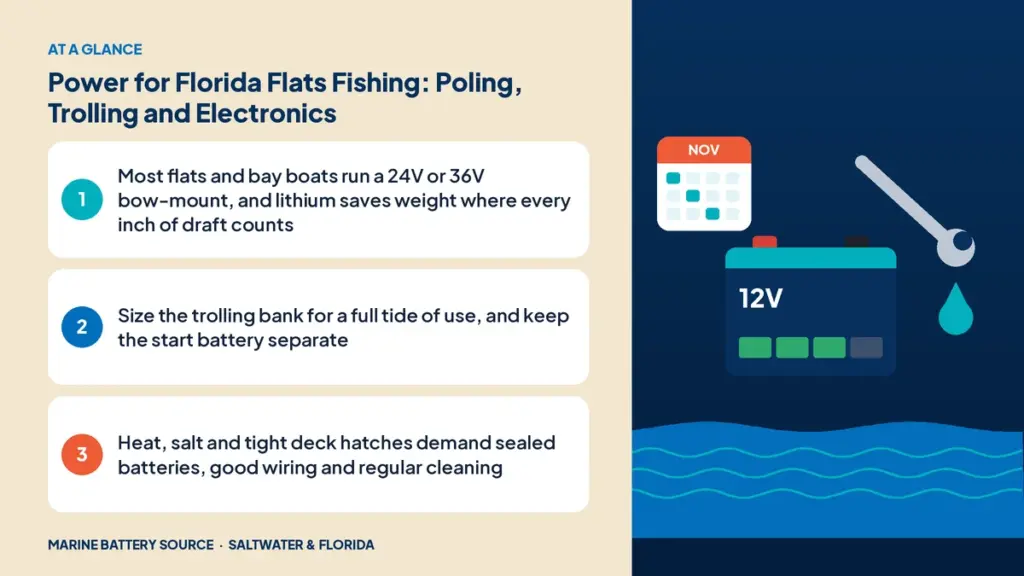
Florida flats fishing is a game of inches and silence. Whether you’re poling the backcountry for redfish, working mangrove shorelines for snook or sight-casting to tarpon, your trolling motor and batteries decide how long you can stay on the fish and how shallow you can float. Heat, salt and cramped hatches make battery choices especially important on flats skiffs and bay boats. Here’s how to set up trolling motor power that lasts a full tide.
How flats boats use power
- Bow-mount trolling motors do the heavy lifting: holding position with GPS anchor modes, moving along shorelines and fighting current in passes.
- Electronics: chartplotters, sonar and sometimes a second display.
- Power-Poles or shallow-water anchors draw short bursts of current.
- Livewells run for hours on a bait day.
- The outboard needs a reliable start battery every time.
Modern GPS-anchor trolling motors can draw significant current on a windy day, holding position against wind and tide for long stretches.
24V or 36V?
| Voltage | Typical motor thrust | Common boats |
|---|---|---|
| 12V | Up to about 55 lb | Kayaks, small skiffs |
| 24V | About 70–80 lb | Smaller bay boats and skiffs |
| 36V | About 100–112 lb | Larger bay boats, heavier skiffs, windy conditions |
Match the battery voltage to your motor. Higher voltage motors draw less current for the same power, which reduces heat in wiring and connections.
Lithium vs lead-acid on the flats
Weight. Three group 31 lead-acid batteries for a 36V system can weigh well over 150 pounds. A single 36V lithium battery of similar usable capacity weighs a fraction of that. Less weight means less draft, easier poling and better hole shot.
Usable capacity. Lithium delivers most of its rated capacity; lead-acid should only be drawn to about half for good life.
Steady thrust. Lithium holds voltage, so the motor pushes as hard late in the day as early.
Space. A single 36V lithium battery takes up much less space in a tight deck hatch than three lead-acid batteries.
Cost. Lithium costs more upfront, but its cycle life is far longer.
Options to compare:
- EPOCH 36V 50Ah Essential for lighter skiffs and moderate days
- EPOCH 36V 100Ah for heavy GPS-anchor use and long days
Sizing for a full tide
Estimate your average current draw. A 36V motor might average 15–25A over a day of mixed use, with spikes higher in wind. Six hours at 20A is 120Ah. That’s more than a 50Ah battery can deliver, so a 100Ah battery, or careful use with a smaller one, is the way to go on long, windy days. Think about your typical day honestly; most anglers underestimate GPS-anchor use.
Keep the start battery separate
Never run the trolling motor from the start battery. Use a dedicated cranking or dual-purpose battery for the outboard and electronics, and a separate trolling bank. A strong cranking option is the EPOCH 12V 172Ah dual-purpose LiFePO4 if you want lithium throughout.
Charging
- Onboard charger: a multi-bank charger with lithium profiles charges both start and trolling banks overnight. The EPOCH 12V/36V onboard lithium charger is built for exactly this setup.
- Charge on the run: a DC-DC charger tops up the trolling bank from the outboard during runs between spots.
- After every trip: charge fully. Lithium tolerates partial charge, but starting the day full matters.
Heat
Flats boats often keep batteries in sealed deck hatches that bake in the sun. Heat shortens battery life and can trigger lithium charge limits. Shade the boat when parked, open hatches to air out when you can and read battery compartment heat for more fixes. Our Florida heat and marine battery life guide covers the bigger picture.
Salt
Flats boats sit low and take spray, and deck hatches leak. Protect the trolling bank:
- Use tinned cable and sealed lugs.
- Protect terminals with dielectric grease or terminal spray.
- Check the bow trolling motor plug for corrosion.
- Rinse the boat gently after each trip.
- See saltwater corrosion prevention.
Wiring the trolling motor
- Use cable sized for the motor’s maximum draw and the round-trip length.
- Fuse or breaker the positive lead near the battery, as the motor maker specifies.
- Secure cables so they don’t chafe in the hatch.
- A connection kit like the Dakota Lithium 36V trolling motor connection kit with on-board charging simplifies the install.
Storms and weather
Afternoon storms on the flats come fast. Watch the sky, head in early and see lightning and boat electrical systems. During hurricane season, check our hurricane prep for boat batteries guide.
Boats that sit
Flats boats owned by snowbirds or occasional anglers often sit for weeks. Disconnect batteries or leave them on a smart maintenance charger. See snowbird boat battery storage.
Poling platforms, jack plates and other loads
Many flats skiffs add hydraulic jack plates, shallow-water anchors and LED lighting. Each one draws from the 12V system, usually the start battery or a small house battery. Jack plates and anchors draw high current in short bursts, so they add little to the daily amp-hour total, but they need cable sized for the peak current and good, clean connections. Livewells are the opposite: low current, but for many hours. On a bait day, a livewell pump running for six hours can use more energy than the outboard’s starter does all week. If you find the start battery getting low by the afternoon, a small dedicated house battery for livewells and electronics is a simple fix.
Weight and balance
On a flats boat, where you put the batteries matters as much as how heavy they are. Three lead-acid batteries in a bow hatch push the bow down and change how the boat poles and drafts. Moving to a single lithium battery can improve both. If you relocate batteries, keep cable runs short, fuse near the battery and secure everything so it can’t shift in a chop.
A typical flats setup
- 12V AGM or lithium start battery for the outboard and electronics
- 36V lithium trolling battery, 50–100Ah depending on use
- 2-bank onboard charger with lithium profiles
- Tinned wiring, fuses near batteries and a sealed bow plug
Shop trolling motor batteries.
Frequently asked questions
What size battery do I need for a flats boat trolling motor?
Match the voltage to your motor, then size capacity for your average day. Heavy GPS-anchor use on windy days often calls for around 100Ah at 36V.
Is lithium worth it on a flats boat?
For most anglers, yes. The weight savings, steady thrust and long life suit flats fishing.
Can I run my trolling motor from my start battery?
No. Keep a separate trolling bank so you can always start the outboard.
How do I keep batteries cool in a deck hatch?
Shade the boat, ventilate the hatch when possible and avoid charging at high current while the battery is hot.
Should I charge my trolling battery after every trip?
Yes. Start each day with a full battery for maximum run time.