


Can a Marine Battery Freeze? Temperature and State of Charge
Yes, a marine battery can freeze, and when it does, it’s usually ruined. But whether it freezes depends almost entirely on its state of charge. A fully charged lead-acid battery is extremely resistant to freezing, while a discharged one can freeze on an ordinary cold night. This guide explains when marine batteries freeze, how to spot freeze damage and how to prevent it.
Why lead-acid batteries freeze
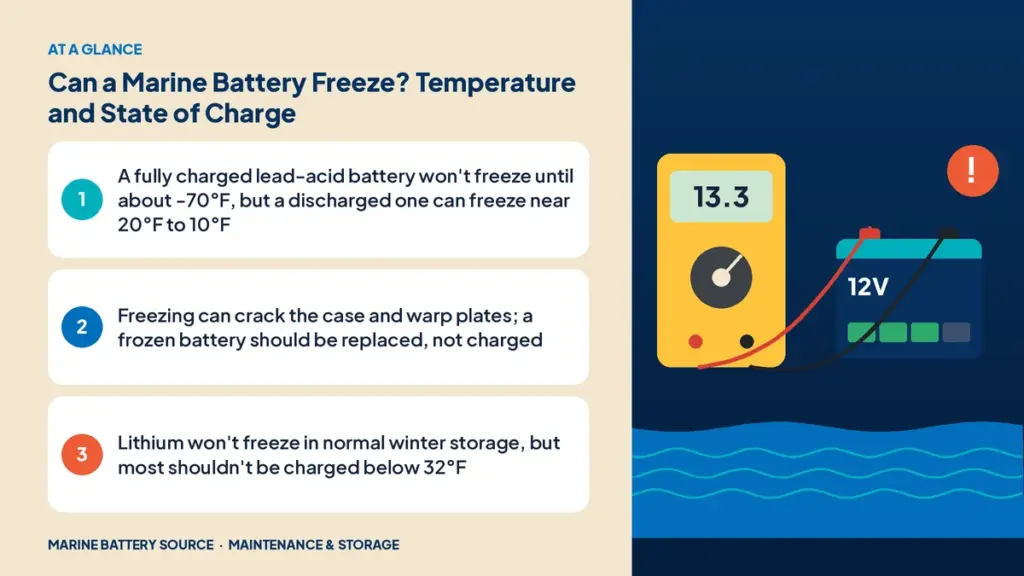
The electrolyte in a lead-acid battery is a mixture of sulfuric acid and water. When the battery is charged, the electrolyte has a high concentration of acid, which has a very low freezing point. As the battery discharges, acid moves into the plates and the electrolyte becomes mostly water, which freezes at a much higher temperature.
Freezing points by state of charge
Approximate freezing points for a 12V lead-acid battery:
- 100% charged (specific gravity about 1.265): about -70°F (-57°C)
- 75% charged (about 1.225): about -35°F (-37°C)
- 50% charged (about 1.190): about -10°F (-23°C)
- 25% charged (about 1.155): about 5°F (-15°C)
- Fully discharged (about 1.120 or lower): about 10°F to 20°F (-12°C to -7°C)
The takeaway: keep lead-acid batteries charged, and freezing is almost never a concern in normal winters.
What freeze damage looks like
- Bulging or cracked case
- Electrolyte leaking
- Visible ice inside cells (flooded batteries)
- Battery won’t take or hold a charge
- Warped or damaged plates (not visible, but causes failure)
What to do if a battery froze
- Don’t charge it. Charging a frozen battery can cause it to rupture or explode.
- Let it thaw slowly in a ventilated area away from people.
- Inspect it. If the case is cracked, bulging or leaking, recycle it.
- Test it after thawing. Even if it looks fine, internal damage is common. A load test will reveal it.
In most cases, a battery that froze should be replaced.
AGM and gel batteries
AGM and gel batteries also contain sulfuric acid electrolyte and follow the same principle: charged batteries resist freezing, discharged ones don’t. AGM is somewhat more resistant to damage because the electrolyte is absorbed in glass mats, but you should still keep them charged.
Lithium batteries
LiFePO4 lithium batteries don’t freeze in the same way, and most can be stored safely down to around -4°F (-20°C) or lower, depending on the maker. The main cold-weather concern with lithium is charging:
- Most LiFePO4 batteries shouldn’t be charged below 32°F (0°C). Charging in the cold can cause lithium plating, permanently damaging cells.
- Many BMS units block charging at low temperatures.
- Heated lithium batteries warm themselves before accepting charge.
Discharging in the cold is generally fine within the maker’s limits, though capacity is temporarily reduced. See how to winterize a lithium battery.
How to prevent freezing
Lead-acid
- Fully charge before storage
- Use a smart maintainer, or recharge every four to six weeks
- Disconnect parasitic loads
- Store indoors in very cold climates
Lithium
- Store at partial charge, disconnected
- Don’t charge below freezing unless heated
- Store indoors if temperatures drop below the maker’s storage limit
Ice fishing and cold-weather use
For anglers who use batteries in the cold, lithium is a strong choice because it holds voltage and capacity better than lead-acid in low temperatures. Heated batteries like the Dakota Lithium 135Ah heated can be charged in the cold. Keep batteries insulated during use, and charge them indoors or let heated models warm up first.
Storing batteries in the boat
If batteries stay in a boat in a cold climate:
- Lead-acid must stay fully charged; a maintainer is best
- Lithium should be disconnected at partial charge
- Make sure no loads can slowly discharge them
See trailer boat battery storage and boat lift and slip battery care.
Trolling motor batteries
Trolling batteries are often discharged after the last trip of the season and left that way, which is exactly when freezing becomes a risk. Charge them fully before storage. See storing trolling motor batteries.
Checking state of charge in winter
For lead-acid, check resting voltage monthly:
- 12.6V or above: safe
- 12.4V: charge soon
- Below 12.2V: charge immediately, especially if a cold snap is coming
Common myths
- “Batteries freeze if stored on concrete.” False. Modern cases aren’t affected by concrete. Temperature and charge level matter.
- “Lithium can’t be used in the cold.” It can be discharged in the cold; it just shouldn’t be charged below freezing unless heated.
- “A frozen battery is fine once thawed.” Usually not. Internal damage is common.
Cold weather and cranking
Even if a battery doesn’t freeze, cold reduces its ability to deliver cranking current. A lead-acid battery at 0°F may deliver only about half its rated capacity, while engine oil thickens and the engine needs more cranking power. That’s why CCA (cold cranking amps) ratings matter for boats used in cold weather. For late-fall or early-spring fishing, choose a starting battery with comfortable CCA margin, keep it fully charged and consider storing it indoors overnight before a cold morning launch. Starting batteries like the Interstate 27M-XHD offer strong cranking for cold starts.
Example: the forgotten trolling bank
An angler finishes the season in late October with three flooded trolling batteries at about 30% charge and leaves them in an unheated pole barn. In January, a cold snap brings temperatures to -5°F. The batteries freeze, two cases bulge, and all three need replacement in spring. The same batteries, charged and on maintainers, would have survived easily. This is one of the most common and preventable battery losses.
For complete storage guidance, see winter storage for marine batteries and our marine battery maintenance guide. Browse our lithium marine batteries.
Frequently asked questions
At what temperature does a marine battery freeze?
A fully charged lead-acid battery freezes at about -70°F. A discharged one can freeze at 10°F to 20°F.
Can I charge a frozen battery?
No. Let it thaw first, inspect it and test it. Charging a frozen battery is dangerous.
Do lithium batteries freeze?
Not in normal winter storage, but most LiFePO4 batteries shouldn’t be charged below 32°F unless they have heating.
Can I leave my boat battery outside in winter?
Only if it’s fully charged and maintained (lead-acid) or disconnected at partial charge within temperature limits (lithium).
How do I know if my battery froze?
Look for a bulging or cracked case, leaks, or a battery that won’t hold a charge.