


Lithium Battery Maintenance: What Still Matters
One of the biggest reasons boaters switch to lithium is that it needs so little maintenance. No watering, no equalizing, no sulfation from sitting partly charged. But “low maintenance” isn’t “no maintenance.” A few good habits will keep a LiFePO4 marine battery performing for thousands of cycles and ten years or more. This guide covers lithium battery maintenance for boats.
What lithium doesn’t need
Compared with flooded lead-acid, you can skip:
- Watering. Lithium batteries are sealed. See how to water flooded batteries for what you’re leaving behind.
- Equalization. The BMS balances cells. Never apply equalization voltage to lithium. See equalizing flooded batteries.
- Hydrometer testing. There’s no liquid electrolyte to test. See battery hydrometer test for lead-acid.
- Worry about partial charge. Lithium doesn’t sulfate, so it’s fine sitting partly charged for a few days.
What lithium does need
The right charger
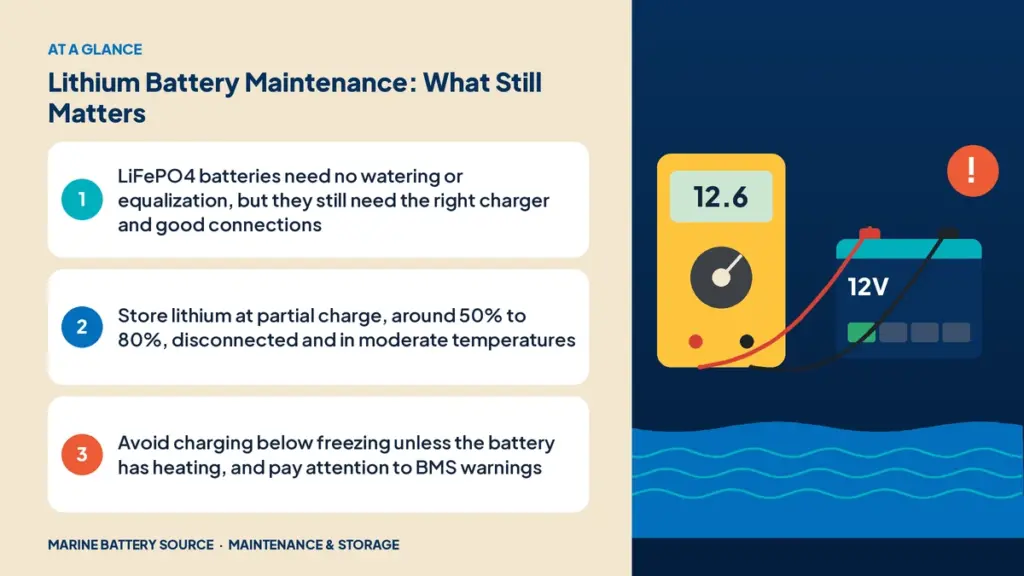
Use a charger with a lithium (LiFePO4) profile, typically absorption around 14.2V to 14.6V for 12V batteries, with little or no float. A lead-acid charger with equalization or a high float voltage can stress the battery or cause the BMS to disconnect. Lithium chargers like the EPOCH 12V 15A lithium charger or the EPOCH 36V 15A lithium charger are designed for this.
Regular full charges
Lithium doesn’t need a full charge every time, but charging to 100% regularly lets the BMS balance the cells and keeps the state-of-charge readout accurate. Many owners charge fully after each trip.
Clean, tight connections
Lithium batteries can deliver high current, so loose or corroded connections heat up quickly. Check terminals monthly in season, torque to the maker’s spec (often lower than lead-acid), and keep them clean and dry.
Temperature awareness
- Charging below freezing (32°F / 0°C) can damage most LiFePO4 cells. Many batteries’ BMS will block charging at low temperature. Heated batteries, like the Dakota Lithium 135Ah heated, warm themselves before accepting charge.
- Discharging in cold is usually fine down to about -4°F (-20°C), with reduced capacity.
- High heat shortens life. Keep batteries shaded and ventilated where possible.
BMS attention
The BMS protects against overcharge, over-discharge, overcurrent, short circuits and temperature extremes. If it disconnects the battery, find out why. Common causes include a load that exceeds the discharge rating, charging in the cold, or a deeply discharged battery. See the marine battery troubleshooting guide.
Storage
For off-season storage:
- Charge to the maker’s recommended storage level, often 50% to 80%.
- Disconnect the battery from all loads, or use the battery’s sleep or storage mode.
- Store in a cool, dry place above freezing if possible.
- Check state of charge every few months. LiFePO4 self-discharges slowly, often 2% to 3% per month.
- Recharge fully before the season.
Don’t store lithium at 100% for long periods in hot conditions, and don’t leave it fully discharged. See winter storage for marine batteries.
Using the battery app
Many lithium batteries have Bluetooth monitoring. Use the app to check:
- State of charge
- Cell voltages (look for imbalance)
- Temperature
- Charge and discharge current
- Cycle count and alerts
A large difference between cell voltages after a full charge may indicate a balancing issue. Contact the manufacturer if it persists.
Cleaning
Wipe the battery case with a damp cloth. Keep terminals dry. Don’t use solvents on the case. Salt residue should be rinsed off the compartment, not the battery itself.
Inspection
Monthly in season:
- Check terminals for tightness and corrosion
- Inspect cables for damage
- Check the hold-down
- Look for swelling, cracks or heat damage on the case
- Review the app for alerts
Lithium in banks
In parallel or series banks:
- Keep batteries the same model, age and capacity
- Charge each battery fully before connecting them into a bank
- Watch for one battery consistently reading differently
- Follow the maker’s limits on series and parallel connections
Lifespan
With proper care, LiFePO4 batteries often deliver 3,000 to 6,000 cycles or more, which can mean ten years or longer on a typical boat. See how long marine batteries last.
A simple lithium maintenance schedule
After each trip
- Recharge, ideally to 100% at least once a week in season
- Glance at the app for alerts
Monthly in season
- Check terminal torque and cable condition
- Look over the case and hold-down
- Compare cell voltages in the app after a full charge
Each season
- Confirm every charging source is still set to the lithium profile
- Check fuses and fuse holders for heat discoloration
- Update firmware if the maker offers app updates
Off-season
- Charge to storage level, disconnect and store above freezing if possible
- Check state of charge every two to three months
Upgrading chargers after a lithium switch
The most common lithium problem isn’t the battery; it’s a charger left on a lead-acid setting. After a conversion, go through the boat and check every source that can charge the battery: the onboard charger, any portable charger, the DC-DC charger and the solar controller. Write the settings down so the next person to touch the system knows what’s there.
Common mistakes
- Using a lead-acid charger without a lithium profile
- Charging below freezing without heating
- Storing fully discharged
- Ignoring BMS shutdowns
- Loose terminals
- Mixing lithium with lead-acid in the same bank
Charging from the engine
Alternators can charge lithium, but a DC-DC charger is usually the best approach to protect the alternator and deliver the right profile. Make sure the DC-DC charger is set for lithium.
Solar and lithium
Solar charge controllers must also be set for lithium. Disable equalization and set the absorption and float voltages to the maker’s recommendations.
For a complete maintenance routine across all battery types, see our marine battery maintenance guide. Browse our lithium marine batteries for upgrades.
Frequently asked questions
Do lithium marine batteries need maintenance?
Very little. Use a lithium charger, keep connections clean and tight, avoid charging below freezing and store at partial charge.
How should I store a lithium battery for winter?
Charge to around 50% to 80%, disconnect it, store it above freezing if possible, and check it every few months.
Can I leave a lithium battery on a charger?
With a lithium charger that stops or drops to a low float when full, yes. Avoid lead-acid chargers that hold a high float or equalize.
Do lithium batteries need to be fully discharged?
No. Lithium has no memory effect. Partial discharges are fine, and regular full charges help the BMS balance cells.
Why did my lithium battery shut off?
The BMS may have disconnected it due to overcurrent, low voltage, high or low temperature, or a fault. Check the app and the conditions.