


Step by Step: Installing a Lithium Battery Bank in a Pontoon
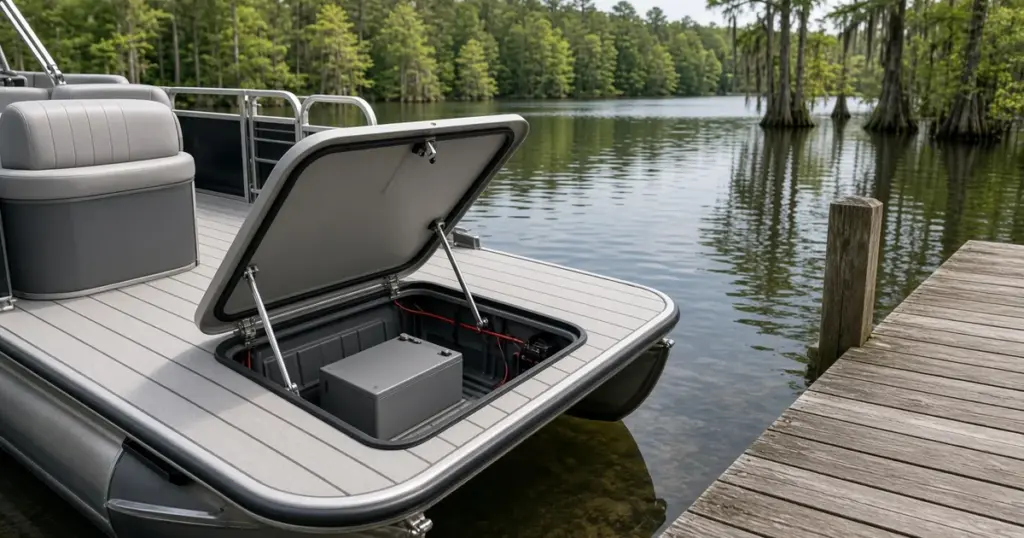
Pontoons have become floating living rooms, with premium stereos, LED lighting, fridges, USB charging and sometimes electric outboards. All that gear puts demands on batteries, and lithium is a natural fit. It’s light, holds voltage under load and handles deep discharges. This guide covers pontoon lithium installation, from choosing the battery to mounting, wiring and charging.
Why lithium on a pontoon
- Runtime. A day of music and lights at the sandbar can drain a lead-acid battery well before sunset.
- Weight. Saving 50 to 100 pounds helps on smaller pontoons.
- Voltage stability. Stereos and amplifiers sound better with steady voltage.
- Longevity. Thousands of cycles vs a few hundred for lead-acid.
- Low maintenance. No watering or equalization.
Choose your system
Starting battery
Many pontoon outboards use a single battery for starting and accessories. A dual-purpose lithium like the EPOCH 12V 172Ah dual-purpose LiFePO4 can handle both if the engine’s cranking requirement fits within the battery’s rating. Check the outboard maker’s guidance on lithium starting batteries.
Separate accessory battery
For heavy stereo and lighting use, a separate accessory battery protects the starting battery. Keep the starting battery as lead-acid or lithium, and add a lithium accessory battery like the EPOCH 12V 105Ah LiFePO4. Charge it with a DC-DC charger from the outboard.
Electric outboards and trolling motors
Electric pontoons and trolling motors often run on 24V, 36V or 48V lithium. Batteries like the EPOCH 48V 100Ah power electric propulsion.
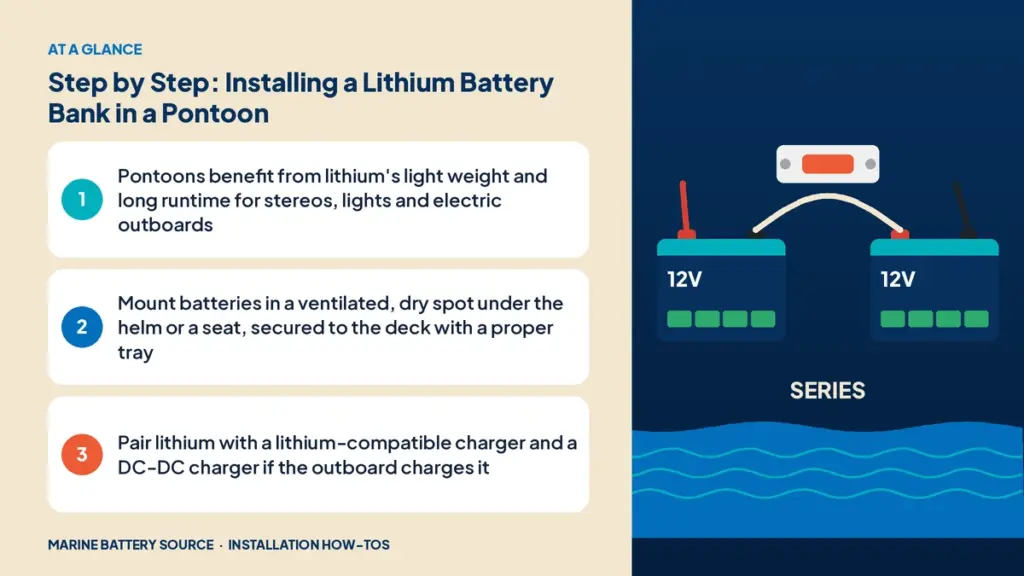
Mounting location
- Under the helm console, near the outboard’s wiring
- Under a seat, with ventilation and access
- In a dedicated battery compartment at the stern
Avoid areas where water collects on the deck. Pontoon decks drain through gaps, but compartments under seats can stay damp.
Mounting the battery
- Choose a solid spot on the deck or a mounting platform.
- Install a tray or box with stainless hardware into the deck’s structure.
- Secure the battery with a strap or bracket.
- Make sure the battery can’t move more than about an inch.
Trays like the Dakota Lithium marine battery tray fit many lithium batteries.
Wiring
Single battery
- Positive from the battery to the main fuse, then the battery switch.
- Switch to the outboard and helm panel.
- Negative to the outboard and a negative bus.
Starting plus accessory battery
- Starting battery feeds the outboard.
- DC-DC charger between the starting battery and the accessory battery.
- Accessory battery feeds the stereo, lights and accessories through a fuse block.
- Separate switches for each battery.
- Common negative bus.
Fusing
Fuse every positive close to the battery. Lithium’s high short-circuit current means you should use fuses with adequate interrupt ratings. Stereo amplifiers need their own fuses at the battery, sized per the amp maker.
Charging
- Shore power: a lithium-compatible onboard charger keeps batteries full between weekends.
- Outboard charging: a DC-DC charger protects the outboard’s charging system and charges lithium properly.
- Solar: a bimini-mounted panel can top up the accessory battery at the dock.
Long cable runs
On larger pontoons, the helm and stern compartments can be 10 to 20 feet apart. Size cables for voltage drop, especially for stereo amplifiers. If the batteries are relocated forward or aft, see how to relocate a boat battery.
Tools you’ll need
A heavy-duty crimper, cable cutter, torque wrench and multimeter. See marine electrical tools.
Cold weather and storage
Most LiFePO4 batteries can’t be charged below freezing unless they have heating. For winter storage, charge to the maker’s recommended storage level and disconnect.
Sizing the accessory battery
Add up what you run and for how long:
- Stereo head unit and amplifier: 5A to 30A depending on volume and amp size
- LED deck and underwater lights: 2A to 10A
- Fridge or powered cooler: 3A to 5A while the compressor runs
- USB charging and small electronics: 1A to 3A
- Fish finder: 1A to 2A
A pontoon running a mid-size amp at moderate volume, LED lights and a fridge for six hours might use 60Ah to 90Ah. A 100Ah lithium covers that with margin, while a 100Ah lead-acid would be pushed well past the 50% discharge it should stay above. If you play music loud all afternoon, step up to a larger battery or two in parallel.
Wiring stereo amplifiers
Big amplifiers deserve special attention. Run the amp’s positive and negative directly to the accessory battery or a heavy busbar, not through the helm’s switch panel. Fuse the positive at the battery with the size the amp maker recommends, and size the cable for both current and length. A remote turn-on lead from the head unit switches the amp, so it doesn’t need a heavy-duty switch in the power cable. Voltage drop on a long run to the stern is a common cause of amps cutting out at high volume.
Keeping the starting battery safe
If both batteries share a negative and a DC-DC charger, the starting battery stays isolated from the accessory loads. Label the switches clearly so guests don’t turn the starting battery off or leave everything on overnight.
Common mistakes
- Using a lead-acid charger on lithium.
- No hold-down because the battery is lighter.
- Stereo amp wired directly to the battery without a fuse.
- Undersized cables on long runs.
- Connecting lithium and lead-acid in parallel.
Comparing with other boat types
Bass boat installs focus on trolling banks; see 36V lithium install on a bass boat. Sailboat house banks are larger projects; see installing a sailboat house bank.
For general steps, see how to install a marine battery, DIY vs professional installation and our trolling motor power system guide.
Example: sandbar-ready pontoon
A 22-foot pontoon with a 115hp outboard, a 600W amplifier, LED lighting and a fridge. The owner keeps the lead-acid starting battery for the outboard, adds a 12V 105Ah lithium accessory battery under the helm, and installs a 20A DC-DC charger between them. A fuse block feeds the amplifier, lights and fridge. On a six-hour sandbar day, the accessory battery handles everything, and the starting battery is untouched.
Frequently asked questions
Can I put a lithium battery on my pontoon?
Yes. Check that your outboard supports lithium starting batteries if using it for cranking, and use a lithium-compatible charger.
Do I need a second battery on my pontoon?
If you run a big stereo or lots of accessories, a separate accessory battery protects your starting battery.
Where should I mount a pontoon battery?
Under the helm, under a seat or in a stern compartment, secured and protected from water.
Can my outboard charge a lithium battery?
Use a DC-DC charger between the starting battery and the lithium battery to charge it correctly and protect the outboard.
How long will a lithium battery run my pontoon stereo?
It depends on the amp’s draw and volume. A 100Ah lithium battery can often run a typical stereo for many hours.