


Circuit Breaker vs Fuse on a Boat
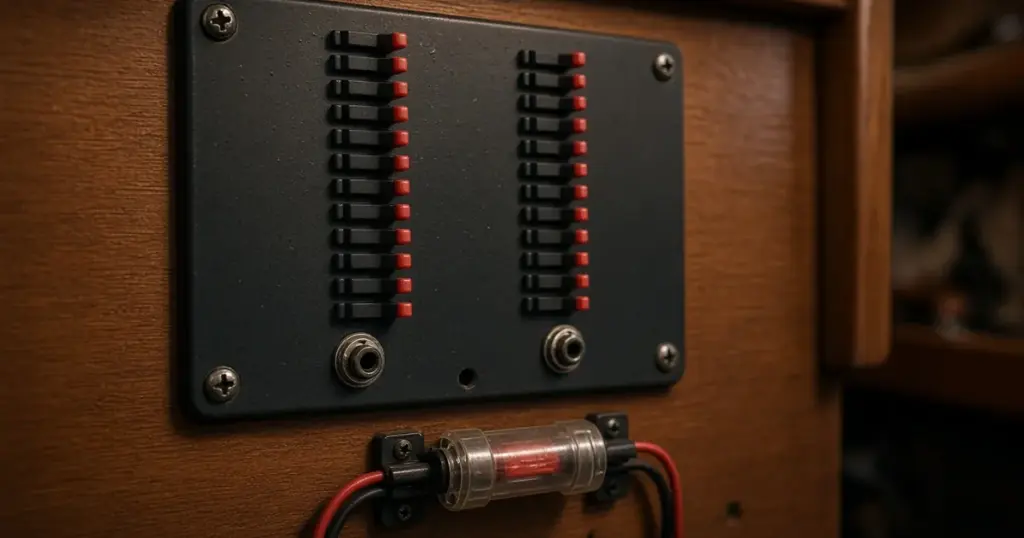
Every circuit on a boat needs overcurrent protection, and the choice usually comes down to a fuse or a circuit breaker. Both open a circuit before the wire overheats, but they work differently, cost differently and suit different parts of the system. Choosing the right one for each location makes a boat safer and easier to live with. This guide compares circuit breakers and fuses on a boat and explains where each one fits best.
What both devices do
A fuse or breaker protects the wire downstream of it. When current exceeds a safe level for that wire, the device opens the circuit before the insulation can overheat or catch fire. Neither one protects the device at the end of the wire; that’s what the device’s own internal protection is for. The core sizing rule is the same for both: rate it above the load’s normal current and at or below the wire’s ampacity. Our marine battery fuse guide covers the sizing method in detail.
How a fuse works
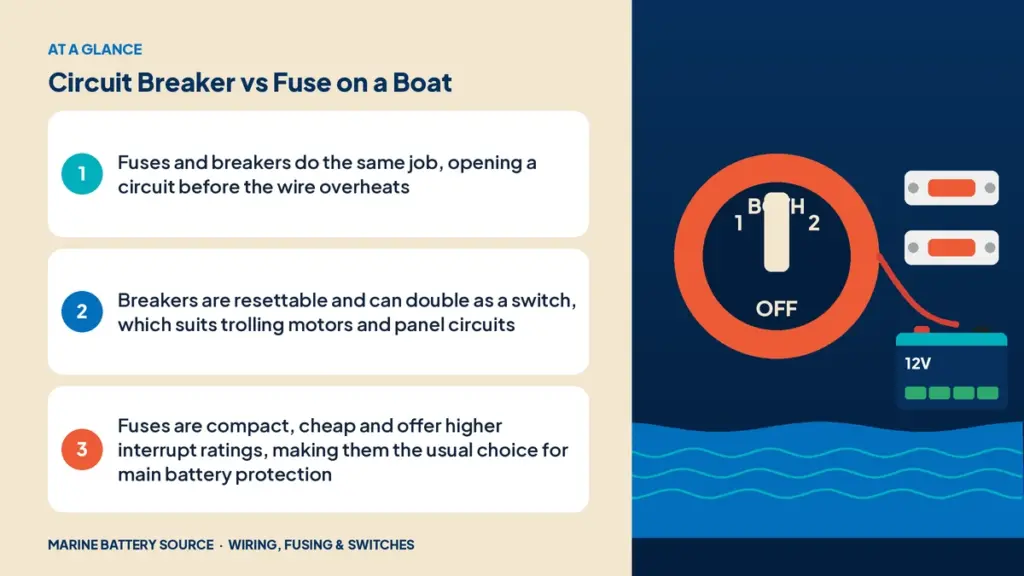
A fuse contains a metal element designed to melt at a specific current. When current goes over the rating long enough, the element melts and the circuit opens. You replace the fuse after finding and fixing the cause.
Pros:
- Inexpensive and compact
- No moving parts to wear or corrode
- High interrupt ratings available, especially MRBF and Class T types
- Simple and very reliable
Cons:
- Must be replaced after it blows, so you need spares aboard
- No built-in way to switch the circuit off
- Easy to replace with the wrong size in a hurry
How a circuit breaker works
A breaker uses a thermal or magnetic mechanism (or both) to trip open when current exceeds its rating. You reset it with a lever, button or switch once the problem is fixed.
Pros:
- Resettable, with no spares to carry
- Many can be used as an on/off switch for the circuit
- Visible trip indication
- Popular for trolling motors because a nuisance trip can be reset on the water
Cons:
- Bulkier and more expensive than fuses
- Mechanical parts can corrode in a wet environment
- Lower interrupt ratings in many models
- Some cheap breakers trip inconsistently with heat or vibration
DC ratings matter
DC current is harder to interrupt than AC because it doesn’t pass through zero 120 times a second. A breaker or fuse rated only for AC may not safely break a DC fault. On a boat, use devices specifically rated for DC at your system voltage. A breaker rated for 12V DC isn’t suitable for a 36V trolling motor circuit. Check the label for the DC voltage rating and interrupt capacity.
Where fuses work best
- Main battery protection. Terminal-mounted fuses put protection right at the battery post. See our MRBF terminal fuse guide.
- Large lithium banks and inverters, where high interrupt ratings are needed. Class T fuses are often specified here.
- Charger and DC-DC charger leads near the battery.
- Branch circuits at a fuse block, especially on smaller boats.
The marine-rated 300A battery fuse and the MRBF fuse block are typical main-feed hardware.
Where breakers work best
- Trolling motors. Most manufacturers recommend a breaker of a specific size, often 50A or 60A, mounted near the battery. Being able to reset it on the water is a real advantage.
- Switch panels. Breaker panels combine protection and switching for lights, pumps and electronics.
- Windlasses and thrusters, where a breaker doubles as an isolation switch.
- Circuits you want to shut off easily without a separate switch.
Can a breaker replace a battery switch?
For a single circuit like a trolling motor, a breaker often acts as its disconnect. For the boat’s main system, a breaker isn’t a substitute for a proper battery switch or battery disconnect switch. A main switch is rated to carry full system current, including the engine starter. On dual-battery boats, the dual battery switch handles battery selection while fuses or breakers protect each cable.
Trolling motor circuits: breaker or fuse?
Both work. The motor maker’s manual usually specifies which, and what size.
- Breaker: resettable after a weed-snag overload, doubles as a disconnect for charging or storage.
- Fuse: smaller, cheaper and very reliable, often in an MRBF holder on the battery.
Many anglers use a breaker mounted near the batteries in the compartment, with the motor plug and cables sized as the manual specifies. Connection kits like the Dakota Lithium 36V trolling motor connection kit bundle the wiring for a clean install.
Nuisance tripping
A breaker that trips often isn’t always undersized. Common causes:
- The motor or load drawing more than expected because of weeds, a fouled prop or a failing motor
- Heat in a hot compartment lowering a thermal breaker’s trip point
- Loose or corroded connections at the breaker terminals
- A breaker rated lower than the motor maker’s recommendation
Don’t just install a bigger breaker. Check the load, the connections and the wire size first.
Sizing example
A 24V trolling motor with a maximum draw of 42A, wired with 8 AWG cable:
- Load current: 42A max.
- Wire ampacity: well above 50A for 8 AWG in most conditions.
- Choose a 50A breaker or fuse, which matches common manufacturer recommendations.
If the cable run is long, upsize the wire for voltage drop, and the breaker size stays the same.
Maintenance
- Fuses: check holders for corrosion and heat discoloration. Carry spares.
- Breakers: exercise them a few times a season by tripping and resetting. Check terminals for corrosion and tightness.
- Both: keep them dry and covered, and re-torque connections annually.
Quick decision guide
- Main battery cable: fuse (MRBF or Class T)
- Trolling motor: breaker or fuse, per the motor maker
- Panel circuits: breaker panel or fuse block
- Inverter feed: fuse (Class T for large lithium banks)
- Charger output: fuse
For full wiring layouts, see our marine battery wiring guide and the marine battery safety guide.
Frequently asked questions
Is a circuit breaker better than a fuse on a boat?
Neither is better everywhere. Fuses are best for main battery protection and high-current lithium systems. Breakers are best for trolling motors and switch panels where resetting and switching are useful.
What size breaker do I need for my trolling motor?
Use the size in your trolling motor’s manual. Many 24V and 36V motors call for a 50A or 60A breaker.
Can I use an automotive breaker on a boat?
Only if it’s rated for DC at your system voltage and suitable for the marine environment. Ignition-protected devices are required in gasoline engine spaces.
Why does my trolling motor breaker keep tripping?
Check for weeds or a fouled prop, a failing motor, loose connections, heat in the compartment, or a breaker smaller than recommended.
Do I still need a main fuse if I have a breaker panel?
Yes. The cable from the battery to the panel needs its own protection close to the battery.