


Marine Battery Fuses: MRBF, ANL and Class T Explained
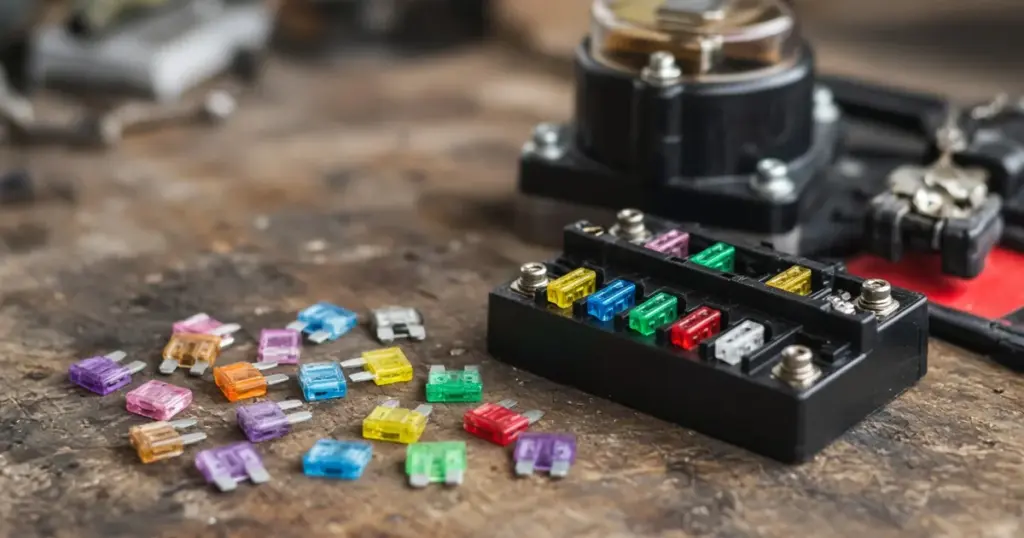
A battery can deliver thousands of amps into a short circuit. Without a fuse, a chafed cable or a dropped wrench can turn a battery cable into a heating element in seconds, melting insulation and starting a fire. A properly sized and placed fuse is the cheapest safety device on any boat. This marine battery fuse guide covers what fuses protect, how to size them, which types to use and where to install them.
What a fuse actually protects
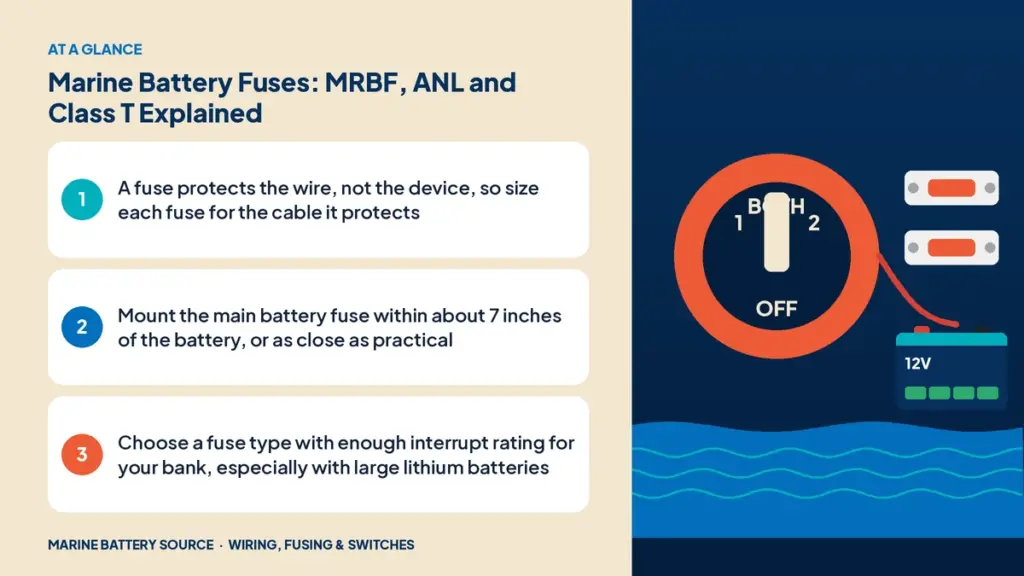
The most important rule of fusing: a fuse protects the wire, not the device. Its job is to open before the cable it protects gets hot enough to damage insulation or start a fire. That means:
- Each fuse is sized for the wire downstream of it.
- If a 10 AWG wire is protected by a 150A fuse, the wire can burn long before the fuse blows.
- A device that needs its own protection usually has an internal fuse or a manufacturer-specified fuse, in addition to the wire fuse.
Where fuses are required
On a boat, every positive conductor connected to a battery should be protected near its source. In practice:
- Main battery cable: fused close to the battery positive.
- Charger and DC-DC charger outputs: fused near the battery end.
- Inverter feed: fused near the battery with a fuse sized for the inverter cable.
- Trolling motor feed: fused or protected by a breaker near the battery.
- Branch circuits: each one fused at the fuse block or breaker panel.
- Any wire to a busbar or distribution point: fused where it leaves the battery.
ABYC recommends overcurrent protection within 7 inches of the battery for most conductors, or within 72 inches if the conductor is sheathed or protected along that run. Closer is always better.
Sizing a fuse
- Find the wire’s ampacity. Look up the cable’s rated current for its gauge, insulation temperature rating and whether it runs in an engine room or bundle. Our cable size guide includes ampacity tables.
- Find the load’s maximum continuous current. For a trolling motor, that’s the manufacturer’s max draw; for an inverter, its continuous rating divided by battery voltage, plus inefficiency.
- Choose a fuse above the load current but at or below the wire’s ampacity. The fuse must not blow during normal operation and must blow before the wire overheats.
- Follow manufacturer recommendations. Trolling motor and inverter makers often specify a fuse or breaker size.
Example: a 36V trolling motor drawing 56A max on 6 AWG wire. A 60A fuse or breaker sits above the motor’s draw and well within the wire’s ampacity.
Common marine fuse types
- MRBF (marine rated battery fuse): mounts directly on the battery terminal stud. Compact, sealed, and rated from roughly 30A to 300A. Ideal for close-to-battery protection. Our MRBF terminal fuse guide goes deeper.
- ANL: a bolt-down fuse in a holder, common in high-current DC systems. Lower interrupt rating, so it may not be enough for large lithium banks on its own.
- MEGA/AMI: bolt-down fuses for mid to high current, compact and common in chargers and distribution.
- Class T: very high interrupt rating, often 20,000A or more. Often recommended for large lithium house banks and inverters.
- ATC/ATO blade fuses: for branch circuits, usually up to 30A, in a fuse block.
- Circuit breakers: resettable protection, popular for trolling motors and panel circuits. See circuit breaker vs fuse on a boat for the trade-offs.
Interrupt rating: the spec most people miss
A fuse’s interrupt rating (also called AIC) is the maximum fault current it can safely stop. If a short-circuit current is higher than that rating, the fuse can arc across and keep conducting, which defeats the point.
Lithium batteries can deliver very high short-circuit current, much higher than a lead-acid battery of the same size. A large LiFePO4 bank can exceed the interrupt rating of an ANL fuse. That’s why lithium manufacturers often specify an MRBF on each battery or a Class T fuse on the main feed. The marine-rated 58V 300A battery fuse is a common main-cable choice for lithium systems, and the MRBF fuse block lets you protect several cables at one point.
Voltage rating
Fuses have a maximum voltage rating too. A fuse rated for 32V isn’t suitable for a 36V or 48V system. When fusing a 36V trolling bank or a 48V system, check that the fuse and holder are rated for at least the system voltage. Many marine fuses are rated 58V for this reason.
Where to mount the main fuse
- As close to the battery positive as possible. A terminal-mounted MRBF is the closest option.
- Before the battery switch, so the cable from the battery to the switch is protected.
- Accessible, but protected from water and accidental contact. Use covers.
- Secured so it can’t move. A loose fuse holder can chafe through cable insulation.
The typical order is: battery positive, main fuse, battery switch, then the positive busbar or fuse block, with each branch fused separately.
Fusing multiple batteries
- Starting and house batteries: each battery’s positive cable needs its own fuse near that battery. The exception many systems make is the starter motor cable, which some standards allow to remain unfused because of the huge current it carries, but follow your engine and boat builder’s guidance.
- Parallel banks: fuse the main positive leaving the bank. For lithium, consider a fuse on each battery’s positive so one failed battery can’t be fed by the others.
- Series trolling banks: fuse the bank’s main positive output near the batteries, sized for the trolling motor cable.
When you add a second battery to a boat, the link cable to the ACR, isolator or DC-DC charger needs a fuse at each battery end.
Branch circuit fusing
Branch circuits run from a fuse block or breaker panel to individual loads. Size each fuse for the branch wire, not the whole system. A 16 AWG wire to a nav light gets a small fuse, while a 10 AWG wire to a livewell pump gets a larger one. Use the correct wire colors so you can trace circuits later; our marine wire color codes guide lists the standard colors.
Signs of a fuse problem
- Blown fuses repeatedly: a short, undersized fuse, or a load drawing more than expected. Don’t just upsize the fuse; find the cause.
- Hot fuse holder: a loose or corroded connection. Clean and retorque.
- Melted or discolored holder: replace it and check the cable and lugs.
- Intermittent power: a corroded fuse contact or cracked holder.
Carry spares
Keep spare fuses of each size on board, along with the tool to change them. A blown trolling motor fuse is a short day on the water without one. You’ll find fuses, fuse blocks and connection kits in our marine battery accessories.
Quick fusing checklist
- Every positive cable from every battery has a fuse near the battery.
- Each fuse is sized for the wire it protects.
- Fuse voltage rating meets or exceeds system voltage.
- Interrupt rating is high enough for your battery chemistry and bank size.
- Fuses and holders are mounted, covered and accessible.
- Spares are on board.
For the full picture, see our marine battery wiring guide and the marine battery safety guide.
Frequently asked questions
What size fuse do I need for my battery?
Size the fuse for the cable it protects. Choose a fuse above the load’s maximum current and at or below the cable’s ampacity, and follow the equipment manufacturer’s fuse recommendation if there is one.
How close to the battery should the fuse be?
ABYC calls for overcurrent protection within about 7 inches of the battery for most cables. A terminal-mounted MRBF fuse is the simplest way to achieve that.
Do lithium batteries need special fuses?
They need fuses with a high enough interrupt rating for their short-circuit current. MRBF and Class T fuses are common choices. Many ANL fuses don’t have enough interrupt rating for a large lithium bank.
Can I use a circuit breaker instead of a fuse?
Yes, for many circuits, especially trolling motors. Make sure the breaker is rated for DC, for the system voltage, and has enough interrupt capacity.
Why does my trolling motor fuse keep blowing?
The fuse may be undersized for the motor’s maximum draw, there may be a short or chafed wire, or the motor may be drawing extra current due to weeds, a fouled prop or a failing motor. Find the cause before upsizing.