


Smart External Regulators for Lithium House Banks
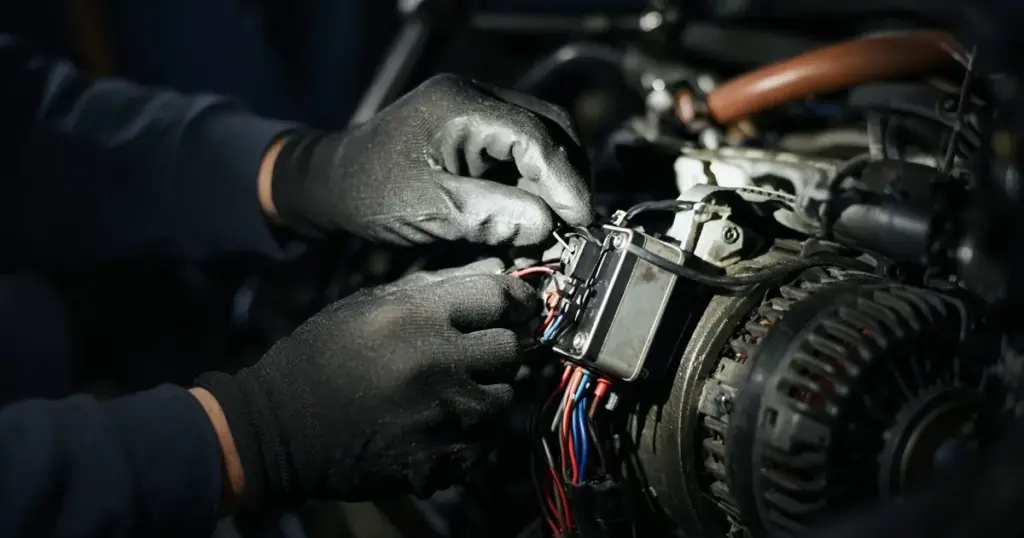
Large lithium house banks can absorb huge amounts of current, which makes them wonderful for fast charging and difficult for alternators. On cruising boats with inboard diesels, an external alternator regulator is the most powerful way to charge lithium from the engine. This guide explains what external regulators do, why they matter for lithium, and how they compare to DC-DC chargers.
Why stock regulators fall short
Most alternators have an internal regulator set to a fixed voltage designed for lead-acid starting batteries. They lack:
- Multi-stage profiles suitable for house banks.
- Battery temperature sensing for lead-acid compensation.
- Alternator temperature sensing to protect the alternator.
- Programmable current limits.
With lithium, the alternator may run at full output for long periods because lithium accepts current until nearly full. That heats the alternator, sometimes to the point of failure.
What an external regulator does
An external regulator controls the alternator’s field current to manage its output:
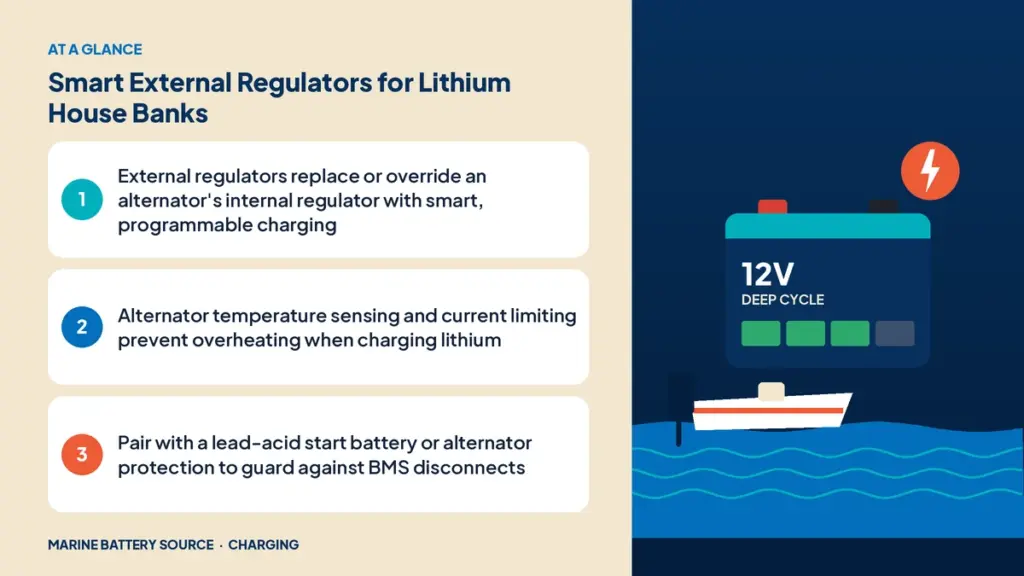
- Lithium charge profile with programmable absorption voltage and time, and float or stop behavior.
- Alternator temperature sensor that reduces output when the alternator gets hot.
- Belt and current management to limit output to what the alternator and belt can sustain.
- Battery voltage sensing at the bank for accurate charging.
- BMS communication on some systems, allowing the battery to request reduced charging or a stop.
External regulator vs DC-DC charger
| Factor | External regulator | DC-DC charger |
|---|---|---|
| Charging current | Up to alternator capacity | Limited to charger rating |
| Alternator protection | Temperature sensing and limits | Current limited by charger |
| Installation | More complex; may need alternator modification | Simpler |
| Typical boats | Cruisers with large banks and inboards | Smaller boats, outboards |
For outboards and smaller boats, a DC-DC charger is usually simpler and safer. See what a DC-DC charger is and alternator charging lithium.
Alternator compatibility
External regulators work with alternators that have an accessible field connection. Some alternators require modification to use an external regulator. Many cruisers upgrade to a high-output, externally regulated alternator, sometimes with a larger pulley and serpentine belt to handle higher loads. Work with a qualified marine electrician.
Protecting against BMS disconnects
If a lithium battery’s BMS opens while the alternator is charging, the alternator can produce a damaging voltage spike. Protection strategies:
- Keep a lead-acid starting battery connected to the alternator output as a buffer.
- Use an alternator protection device that absorbs transients.
- Integrate the regulator with the BMS so it reduces charging before a disconnect.
- Follow the battery and regulator makers’ recommendations.
Setting up the profile
- Use the lithium battery maker’s recommended absorption voltage, often around 14.0V to 14.4V for 12V LiFePO4.
- Set a short absorption time or a current-based end of charge.
- Set float low or disable it, per the battery maker.
- Set alternator temperature limits and current derating.
- Consider a reduced-output “small engine” or idle mode if the engine is small for the alternator.
Battery and fuse considerations
Large lithium banks, such as two EPOCH 12V 460Ah V2 Elite batteries in parallel, can deliver very high fault current. Fit a Class T fuse close to the bank, size cables for alternator output and loads, and follow the battery maker’s limits for charge current.
Combining with other sources
External regulators handle engine charging; solar, wind and shore chargers handle the rest. Set all sources to compatible voltages. See charging on the water, wind and hydro generators and solar charging for small-boat applications.
Liveaboard example
A 42-foot cruising sailboat has a 920Ah lithium house bank, an AGM starting battery and a 40 hp diesel. The owner fits a 150A externally regulated alternator with temperature sensing, derated to about 100A continuous. Running the engine for an hour adds roughly 90Ah to 100Ah, with 600W of solar supplying the rest on sunny days. See the liveaboard sailboat battery guide for a full energy budget.
Installation overview
A typical installation includes the regulator, an alternator temperature sensor bolted to the alternator case, a battery temperature or voltage sensing lead at the house bank, a field wire to the alternator and a switched power or ignition feed. The regulator is usually mounted in a dry spot near the engine, but away from the hottest areas. Many regulators can be configured through a display, dip switches or a phone app. After installation, test under real conditions: run the engine at cruising rpm with the bank partly discharged and watch alternator temperature and output over 30 to 60 minutes. Adjust current limits if the alternator runs too hot.
Monitoring the system
A battery monitor on the house bank shows charging current, state of charge and how long the alternator runs at full output. Some regulators and lithium batteries share data over a network, letting the regulator respond to the battery’s state directly. Even without integration, monitoring lets you spot problems such as a slipping belt, a failing temperature sensor or a bank that never reaches full charge.
Choosing batteries for engine charging
Lithium batteries built for house banks, such as EPOCH and Battle Born LiFePO4 models, publish maximum charge currents. Make sure your regulator’s current limit stays under the bank’s combined limit, and that cables and fuses are rated for the alternator’s maximum output.
Common mistakes
- Running a high-output alternator at full current without temperature sensing.
- Connecting the alternator directly to lithium with no buffer or protection.
- Using lead-acid profiles that hold lithium at high voltage.
- Undersized belts that slip and wear under higher loads.
Is it worth it?
For boats with large lithium banks and regular engine use, yes. For boats that rarely run the engine or have smaller banks, a DC-DC charger may give most of the benefit with less complexity. Read charging lithium batteries on a boat and browse house bank batteries in the store.
Frequently asked questions
What is an external alternator regulator?
A smart regulator that controls the alternator’s output with programmable profiles, temperature sensing and current limits.
Do I need an external regulator for lithium?
Not always. Smaller systems often use a DC-DC charger instead. Large banks with inboard engines benefit most.
Can an external regulator damage my alternator?
Set correctly, it protects the alternator with temperature sensing and current limits. Poor setup can overwork it.
How do I protect my alternator if the BMS disconnects?
Keep a lead-acid buffer battery connected, use alternator protection and follow maker guidance.