


Charging on the Water: Alternators, DC-DC and Solar
Shore power is easy: plug in and let the charger work. Out on the water, charging is a different problem. Your batteries are being used, and the only sources of energy are the engine, the sun, the wind and the boat’s own motion through the water. This guide covers every way of charging boat batteries while underway, how they compare, and how to build a system that keeps up with your loads.
Why charging on the water matters
- Trolling banks can be drained in a day and recharged only partly before the next.
- House banks on cruising boats power fridges, lights and electronics around the clock.
- Starting batteries must stay full so the engine always starts.
- On multi-day trips, charging underway or at anchor is the only way to keep going.
The engine alternator
Every inboard and most outboard engines have a charging system. Outboard charging outputs range from a few amps on small engines to 50A or more on large ones. Inboard alternators often produce 50A to 150A or more.
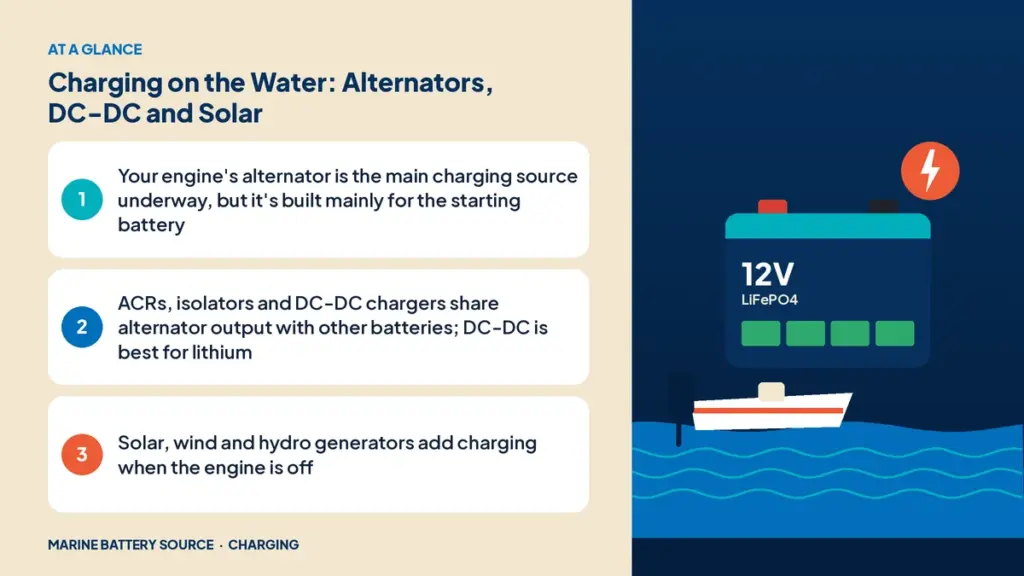
The alternator’s voltage regulator is usually designed for lead-acid starting batteries. That works well for the cranking battery, but sharing that output with other batteries, especially lithium, needs the right hardware. See charging lithium from an alternator.
Sharing alternator output
Battery switch
A manual switch set to “Both” while running connects all batteries to the alternator. It’s simple but relies on remembering to switch back, and it isn’t suitable for mixing lithium and lead-acid.
Automatic charging relay (ACR)
An ACR connects batteries when it senses charging voltage and separates them when voltage falls. It protects the starting battery from being drained by house loads. Best suited to batteries of the same chemistry.
Diode isolator
An isolator lets current flow from the alternator to each battery but not between batteries. Traditional diode isolators cause a voltage drop, which can undercharge batteries unless the regulator compensates.
DC-DC charger
A DC-DC charger draws from the starting battery and charges a second battery with its own profile, current limit and voltage, including higher voltages for 24V or 36V trolling banks. It’s the preferred option for lithium. See what a DC-DC charger is and ACR vs isolator vs DC-DC for comparisons.
Charging trolling batteries while running
Many anglers want the outboard to top up their trolling batteries between spots. A DC-DC charger like the EPOCH 12V to 36V DC-DC charger draws from the 12V starting system and charges a 36V lithium trolling battery. Expect a top-up, not a full recharge, on a typical day. See charging trolling batteries while running.
Solar power
Solar panels charge batteries silently whenever there’s daylight, with or without the engine. They’re ideal for:
- Maintaining batteries on moored or lift-kept boats.
- Offsetting fridge and electronics loads at anchor.
- Topping up trolling batteries between fishing days.
A panel’s real-world daily output depends on size, sun angle, shading and weather. As a rough rule, each 100W of panel produces about 25Ah to 35Ah per day at 12V in good sun. See boat solar panel sizing, MPPT vs PWM charge controllers and solar for trolling motor batteries.
Wind and hydro generators
Cruising sailors often add wind generators, which charge day and night when there’s wind, and hydro generators, which spin a propeller in the water while sailing. Each has strengths for long passages and windy anchorages. See wind and hydro generators for cruisers.
Higher-output alternator charging
Cruising boats with large lithium house banks often upgrade to a high-output alternator with an external smart regulator. That allows faster charging with temperature sensing and lithium-appropriate voltages. See external alternator regulators for lithium.
Comparing charging sources
| Source | Works when | Typical output | Best for |
|---|---|---|---|
| Outboard alternator | Engine running | 5–50A+ | Starting battery, top-ups |
| Inboard alternator | Engine running | 50–150A+ | House and starting banks |
| DC-DC charger | Engine running | 10–50A | Lithium or second banks |
| Solar | Daylight | 25–35Ah per day per 100W | Maintenance, anchor loads |
| Wind generator | Wind | Varies widely | Cruising at anchor |
| Hydro generator | Sailing | Varies with speed | Offshore passages |
Building a system for your boat
- Estimate daily energy use for each battery or bank.
- List charging sources you have: engine hours, solar space, wind exposure.
- Match chemistry: use DC-DC charging and lithium profiles for lithium banks.
- Fuse every connection close to the battery.
- Monitor: a battery monitor shows whether you’re keeping up.
For lithium-specific guidance across all sources, read charging lithium batteries on a boat.
Example systems
- Bass boat: outboard charges the AGM cranking battery; a 12V-to-36V DC-DC charger tops up a 36V lithium trolling battery.
- Pontoon: outboard and ACR charge two AGM batteries; a small solar panel on the bimini maintains them between weekends.
- Cruising sailboat: alternator with external regulator, 400W of solar and a wind generator keep a lithium house bank full at anchor.
Lithium batteries make charging on the water easier
Lithium batteries accept charge quickly and efficiently, with little of the slow absorption stage that lead-acid needs. That means every amp from an alternator, DC-DC charger or solar panel goes further. A short run between fishing spots or a few hours of sun can put a meaningful amount of energy back into a lithium bank, while a lead-acid bank at 80% state of charge would accept only a trickle. For boats that rely on charging away from the dock, lithium batteries and a DC-DC charger are a strong combination. Dual-output units such as the EPOCH dual-output 12V/36V DC-DC charger can top up both a 12V accessory battery and a 36V trolling battery from one engine.
Monitoring your charging
A battery monitor or Bluetooth battery app shows charging current in real time. Watching it underway tells you how much each source is contributing and whether a connection or fuse is limiting output.
Common mistakes
- Expecting an outboard to fully recharge a drained trolling bank on a short run.
- Paralleling lithium and lead-acid through a switch or ACR.
- Undersized cables between alternator, DC-DC charger and batteries.
- Shaded solar panels producing a fraction of their rating.
Browse chargers and DC-DC chargers in the store.
Frequently asked questions
Can my outboard charge my trolling motor batteries?
Yes, through a DC-DC charger or, for matched lead-acid systems, an ACR. Expect a top-up rather than a full recharge.
What’s the best way to charge lithium batteries underway?
A DC-DC charger, or an alternator with an external regulator set for lithium on larger boats.
How much solar do I need on my boat?
Estimate daily energy use and divide by about 25Ah to 35Ah per 100W of panel in good sun.
Do I need a wind generator?
Mostly for cruisers spending long periods at anchor in windy areas. Most trailered boats don’t need one.