


Canoe Trolling Motor Batteries: Light Setups That Last

A small electric trolling motor turns a canoe into a quiet, efficient fishing or exploring platform, and it extends your range far beyond what paddling allows. But canoes are narrow, tippy and weight-sensitive, so the battery choice matters more than in almost any other boat. This canoe trolling motor battery guide covers sizing, chemistry, placement, mounting and charging.
How canoe trolling motors are mounted
- Side mounts: a bracket clamps across the gunwales, usually near the stern, and the motor hangs off one side.
- Square-stern canoes: a small transom accepts a clamp-on motor directly.
- Bow mounts are rare on canoes but possible with custom brackets.
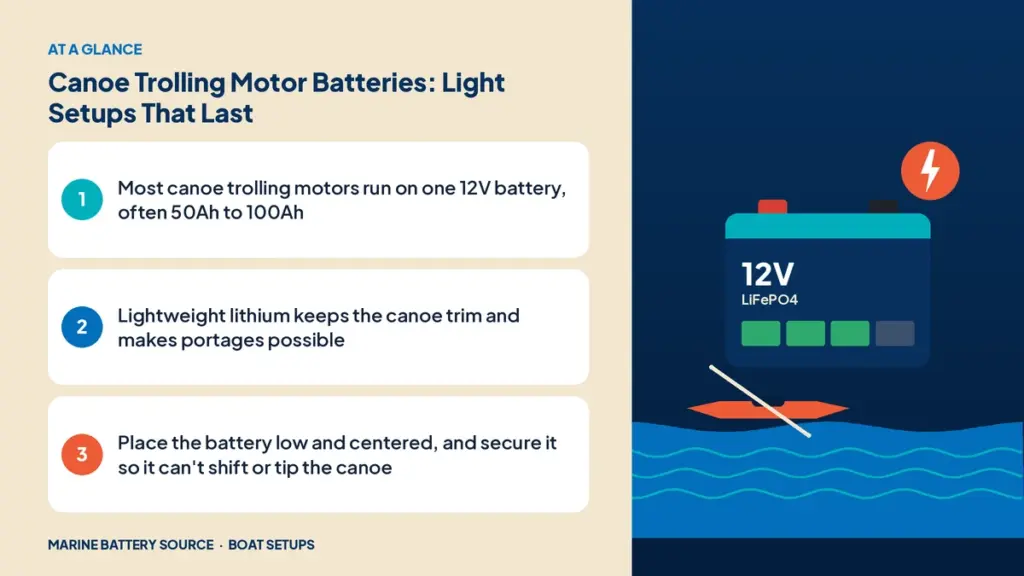
Most canoe motors are 12V freshwater models with 30 to 55 lb of thrust.
How much power a canoe motor uses
Current draw depends on thrust and speed setting. As a rough guide:
- A 30 lb thrust motor may draw up to about 30A at full speed.
- A 55 lb thrust motor may draw up to about 50A at full speed.
- At low and medium settings, draw is far less, often 5A to 20A.
Canoes are efficient hulls, so many paddlers cruise at modest settings. Check the motor’s spec sheet for current at each speed.
Sizing the battery
Battery needed (Ah) = average draw (A) × hours of use ÷ usable fraction
Example: average draw of 12A for 4 hours is 48Ah. With lithium (about 90% usable), that’s about 53Ah; a 50Ah to 75Ah lithium battery works. With lead-acid (about 50% usable), you’d need about 96Ah, which means a heavy Group 27 or 31 battery.
For short evening fishing trips, a 30Ah to 50Ah lithium battery may be plenty. For all-day trips or a lot of wind, go to 75Ah or 100Ah.
Why lithium suits canoes
Weight is the big reason. A Group 27 lead-acid battery can weigh around 60 lb, which is heavy in a canoe and nearly impossible to portage. Lithium options:
- Battle Born 30Ah: 8.6 lb for short trips.
- EPOCH 12V 50Ah Essential: 14.3 lb with Bluetooth.
- Battle Born 75Ah Group 24: 27 lb for longer days.
- EPOCH 12V 100Ah Eco: 21 lb for all-day range.
Check that the battery’s continuous discharge rating exceeds the motor’s maximum draw; small batteries sometimes have lower current limits.
Balance and placement
Canoes are sensitive to weight distribution. A battery placed poorly can make the canoe list, lift the bow or reduce stability.
- Place the battery low on the floor, never on a seat.
- Keep it near the centerline.
- Use it as trim ballast: with a stern-mounted motor and a paddler in the stern, placing the battery forward of center often levels the canoe.
- Adjust gear until the canoe sits level when loaded.
Mounting
- Use a battery box with a strap secured to a thwart or a mounting point.
- Cover the terminals; wet feet and spray are constant in a canoe.
- Route cables along the hull, away from where you step.
- Fuse the positive cable near the battery.
See battery box and mounting tips for more.
Charging
After each trip, recharge with a charger matched to the battery chemistry. A lithium charger like the EPOCH 12V 15A refills a 50Ah battery from half in under two hours. For multi-day trips, a small folding solar panel with a lithium-compatible controller can top up a battery at camp.
Portaging with a battery
On canoe trips that include portages, every pound matters. Choose the smallest battery that meets your daily needs, carry it in a box with a handle or in a pack, and keep the terminals covered. Some paddlers carry two small batteries instead of one large one to split the load.
Running electronics too
A small fish finder draws about 0.5A to 1.5A. You can run it from the trolling battery, but motor interference may show on the screen. A separate small battery, as covered in the fish finder battery guide, avoids that and gives you a backup.
Planning a day on the water
Think through your day before choosing a battery. If you plan to paddle out to a shoreline, fish slowly for a few hours and motor back, your energy use is mostly the two transits plus occasional repositioning. That might be only 20Ah to 30Ah, and a small lithium battery is enough. If you plan to troll for walleye or crappie for most of the day, the motor runs almost continuously and you may use 50Ah to 80Ah. River trips upstream against current can use even more, because the motor works hard the whole way.
A battery with Bluetooth monitoring, or a simple voltage meter, helps you learn your actual usage after a few trips. Once you know your typical numbers, you can choose a battery size with confidence rather than guessing.
Cold-water and shoulder-season trips
Early spring and late fall are great times to fish from a canoe, but cold weather affects batteries. Lead-acid batteries lose capacity in the cold. Lithium batteries discharge well in cool weather, but most shouldn’t be charged below about 32°F. Charge at home in a warm space and bring the battery out fully charged.
Safety
- Always carry a paddle.
- Wear a life jacket; canoes are easy to capsize.
- Don’t overload the canoe; check its capacity plate if present.
- Know local rules for motors on canoes, which may require registration.
Common mistakes
- Using a heavy lead-acid car battery.
- Leaving the battery loose on the floor.
- Placing the battery on one side, causing a list.
- Running a motor that draws more than the battery’s rated current.
Related guides
Canoe setups share a lot with tenders and flats skiffs. For the full picture, read the small boat battery guide and setups by boat type. Browse trolling motor batteries in the store.
Frequently asked questions
What size battery do I need for a canoe trolling motor?
For most canoes, a 12V 50Ah to 100Ah lithium battery, depending on how long and how hard you run the motor.
Where should the battery go in a canoe?
Low and centered, often forward of the stern paddler to balance the motor and paddler weight.
Can I use a car battery in my canoe?
It’s not recommended. Car batteries are heavy and not designed for deep cycling.
How long will a 50Ah battery run a canoe trolling motor?
At an average 12A draw, roughly 3.5 to 4 hours using most of a lithium battery’s capacity.