


Bass Boat Battery Setup: Starting, Trolling and Electronics
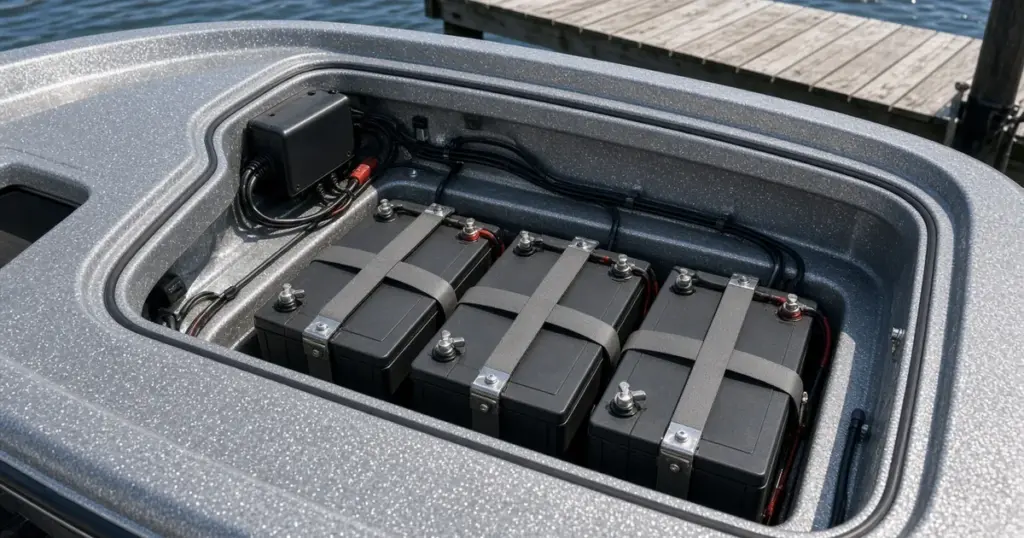
A modern bass boat is a serious electrical platform: a big outboard, a high-thrust trolling motor, multiple large displays, forward-facing sonar, shallow-water anchors and livewells. All of it runs on batteries in a compartment at the stern. A well-planned bass boat battery setup means you fish all day without power worries, and the boat runs better because the weight is right. This guide explains the standard layout and the common upgrades.
The standard layout
Most bass boats carry:
- A cranking battery for the outboard, which also usually powers the boat’s accessories: bilge, livewells, lights and often the electronics.
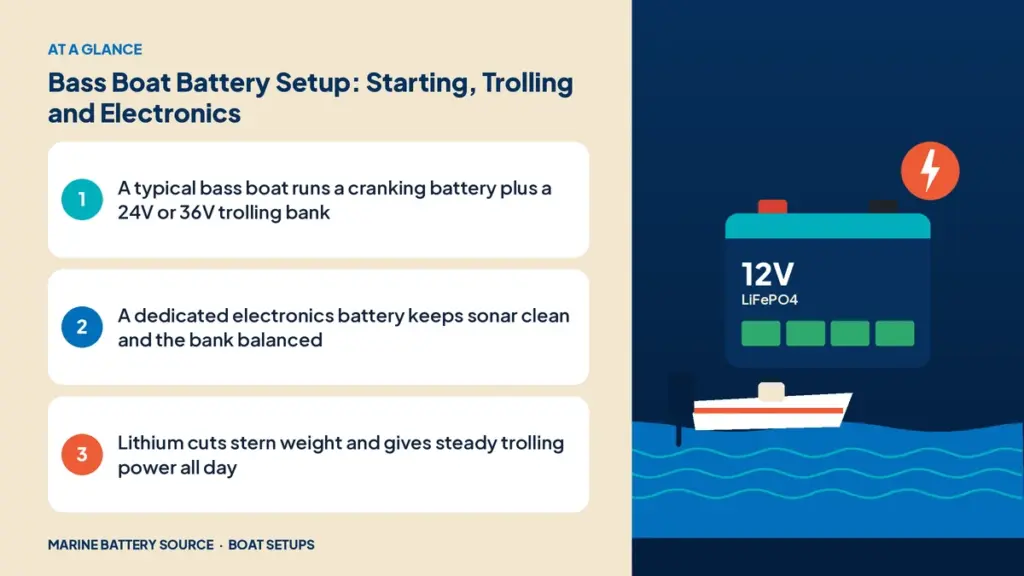
- A trolling motor bank: two 12V batteries in series for 24V, or three for 36V, or a single 24V or 36V lithium battery.
- A multi-bank onboard charger with one output per 12V battery.
Many tournament anglers add a fourth battery, dedicated to electronics.
The cranking battery
It must meet the outboard’s cranking and reserve requirements. Because it often powers accessories too, a high-reserve dual-purpose battery is a common choice. Examples include the Interstate 31M-AGM (925 CCA, 1190 MCA, 200 minutes RC) or a cranking-rated lithium battery like the Dakota Lithium DL 12V 135Ah heated (1000 CCA listed), if the engine maker allows lithium starting.
The trolling bank
Most high-thrust bow-mount motors on bass boats run on 24V or 36V. Options:
- Three 12V lead-acid batteries for 36V: proven, lower cost, but heavy, often close to 200 lb.
- Three 12V lithium batteries: keeps the three-bank charger layout, saves a lot of weight.
- A single 36V lithium battery: simplest wiring and lightest. The EPOCH 36V 50Ah Essential (1.92 kWh, 35 lb, Group 31 size) and Dakota Lithium 36V 60Ah (2,304 Wh, 44 lb) are examples.
The trade-offs of a single battery versus three are explained in our guides to 36V trolling batteries and to converting a 36V bank to lithium.
The electronics battery
Running graphs and sonar from the cranking battery works, but heavy electronics loads can drain it and create interference. A dedicated electronics battery keeps sonar images clean and protects the cranking battery. A light lithium battery like the EPOCH 12V 50Ah Essential (0.64 kWh, 14.3 lb) works well. Size it from your electronics’ total draw and hours.
Onboard charging
A multi-bank onboard charger is standard. A 36V lead-acid bank plus a cranking battery needs four banks; adding an electronics battery means five, or a second charger. If you switch to a single 36V lithium battery, you need a 36V lithium charger output, such as the EPOCH 36V 15A or a multi-voltage unit like the EPOCH 12V-36V onboard charger. Many anglers also add a DC-DC charger to top up the trolling bank from the outboard while running.
Weight and performance
Bass boats are performance hulls. Batteries sit in the stern, and their weight affects holeshot, top speed and how the boat rides. Converting a 36V lead-acid bank to lithium can remove well over 100 lb from the stern. Many anglers notice faster planing and a better ride.
Wiring considerations
- Long cable run to the bow: size the trolling motor cable for the round-trip length and the motor’s maximum current.
- Circuit breakers: on the trolling motor positive near the batteries, sized per the motor maker.
- Electronics wiring: run power and ground directly to the electronics battery, fused near the battery, separate from trolling motor cables.
- Shallow-water anchors: these draw current from the cranking or house battery when deploying; check the maker’s wiring guidance.
Typical bass boat configurations
| Setup | Batteries | Approx. battery weight |
|---|---|---|
| Traditional lead-acid | Cranking + three 12V AGM | Often 250 lb or more |
| Lithium trolling | Cranking (lead-acid) + one 36V lithium | Much lighter |
| Full lithium | Lithium cranking + 36V lithium + lithium electronics | Lightest |
Weights vary by model; compare listed weights before buying.
Common bass boat battery problems
- Trolling motor fades by afternoon: lead-acid voltage sag or undersized bank.
- Cranking battery low after a day of electronics: add an electronics battery or a bigger cranking battery.
- One trolling battery always low: an accessory tapped from one battery, or a failing battery or charger bank.
- Sonar interference: shared grounds with the trolling motor.
Planning the compartment layout
Bass boat battery compartments are tight. Before buying, measure the space and plan:
- Tray positions for each battery, using the boat’s original trays where possible.
- Charger mounting in a dry, ventilated spot with leads short enough to reach each battery.
- Breaker locations close to the batteries, reachable without unloading the compartment.
- Cable routing that keeps trolling motor leads, electronics wiring and charger leads organized and protected from chafe.
- Access for checking terminals and reading battery indicators.
Lithium conversions often free up space, since a single 36V battery may occupy one Group 31 footprint instead of three. Use the extra space for an electronics battery or simply for easier access.
Charging on the run
On tournament days with long runs between spots, a DC-DC charger can feed the trolling bank from the outboard’s charging system. The EPOCH 12V-to-36V DC-DC charger is one example. It won’t replace overnight charging, but it can add meaningful energy on a long run and reduce the risk of running short late in the day.
Tournament day routine
- Charge all banks fully the night before.
- Check the charger shows complete on every bank.
- Check battery state of charge via Bluetooth or voltage before launching.
- Plan runs on the outboard for long moves to save trolling power.
- Plug in the charger as soon as you’re home.
Other boat types for comparison
If you also fish from a center console or kayak, the battery needs are quite different; see center console battery setups and the kayak battery guide. Pontoon fishing setups are in the pontoon battery guide, and electric propulsion in the electric outboard guide.
For the overview, read battery setups by boat type and small boat electrical basics. Browse trolling motor batteries in the store.
Frequently asked questions
How many batteries does a bass boat need?
Typically one cranking battery plus two or three trolling batteries, or a single 24V or 36V lithium trolling battery. Many anglers add a dedicated electronics battery.
Is lithium worth it on a bass boat?
For many anglers, yes. It removes significant stern weight, delivers steady thrust all day and charges faster.
Should electronics run off the cranking battery?
It works for modest loads, but heavy electronics can drain it and cause interference. A dedicated electronics battery is the cleaner solution.
What charger do I need for a bass boat?
A multi-bank onboard charger with one output per 12V battery, or a matching-voltage lithium charger output for single 24V or 36V lithium batteries.