


Battery Banks for Cruising Catamarans
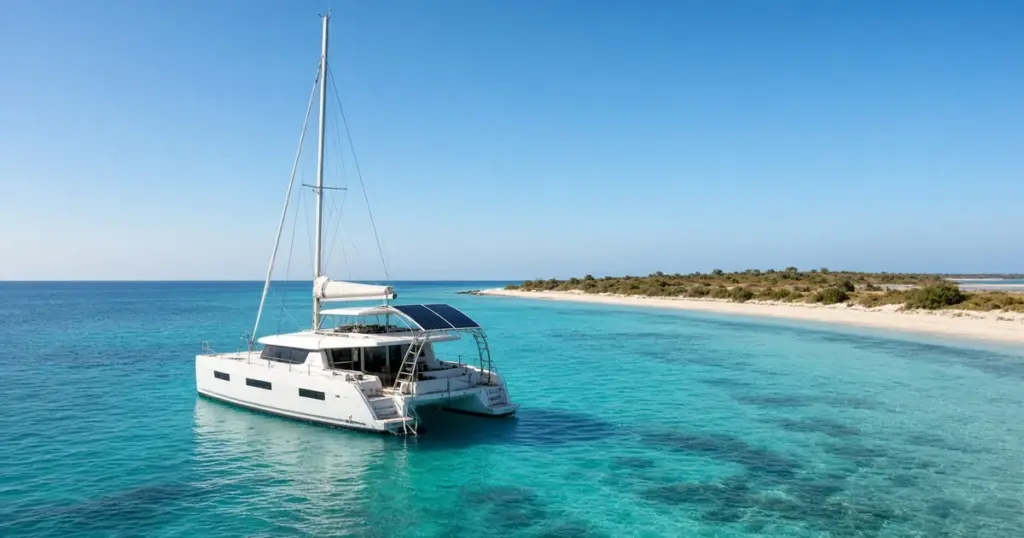
Cruising catamarans have become hugely popular with liveaboards, and their electrical systems reflect their lifestyle: lots of solar, big refrigeration, watermakers, inverters and often two engines. A catamaran battery bank has a few unique considerations, from weight distribution to long cable runs between hulls. This guide covers how to plan one.
What makes catamarans different
- Large roof area on the hardtop and davits for solar.
- Weight sensitivity. Catamarans perform best when light, and weight in the ends or high up affects motion.
- Two hulls and two engines, each with its own alternator and often its own starting battery.
- Long cable runs between hulls, bridgedeck and helm.
- Big loads: watermakers, multiple fridges, induction cooking on some boats, air conditioning.
Energy budget first
As with any liveaboard, start with an energy budget. Catamarans often carry more appliances than monohulls of similar length. Our pillar on sailboat and liveaboard battery systems explains the process.
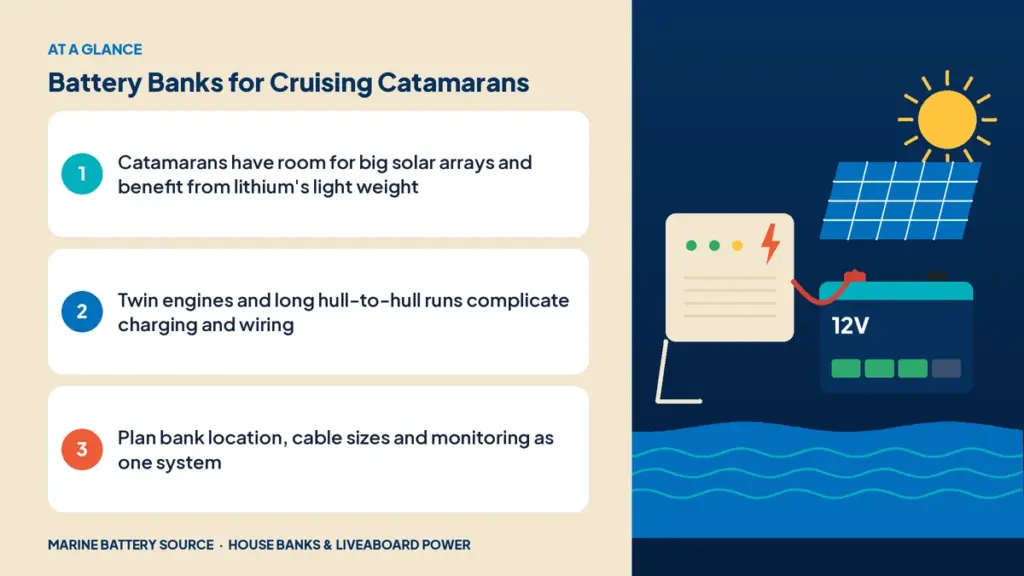
Why lithium suits catamarans
Weight matters more on a cat than on most monohulls. A large lead-acid bank can weigh several hundred pounds. Lithium cuts that dramatically and delivers more usable energy. Store options include:
- EPOCH 12V 460Ah V2 Elite: 5.89 kWh, 8D size, Bluetooth and heating.
- EPOCH 24V 230Ah V2 Elite: 5.89 kWh at 24V, 97 lb.
- Battle Born 270Ah 12V GC3: 80.8 lb.
Read building a lithium house bank for detailed design.
Where to put the bank
Many production catamarans place the house bank in one hull, sometimes under a berth or in the bridgedeck area. Considerations:
- Keep weight central and low, away from the bows and sterns.
- Balance port and starboard as much as possible.
- Keep high-current cables short: place the bank near the inverter and main distribution.
- Avoid hot engine rooms.
Charging from two engines
Each engine has an alternator. Common approaches:
- Each alternator charges its own starting battery, with DC-DC chargers feeding the lithium house bank from one or both.
- External regulators with lithium profiles and temperature sensing on one or both alternators.
- Combining both alternators’ output into the house bank through appropriate charging devices.
Two alternators offer redundancy and more charging capacity when motoring. Our guide to charging on the water explains DC-DC charging and regulators.
Solar on catamarans
The hardtop and davits can often host a substantial solar array, which is a major advantage. With enough panels, many catamarans meet most daily needs from solar in sunny climates. Use MPPT controllers, minimize shading from the boom and rigging, and keep wire runs adequately sized. See charging without the engine.
Cable runs and voltage
Long runs from one hull to the other, or to a windlass on the forward crossbeam, mean voltage drop. Consider:
- Larger cable for long runs.
- Locating high-current loads like the inverter near the bank.
- A 24V or 48V house system on larger cats with heavy loads, with converters for 12V equipment.
Big loads to plan for
- Watermakers: 12V and 24V units draw significant current while running; AC units run through the inverter or generator.
- Refrigeration: many cats carry multiple fridges and freezers.
- Air conditioning: see whether batteries can handle it in our guide to running A/C on batteries.
- Induction cooking: very high power draws through the inverter.
Generator or not?
Many catamarans ship with generators, but large lithium banks and solar reduce generator use substantially. Read generator vs big lithium bank.
Upgrading an existing catamaran
If your cat has an aging AGM bank, a lithium upgrade can save weight and give more usable energy. Review alternators, chargers, solar controllers, fusing and monitoring. See upgrading from AGM to lithium.
Monitoring and switching
- Install a shunt-based monitor for the house bank.
- Label the battery switches for each engine and the house bank.
- Include an emergency parallel option for engine starting.
- Use Bluetooth battery data where available.
Sample catamaran system
For a 42-foot cruising catamaran using around 300Ah per day at 12V:
- House bank: about 800Ah to 900Ah lithium (roughly 10 to 11.5 kWh), giving two to three days of autonomy.
- Solar: as much as the hardtop allows, often 800W to 1,500W or more on large cats.
- Charging: DC-DC chargers or lithium-capable regulators on both alternators, and an inverter/charger for shore and generator power.
These figures are illustrative. Your energy budget determines the actual design.
Weight savings in practice
Replacing a large AGM bank with lithium of similar usable energy can save hundreds of pounds on a cruising catamaran, which helps sailing performance, fuel economy and payload for water, provisions and gear.
Daily routine aboard
Owners who live comfortably on catamaran power tend to share a few habits:
- Run big loads when the sun is high. Watermakers, laundry and induction cooking draw heavily; scheduling them midday lets solar carry much of the load directly.
- Check the monitor at fixed times, such as morning and sunset, to spot trends early.
- Keep the inverter off overnight unless it’s needed.
- Use one engine for charging on short motoring legs where practical, and alternate between them to balance engine hours.
- Keep panels clean and shade-free, moving the boom and lines away from the hardtop when at anchor.
These habits often matter as much as the size of the bank.
Safety
- Main fuses with adequate interrupting capacity at each bank.
- Secure batteries against violent motion.
- Proper ventilation for any remaining lead-acid batteries.
- Follow ABYC standards and battery maker instructions.
For reserve planning, read house bank sizing for overnight boating. Browse house bank batteries and EPOCH batteries in the store.
Frequently asked questions
How big should a catamaran battery bank be?
Base it on your daily energy use and desired autonomy. Many cruising catamarans run large lithium banks of several hundred amp-hours or more at 12V, or equivalent at 24V.
Where should the battery bank go on a catamaran?
Low and near the center of the boat, balanced between hulls where possible, and close to the inverter and main distribution.
Can solar power a catamaran?
Catamarans often have room for large arrays that can meet most daily needs in sunny climates. Engines or a generator fill gaps.
Should a catamaran use a 24V house bank?
Larger cats with heavy inverter, watermaker or cooking loads can benefit from 24V. Smaller cats with modest loads usually stay with 12V.