


How to Do a Boat Energy Audit (Amp-Hour Budget)
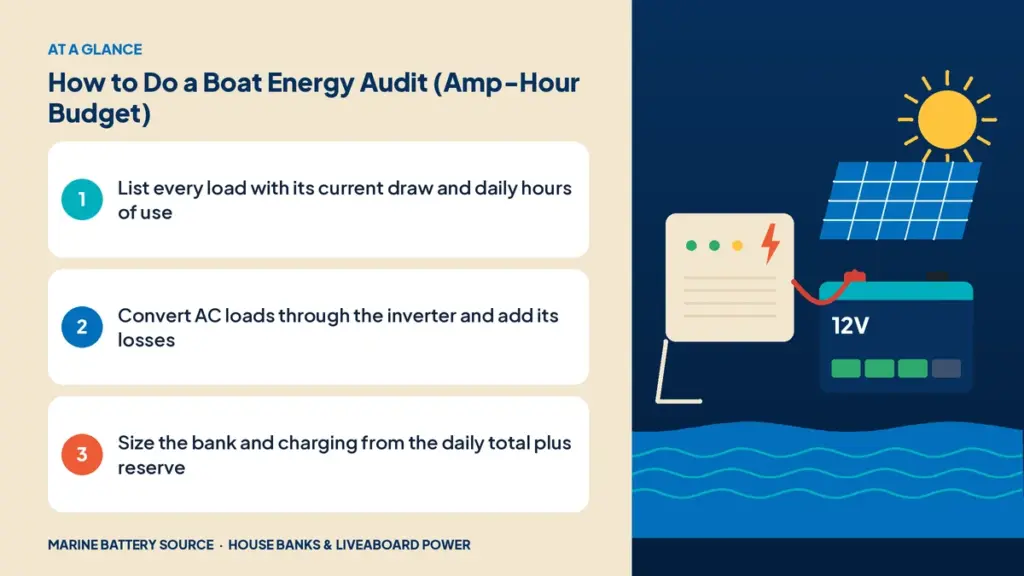
Every good house bank starts with an energy audit. Before you choose batteries, chargers or solar panels, you need to know how much energy your boat actually uses in a day. A boat energy audit, sometimes called an amp-hour budget, turns a vague sense of “we use a lot of power” into a number you can design around. This guide walks you through it step by step.
Why do an energy audit?
- Right-size the house bank. Too small and you run flat; too big and you carry weight and cost you don’t need.
- Plan charging. The audit tells you how much energy must go back in each day from the engine, solar, a generator or shore power.
- Find the energy hogs. Often one or two loads use most of the energy.
- Compare upgrades. It shows what switching to LED lighting or a more efficient fridge is worth.
Step 1: List every load
Walk through the boat and list every electrical device that runs from the house bank. Group them:
- Constant loads: refrigeration, electronics on standby, monitoring systems.
- Intermittent loads: lights, pumps, fans, the VHF, the stereo.
- High-current, short-duration loads: windlass, bow thruster, electric winches, the starter if it’s on the house bank.
- AC loads through an inverter: microwave, coffee maker, TV, laptop chargers, air conditioning.
Step 2: Find each load’s current
For 12V DC loads, find the current draw in amps from the manual or label. If a device lists watts, divide by the system voltage: a 24W light at 12V draws 2A. A DC clamp meter on the device’s supply cable gives a real measurement.
For AC loads, find the watts. Most AC appliances list watts or amps at 120V. Multiply amps by 120 to get watts.
Step 3: Estimate hours per day
Be honest. Estimate how many hours each device runs per day in your typical use. For cycling devices like refrigerators and pumps, estimate the fraction of time they actually run, called the duty cycle.
Step 4: Calculate amp-hours per day
For DC loads: amps × hours = amp-hours (Ah).
For AC loads through an inverter: watts × hours ÷ system voltage ÷ inverter efficiency = DC amp-hours. Inverters lose some energy in conversion; using an efficiency around 85% to 90% is a reasonable planning assumption unless your inverter’s spec says otherwise. Add the inverter’s idle draw for the hours it’s switched on. Our guide to inverter sizing explains how.
A sample audit
| Load | Draw | Hours/day | Ah/day |
|---|---|---|---|
| 12V compressor fridge (avg) | 2.0A avg | 24 | 48 |
| LED cabin lights | 1.5A | 4 | 6 |
| Anchor light | 0.5A | 10 | 5 |
| Chartplotter and instruments | 2.0A | 4 | 8 |
| VHF (standby) | 0.5A | 12 | 6 |
| Water pump | 5A | 0.5 | 2.5 |
| Fans | 1A | 6 | 6 |
| Phone and laptop charging (AC) | 60W | 3 | 17 |
| Inverter idle | 0.5A | 3 | 1.5 |
| Total | 100Ah |
These figures are illustrative; use your own boat’s numbers. For refrigeration specifics, see powering a boat fridge.
Step 5: Turn the total into a bank size
Size the bank so your daily use fits within a comfortable depth of discharge, with reserve for cloudy days or a missed charge.
- Lead-acid: plan to use about 50% of rated capacity. A 100Ah daily load needs about 200Ah rated, more for reserve.
- Lithium: plan to use about 80%. A 100Ah daily load needs about 125Ah rated, more for reserve.
If you want two days without charging, double the daily figure. Our guide to house bank sizing for overnight boating walks through reserve planning.
Store examples at roughly this scale:
- EPOCH 12V 300Ah Essential: 3.84 kWh, Group 31 size, 58 lb, Bluetooth and heating.
- Battle Born 270Ah 12V GC3: 80.8 lb.
- Two Trojan T-105 6V batteries in series for a 12V lead-acid bank, each listed at 1.50 kWh at the 20-hour rate.
Step 6: Plan the charging
Whatever you use, you must put back, plus charging losses. Lead-acid batteries need more energy back than you took out, and they charge slowly near full. Lithium is more efficient and accepts charge quickly. Options:
- Engine alternator, through a DC-DC charger for lithium.
- Solar panels, sized from your daily Ah and local sun hours.
- Generator with a battery charger.
- Shore power at the dock.
Our guide to charging lithium batteries on a boat covers each method.
Step 7: Find the savings
Look at the biggest lines in your audit. Common improvements:
- Switch any remaining incandescent or halogen lights to LED.
- Improve refrigerator insulation and ventilation around the compressor.
- Turn off the inverter when not needed to avoid idle draw.
- Charge devices directly from 12V USB outlets instead of through the inverter.
High-current loads
Windlasses and thrusters draw large currents for short periods. Their energy use per day may be small, but they need heavy cables, appropriate fuses, and a battery that can deliver the current. See powering an anchor windlass.
Common audit mistakes
- Using maximum current instead of average. A fridge’s running current isn’t its average; use the duty cycle.
- Forgetting standby loads. Stereos, chargers, displays and inverters on standby draw small currents around the clock, and they add up.
- Ignoring inverter losses. AC loads cost more DC energy than their wattage suggests.
- Assuming perfect weather. Hot days raise refrigeration loads; cloudy days cut solar input.
- Not planning reserve. A bank sized exactly to the audit leaves nothing for surprises.
Verify with a battery monitor
An audit is an estimate. A shunt-based battery monitor measures actual amp-hours in and out, letting you check and refine your numbers. Lithium batteries with Bluetooth also show state of charge. Spend a few typical days aboard and compare reality with your audit.
Using the audit at anchor
Knowing your daily use makes planning a weekend away from the dock much easier. Read power planning for anchoring out for a worked example, and for long-term living aboard see sailboat and liveaboard battery systems. Browse the store’s house bank batteries.
Frequently asked questions
How do I calculate my boat’s daily power use?
List every load, find its current draw, estimate hours of use per day, and multiply. Add AC loads through the inverter using watts, hours and inverter efficiency.
How big should my house battery bank be?
Divide your daily amp-hours by the usable fraction of the chemistry (about 0.5 for lead-acid and about 0.8 for lithium), then add reserve.
What uses the most power on a boat?
Refrigeration is often the biggest continuous load. Inverter-powered appliances, air conditioning and heating elements can be very large.
Do I need a battery monitor?
It isn’t required, but a shunt-based monitor measures real usage and makes your audit far more accurate.