


Dual-Purpose Marine Batteries: Who Should Use One?
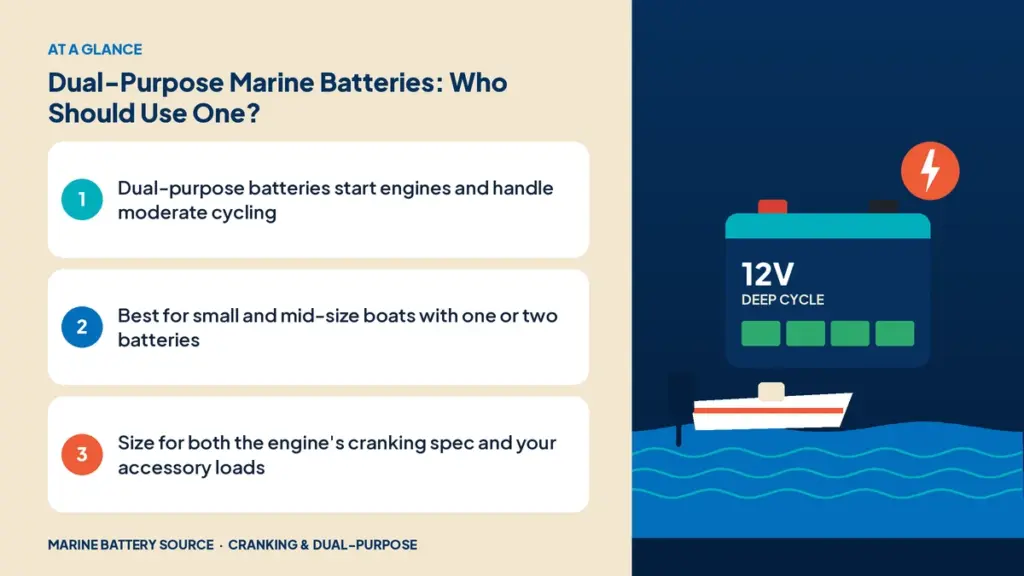
A dual-purpose marine battery is built to do two jobs: deliver enough current to start an engine and handle moderate deep cycling from electronics, lights and pumps. It’s a compromise, but a very practical one for many boats. This guide explains how dual-purpose batteries work, who should use one, how they compare across chemistries, and how to size one correctly.
How dual-purpose batteries differ
Lead-acid batteries are designed around plate construction:
- Starting batteries use many thin plates for maximum surface area and high short-burst current.
- Deep-cycle batteries use fewer, thicker plates that tolerate repeated deep discharges.
- Dual-purpose batteries sit in between, with plates designed to crank an engine while tolerating more cycling than a pure starter.
Lithium dual-purpose batteries work differently. LiFePO4 cells handle deep cycling naturally, so a “dual-purpose” lithium battery is one whose cells and BMS are also built to deliver the high current an engine starter needs. For a full comparison, see cranking vs dual-purpose vs deep-cycle batteries.
Who should use a dual-purpose battery?
Boats with one battery
Small outboard boats, skiffs and runabouts often have room for only one battery. It has to start the engine and run the electronics. A dual-purpose battery is the natural choice.
Boats with two identical batteries
Many boats carry two batteries with a 1-2-Both switch. Using two dual-purpose batteries means either can start the engine or run accessories. That simplicity and redundancy are popular with owners of center consoles and bay boats. Our guide to twin outboard battery setups covers multi-engine variations.
Boats with modest accessory loads
If accessories draw only a few amps for a few hours, a dual-purpose battery handles it. Heavier loads, such as refrigerators, inverters and big audio, are better served by a dedicated deep-cycle house bank.
Who should not rely on one?
- Boats with large house loads, which need a real deep-cycle or lithium house bank.
- Trolling motor banks, which need deep-cycle batteries.
- Engines with very high cranking requirements that a dual-purpose battery of the right size can’t meet.
Lead-acid dual-purpose options
Lead-acid dual-purpose batteries come in flooded and AGM versions. Examples from the store:
| Battery | Type | CCA | MCA | RC (min) |
|---|---|---|---|---|
| Interstate HD24-DP | Flooded, 24M | 405 | 505 | 100 |
| Interstate 24M-AGM-A | AGM, 24M | 750 | 940 | 140 |
| Interstate 27M-AGM | AGM, 27M | 850 | 975 | 182 |
| Interstate 31M-AGM | AGM, 31M | 925 | 1190 | 200 |
AGM dual-purpose batteries generally offer strong cranking and good vibration resistance, while flooded versions cost less. Our AGM starting battery guide explores the AGM option.
Lithium dual-purpose options
Cranking-rated lithium batteries combine starting power with deep cycling and much lower weight:
- Dakota Lithium DL 12V 135Ah heated: 1000 CCA listed, 1,620 Wh, 27.2 lb, Group 24 size.
- EPOCH 12V 172Ah: 1000 CCA listed, Group 31, 40 lb, Bluetooth.
- The Dakota Lithium DL 12V 60Ah, with 1000 CCA listed in a Group 24 size at 16.5 lb.
Because lithium tolerates deep discharge, a large dual-purpose lithium battery can run electronics far longer than a lead-acid dual-purpose battery of the same size. Check your engine maker’s guidance before using lithium for starting; see lithium starting batteries for outboards.
Sizing a dual-purpose battery
You need to meet two requirements:
- Cranking: meet or exceed the engine’s minimum CCA or MCA and reserve capacity. See outboard cranking requirements.
- Accessory energy: add up the amp-hours your electronics use between charges.
Then make sure the battery can deliver the accessory energy and still start the engine. For lead-acid, plan to use no more than about half of rated capacity, and preferably less since you need starting power left. For lithium, you can use more, but keep a healthy reserve for starting.
Example: electronics drawing 4A for 6 hours with the engine off use 24Ah. A lead-acid dual-purpose battery with an RC around 180 minutes (about 75Ah at 25A, more at lighter loads) handles that, though it’s being cycled fairly deeply. A 100Ah-plus lithium dual-purpose battery handles it easily.
Charging a dual-purpose battery
On a single-battery boat, the outboard charges the battery while running. Shore charging with an onboard charger set to the correct profile keeps it topped up between trips. A lead-acid battery that’s routinely drawn down and only partly recharged by short runs will sulfate and lose capacity. For lithium, use a charger with a lithium profile.
Getting the most life
- Recharge after every trip.
- Avoid draining lead-acid dual-purpose batteries below about half.
- Use a battery switch to isolate the battery when the boat sits.
- Keep terminals clean and tight.
- Replace a battery that tests weak before it fails at the ramp.
Dual-purpose or two separate batteries?
A single dual-purpose battery is simple. Two batteries, one for starting and one for house loads, are more resilient: you can drain the house battery and still start. Our article on separating starting and house batteries explains why many boaters make that move. If your boat runs on one battery, see running a small boat on one battery.
Common mistakes with dual-purpose batteries
- Treating it like a house bank. Running a refrigerator or inverter from a lead-acid dual-purpose battery all weekend will shorten its life quickly.
- Mixing with an old battery. Paralleling a new battery with an old one drags the new one down.
- Ignoring the cranking spec. A big dual-purpose battery with high reserve capacity still needs to meet the engine’s cranking minimum.
- Skipping the switch. Without a way to isolate the battery, small parasitic loads can drain it while the boat sits.
Group sizes
Dual-purpose batteries come in Group 24, 27 and 31 most commonly, plus larger sizes for big boats. Choose the largest that fits your tray if you want more reserve. See our BCI group size guide.
For the complete buying process, read choosing a boat starting battery, and browse dual-purpose batteries in the store.
Frequently asked questions
What is a dual-purpose marine battery?
A battery designed to start an engine and handle moderate deep cycling from accessories. It’s a compromise between a starting battery and a deep-cycle battery.
Can a dual-purpose battery run a trolling motor?
It can in a pinch, but deep-cycle batteries are better for sustained trolling loads. Lithium dual-purpose batteries handle cycling better than lead-acid ones.
Is a dual-purpose battery good for starting?
Yes, as long as it meets your engine’s cranking and reserve requirements.
How long does a dual-purpose marine battery last?
It depends on use, charging habits and chemistry. Lead-acid versions last longest when recharged promptly and not discharged deeply. Lithium versions generally offer far more cycles.