


Can You Use Lithium as a Starting Battery on an Outboard?
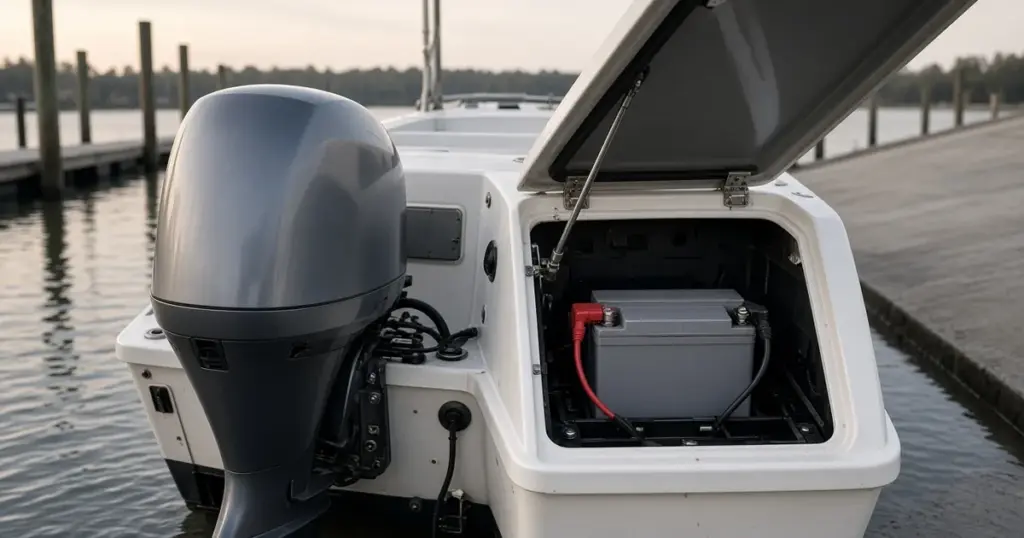
Lithium batteries have become the default upgrade for trolling motors and house banks. Starting batteries are the next frontier. A cranking-rated LiFePO4 battery can deliver strong starting current at a fraction of lead-acid’s weight. But not every lithium battery can start an engine, and outboard charging systems weren’t all designed with lithium in mind. This guide explains when a lithium starting battery for an outboard makes sense and what to check before you switch.
Can lithium start an outboard?
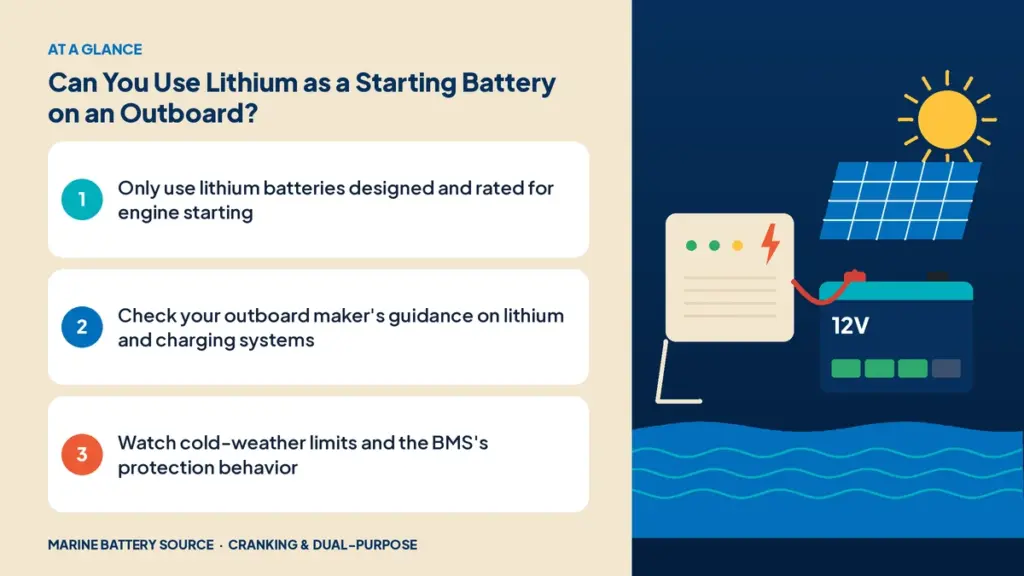
Yes, if the battery is designed for it. Lithium iron phosphate cells can deliver high current, but the battery’s BMS determines how much current it allows and for how long. Deep-cycle lithium batteries often have BMS limits around 100A to 200A continuous, which is far below the hundreds of amps a large outboard starter can draw. A cranking-rated or dual-purpose lithium battery has a BMS and cells built for those short, heavy pulses.
Look for:
- A published cranking or CCA rating.
- Pulse discharge ratings that cover the starter’s draw.
- Explicit approval for engine starting from the battery maker.
Real cranking-capable lithium batteries
The store carries several lithium batteries designed to start engines:
- Dakota Lithium DL 12V 60Ah: 1000 CCA listed, Group 24 size, 16.5 lb, with 750A 2-second and 650A 5-second pulse ratings on its listing.
- Dakota Lithium DL 12V 135Ah heated: 1000 CCA listed, Group 24 size, 27.2 lb, with internal heating and an RC of 340 minutes listed.
- EPOCH 12V 172Ah dual purpose: 1000 CCA listed, Group 31, 40 lb, with Bluetooth.
- The EPOCH 12V 300Ah Pro Series cranking and deep-cycle battery in an 8D footprint, for large boats with heavy house loads.
- The Lithium Rhino 12V 120Ah dual cranking conversion kit.
Compare that to a typical Group 31 lead-acid starting or dual-purpose battery, which can weigh 60 lb or more.
Check your engine maker’s guidance
Outboard manufacturers differ in how they treat lithium. Some publish guidance for lithium starting batteries, and some recommend specific types or charging arrangements. Before switching, check your engine’s manual and any service bulletins, and ask your dealer if you’re unsure. Warranty terms may depend on following those recommendations.
Charging system compatibility
Outboards charge their batteries through an alternator or a stator with a regulator/rectifier. Lithium batteries accept charge readily and have a different ideal voltage profile from lead-acid. Things to consider:
- Charging voltage. The engine’s regulated voltage must suit the lithium battery maker’s recommendations.
- Charge current. Lithium can accept high current, which may cause some charging systems to run at full output for longer. This is a bigger consideration on large house banks than on a starting battery.
- BMS disconnects. If the BMS disconnects the battery while the engine is charging, the sudden loss of load can create a voltage spike that some charging systems don’t tolerate. Battery makers address this in different ways; follow their guidance.
Our guide on lithium cranking batteries and outboard charging systems goes deeper.
Cold weather
Lithium batteries generally shouldn’t be charged below about 32°F unless they have internal heating. Discharge is possible at lower temperatures, but performance drops. If you boat in cold climates, choose a heated cranking battery or keep lead-acid for starting. Our cold-weather cranking guide explains how temperature affects all chemistries.
Benefits of lithium for starting
- Weight savings, which matter on small boats and high-performance hulls.
- Low self-discharge, so a boat that sits for weeks starts more reliably.
- Dual-purpose ability: a large cranking-rated lithium battery can also run electronics without the deep-cycle damage lead-acid suffers.
- Long cycle life.
Drawbacks to consider
- Higher up-front cost.
- Not all engines and charging systems are a good match.
- Cold-charging limits for non-heated models.
- A BMS fault or protective shutdown leaves you without starting power unless you carry a backup.
Should you keep a backup?
Any single starting battery is a single point of failure. Many boaters carry a jump pack or set up a parallel switch with a house battery. That applies equally to lead-acid and lithium. See our starting battery guide for options.
Lithium for inboard and sterndrive engines
Inboards and sterndrives are larger and often draw more current at start, and their charging systems vary. The same principles apply: use a cranking-rated battery, check the engine maker’s guidance and confirm charging compatibility. See inboard and sterndrive starting batteries.
Dual-purpose lithium on smaller boats
On a boat with one battery, a cranking-capable lithium battery can start the engine and run electronics all day without the deep-cycle damage lead-acid suffers. Learn more in our dual-purpose battery guide. Even then, leave enough capacity to start.
Fitting a lithium starting battery
- Confirm the engine’s CCA, MCA and RC requirements; see outboard cranking requirements.
- Choose a lithium battery rated for starting that meets or exceeds them.
- Check the group size and terminals for your tray and cables.
- Confirm charging compatibility.
- Secure the battery firmly; lighter batteries still need solid hold-downs.
- Set up a charger with a lithium profile for shore charging.
Storage and the off-season
One practical advantage of lithium starting batteries is low self-discharge. A lead-acid battery left on a boat for weeks without a maintainer slowly loses charge, and small parasitic loads like bilge pump float switches or stereo memory speed that up. A lithium battery holds its charge much longer, although parasitic loads still drain it. Use the battery switch to isolate it when the boat sits, and follow the maker’s storage guidance for the off-season.
Quick comparison
| Lead-acid starting | Lithium cranking-rated | |
|---|---|---|
| Weight | Heavier | Much lighter |
| Self-discharge | Higher | Very low |
| Cold charging | Yes | Not below freezing unless heated |
| Deep cycling | Damages starting batteries | Tolerated |
| Cost | Lower | Higher |
Browse the store’s dual-purpose batteries for cranking-capable options, and read cranking vs dual-purpose vs deep-cycle batteries for the fundamentals.
Frequently asked questions
Can I use any lithium battery to start my outboard?
No. Use only lithium batteries designed and rated for engine starting. Many deep-cycle lithium batteries have BMS limits too low for a starter.
Will a lithium starting battery damage my outboard’s charging system?
Compatibility depends on the engine and battery. Check your engine maker’s guidance and follow the battery maker’s instructions for charging-system compatibility.
Are lithium starting batteries good in cold weather?
They can discharge in cold weather, but most shouldn’t be charged below about 32°F unless heated. Heated cranking-rated models address this.
How much weight does a lithium starting battery save?
It varies by model. A cranking-rated Group 24 lithium battery can weigh well under 30 lb, compared with roughly 45 to 60 lb or more for many lead-acid starting batteries.