


How Many Cranking Amps Does Your Outboard Need?
Ask around the dock how many cranking amps an outboard needs and you’ll hear a dozen answers. The only one that really counts is in your engine’s manual. But understanding why the spec is what it is, and how to add sensible margin, helps you pick a battery that starts the engine reliably for years. This guide covers outboard battery CCA requirements, where to find them, and how to apply them.
Where to find the requirement
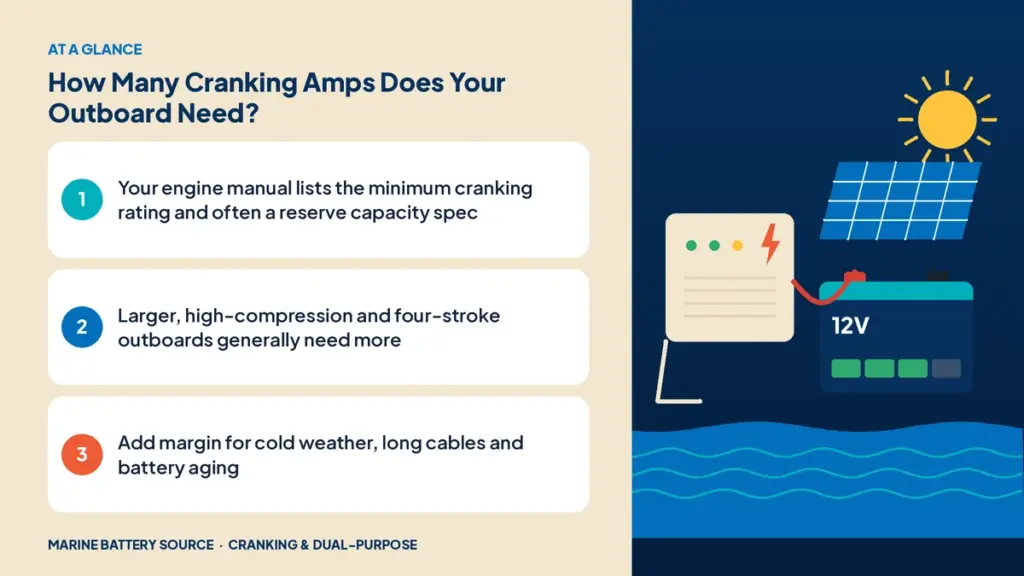
Outboard manufacturers publish battery requirements in the owner’s manual, usually in the specifications or electrical section. The listing typically includes:
- Minimum cranking rating, given as CCA, MCA, or both.
- Minimum reserve capacity in minutes, or sometimes amp-hours.
- Recommended battery type, such as starting or dual-purpose, and sometimes notes on AGM or lithium.
If you don’t have the manual, the manufacturer’s website usually has it, or your dealer can look it up by model and serial number. Battery requirements can change between model years, so match your exact engine.
Why requirements vary
Several factors drive how much cranking current an engine needs:
- Displacement and compression. Bigger, higher-compression engines take more effort to turn over.
- Four-stroke vs two-stroke. Modern four-strokes are often more demanding at start, and they rely on battery voltage for electronic fuel injection and engine management.
- Starter design. Gear-reduction starters and engine electronics influence the draw.
- Electrical load during start. Fuel pumps, ECUs and sensors draw current while cranking.
Small tiller outboards may need only a modest starting battery, while large V6 and V8 outboards typically call for considerably more cranking power and higher reserve capacity. Always use the number for your engine.
CCA, MCA and reserve capacity together
Engine makers set a cranking minimum so the starter gets enough current, and a reserve capacity minimum so the battery can support the engine’s electronics and essentials. A battery should meet both. Our guides on CCA vs MCA and reserve capacity explain each rating.
Match the unit. If the manual lists 800 MCA, compare batteries by MCA. If it lists CCA, compare by CCA. MCA is measured at 32°F and is always higher than CCA for the same battery.
Adding margin
Meeting the minimum exactly leaves no room for real-world losses. Consider extra margin if:
- You boat in cold weather.
- The battery sits far from the engine with long cables.
- Electronics run from the starting battery with the engine off.
- You keep batteries several seasons before replacing.
A battery comfortably above the minimum gives you more starts in reserve as it ages. But don’t chase extremely high numbers if the battery won’t fit or adds unnecessary weight.
Examples from the store
Interstate’s marine line lists both CCA and MCA, which makes comparison simple:
| Battery | Type | CCA | MCA | RC (min) |
|---|---|---|---|---|
| Interstate M-24M-MS | Starting, 24M | 400 | n/a | 75 |
| Interstate 24M-HD | Starting, 24M | 500 | 625 | 95 |
| Interstate 24M-XHD | Starting, 24M | 800 | 1000 | 135 |
| Interstate 27M-XHD | Starting, 27M | 800 | 1000 | 182 |
| Interstate 31M-AGM | AGM dual purpose, 31M | 925 | 1190 | 200 |
Notice how batteries with the same cranking rating can have very different reserve capacity depending on group size.
Lithium starting batteries
Some lithium batteries are designed for engine starting and list cranking ratings. The EPOCH 12V 172Ah dual purpose lists 1000 CCA in a Group 31 size. Before choosing lithium for starting, check your outboard maker’s guidance and the battery’s suitability for your charging system. See lithium starting batteries for outboards.
Group size and fit
Cranking ratings tend to rise with case size, but so do weight and footprint. Check that the battery fits the tray, the hold-down and the terminals. Group 24, 27 and 31 are the most common marine sizes. Our BCI group size guide covers dimensions.
Dual-purpose batteries for starting
On boats with modest electrical loads, a dual-purpose battery can start the engine and run electronics. It must still meet the engine’s cranking and reserve minimums. Learn more in our dual-purpose battery guide.
Twin and triple engines
On multi-engine boats, each engine typically has its own starting battery meeting that engine’s spec. Some boats add a house bank and parallel switch. See battery setups for twin and triple outboards.
Signs your battery is undersized or aging
- The engine cranks slowly, especially on cool mornings.
- Clicking or a single clunk when you turn the key.
- Warning lights or engine electronics resetting during start.
- The battery tests below its rated CCA.
If you see these signs, test the battery and inspect connections before replacing. Voltage drop in corroded cables can mimic a weak battery.
Testing what you have
A conductance tester estimates available CCA, and a load test confirms the battery can hold voltage under a heavy draw. Many parts stores test batteries. Compare the result to your engine’s minimum: when the battery approaches it, plan a replacement before the season’s big trips.
Cable runs on center consoles and bay boats
Many center consoles and bay boats keep batteries in the console or under a leaning post, well forward of the engine. The cable to the starter can be 15 feet or more each way. Long runs lose voltage during cranking, so the engine sees less than the battery delivers. Builders size those cables accordingly, but if you’re re-rigging, relocating batteries, or adding a switch, keep cable size and connection quality in mind. In those boats, choosing a battery with cranking margin above the minimum is cheap insurance.
When the spec isn’t available
If you truly can’t find a requirement for an older engine, compare with similar engines from the same manufacturer and era, ask a dealer, and lean toward a battery with generous cranking and reserve ratings that fits your tray. Don’t guess low.
Checklist
- Look up your engine’s minimum cranking rating and reserve capacity.
- Note the units, CCA or MCA.
- Choose a battery that meets or exceeds both, with margin for your conditions.
- Confirm group size, terminal type and fit.
- Check charging compatibility if you’re considering lithium or AGM.
For a complete overview, read choosing a boat starting battery and our comparison of cranking, dual-purpose and deep-cycle batteries. Browse cranking batteries in the store.
Frequently asked questions
How many CCA does a 150 hp outboard need?
Check the owner’s manual for your specific model. Requirements vary by manufacturer, engine design and model year. Use the listed minimum and add margin for cold weather and aging.
Is MCA or CCA more important for an outboard?
Use whichever unit your engine maker specifies. If both are listed, meet both.
Can I use a bigger battery than recommended?
Yes, as long as it fits securely and the charging system can keep it charged. A higher rating gives margin.
What happens if my battery’s CCA is too low?
The engine may crank slowly or not start, particularly in cold weather or as the battery ages. Engine electronics may also reset during cranking.