


12 Ways to Extend Trolling Motor Run Time

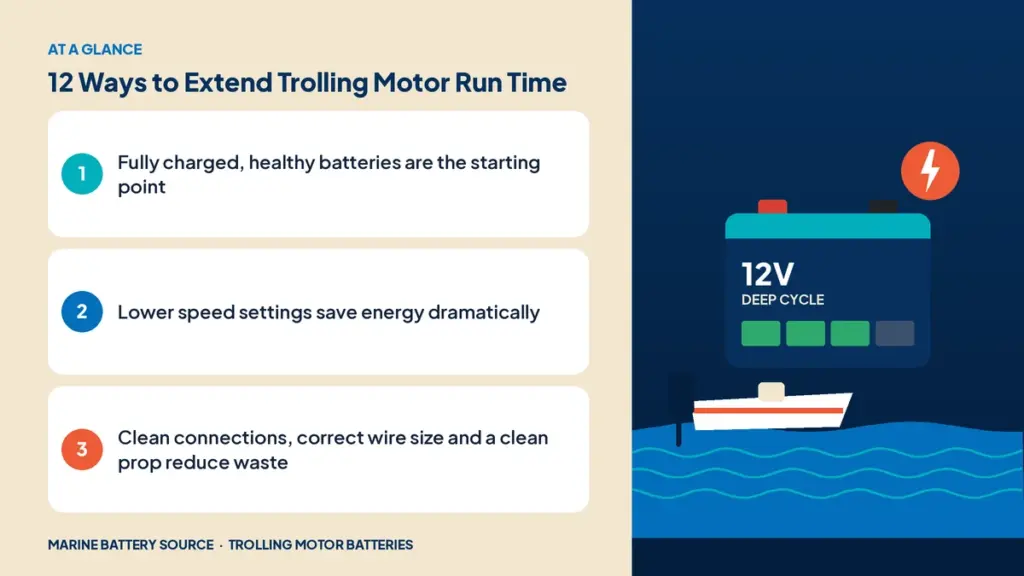
Running out of trolling motor power before you run out of fishing time is frustrating. The good news is that you can often extend trolling motor run time without buying anything, simply by changing how you charge, wire and run the motor. When you do need hardware, the upgrades are well known. Here are twelve practical ways to get more hours from your bank.
1. Start every trip fully charged
It sounds obvious, but many anglers start with batteries that aren’t full. Lead-acid batteries in particular need a long absorption stage to reach 100%. Leave the charger connected until every bank shows complete. Our guide on charging trolling motor batteries explains timing.
2. Use the right charger profile
A charger set for the wrong chemistry may stop short of full charge or overcharge. Check that each bank’s profile matches your battery maker’s specification.
3. Slow down
Power rises steeply with speed. Running at a moderate setting rather than near full speed can cut current draw dramatically. Most anglers fish most effectively at low to moderate speed anyway. Save high speed for repositioning, and use the outboard for long moves.
4. Use the outboard for long moves
Every mile you cover on the trolling motor uses energy you’ll want later. If the next spot is far away, pull the trolling motor up and run the big motor.
5. Manage GPS anchoring
GPS anchoring holds you on a spot but can draw heavily in wind and current. Use a looser holding setting when you can, and consider a mechanical or shallow-water anchor on windy days. See how spot-lock affects battery life for details.
6. Upgrade undersized wire
Voltage lost in undersized cable is energy that never reaches the prop. On long bow-to-stern runs, moving up a gauge can give the motor noticeably more voltage. Our wire size and breaker guide shows how to calculate voltage drop.
7. Clean and tighten every connection
Corroded terminals, loose lugs and dirty plugs add resistance. Inspect them at least a few times a season:
- Clean terminals and lugs to bright metal.
- Tighten to the battery maker’s torque spec.
- Seal with dielectric grease or terminal protectant.
- Replace any discolored or heat-damaged plug.
8. Keep the prop clean
Fishing line and weeds wrapped around the prop shaft increase drag and current. Check the prop regularly, especially after fishing heavy cover. Line wrapped behind the prop can also damage seals.
9. Move electronics off the trolling bank
Graphs, sonar and lights running from one battery in a series bank reduce trolling time and unbalance the string. A small dedicated battery solves both. See running electronics off the trolling battery.
10. Reduce weight
A lighter boat needs less thrust to move. Leave unnecessary gear on shore. Converting a lead-acid bank to lithium can remove a large amount of weight on its own. The EPOCH 36V 50Ah is listed at 35 lb, compared with roughly 60 to 70 lb for a single Group 27 or 31 lead-acid battery.
11. Replace aging batteries
Lead-acid batteries lose capacity as they age, and one weak battery limits a whole series string. If your runtime has shrunk year after year, a load test may show the bank is near the end of its life. When replacing, replace the whole set.
12. Add capacity or switch chemistry
If you’ve done everything above and still run short, you need more usable energy:
- Switch to lithium. You can use far more of a lithium battery’s rated capacity than lead-acid, and the voltage stays steady so the motor doesn’t fade.
- Increase capacity. A higher amp-hour battery at the same voltage. For example, the EPOCH 36V 100Ah holds double the energy of a 36V 50Ah battery.
- Add a parallel string, where space and the motor maker allow.
Our guide to upgrading a 36V bank to lithium walks through the change.
Bonus: charge on the run
A DC-DC charger fed by the outboard’s alternator puts energy back into the trolling bank while you run between spots. It won’t replace a shore-power charge, but it can stretch a long tournament day. The EPOCH 12V-to-36V DC-DC charger is designed for this.
Quick reference
| Tip | Cost | Typical impact |
|---|---|---|
| Full charge, correct profile | Free | Large, if you weren’t fully charging |
| Lower speed | Free | Large |
| Outboard for long moves | Free | Medium to large |
| Smarter anchoring | Free | Medium in wind |
| Clean connections and prop | Minimal | Small to medium |
| Upgrade wire | Moderate | Medium on long runs |
| Separate electronics battery | Moderate | Small to medium |
| Lithium or more capacity | Higher | Large |
Measure, then decide
The best way to know which changes help is to measure. A battery monitor or Bluetooth battery app shows how much energy you use per hour and how changes affect it. Try running at a lower setting for an afternoon and compare the result. Our trolling motor power system guide explains how the pieces fit together, and the 24V and 36V wiring guide covers series layouts.
Know when the problem is the battery
If runtime drops suddenly rather than gradually, look for a fault: a dead cell in a lead-acid battery, a failing connection, or a charger bank not working. A multimeter check of each battery after charging and after use can pinpoint the culprit.
For a deeper look at choosing capacity, read our pillar on choosing a trolling motor battery or our marine battery wiring guide. Browse trolling motor batteries to compare capacities.
Frequently asked questions
How can I make my trolling motor battery last longer on the water?
Start fully charged, run at lower speeds, use the outboard for long moves, manage GPS anchoring and keep connections and the prop clean.
Does wire size affect trolling motor run time?
Yes. Undersized wire wastes energy as heat and lowers the voltage at the motor, especially on long runs.
Will lithium batteries give me more run time?
Usually, because you can use more of their rated capacity and the voltage stays steady. The exact gain depends on the capacity you choose.
Why is my trolling motor run time getting shorter each year?
Lead-acid batteries lose capacity with age and partial charging. One weak battery in a series bank also limits the whole string.