


Can You Run Electronics Off Your Trolling Motor Battery?
It’s tempting: the trolling motor battery is right there, and running the fish finder off it saves adding another battery. On a simple 12V setup, it can work. But on 24V and 36V systems, and with modern high-draw sonar, it often causes problems. This guide explains when you can run electronics off your trolling motor battery, what goes wrong, and the better alternatives.
Can you do it?
On a 12V trolling motor with a single battery: yes, you can power a 12V fish finder from the same battery. It will reduce trolling time somewhat, and some setups pick up interference, but it’s a common setup on kayaks and jon boats.
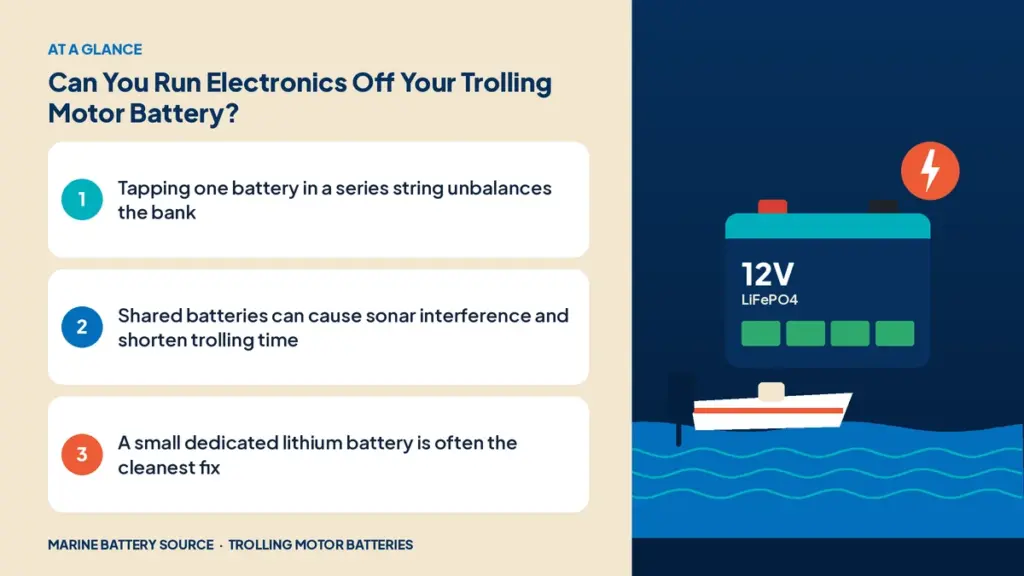
On a 24V or 36V system built from 12V batteries: you can physically connect a 12V device to one battery in the string, but it’s not recommended. That battery discharges more than the others, the string goes out of balance, and the weakest battery limits the whole bank.
On a single-case 24V or 36V battery: you need a DC-DC converter to step the voltage down to 12V.
Problem 1: series-string imbalance
In a 36V bank of three 12V batteries, the trolling motor draws the same current from all three. If you add a fish finder to battery one, it draws more than batteries two and three. Over a day, it ends up lower. When you charge with a multi-bank charger, each battery gets topped up, which helps, but lead-acid batteries cycled unevenly tend to age unevenly.
With lithium, each battery’s BMS protects it, but if one battery reaches its low-voltage cutoff first, the whole motor stops.
Problem 2: sonar interference
Trolling motors can create electrical noise that shows up on sonar screens as lines or clutter. Sharing a battery and ground with the motor makes it more likely. Many electronics makers recommend powering sonar from a separate battery, or at least running dedicated power and ground wires straight to the battery rather than sharing the motor’s leads.
Problem 3: runtime
Modern electronics draw real power. A big display, forward-facing sonar and networked units can draw several amps together, all day long. That’s energy no longer available for the trolling motor. See ways to extend trolling motor run time for more on budgeting energy.
Better options
A dedicated electronics battery
A small 12V lithium battery dedicated to electronics keeps sonar clean and the trolling bank balanced. Examples in the store:
- EPOCH 12V 50Ah Essential: 0.64 kWh, listed at 14.3 lb with Bluetooth.
- The Dakota Lithium 12V 54Ah electronics battery, listed at 14.3 lb with a 648 Wh rating.
- Small Battle Born Base Series batteries from 10Ah to 30Ah for kayaks and light loads.
A DC-DC converter
On a single-case 24V or 36V lithium battery, a converter provides 12V for small loads. Dakota Lithium offers a 24V or 36V to 12V 10A DC-DC converter. Make sure the converter’s current rating covers your electronics’ total draw with margin. Converters can also introduce noise, so quality and grounding matter.
The starting battery
On boats with an outboard, the cranking battery often powers electronics. That works well if the battery has enough reserve, and the engine recharges it while running. A dual-purpose battery is a good fit here. Make sure you can still start the engine at the end of the day; a battery switch or automatic charging relay helps.
Sizing a dedicated electronics battery
- Add up the current draw of each device from its manual.
- Multiply by hours of use.
- Add margin for cold mornings, aging and long days.
Example: devices drawing 5A total for 10 hours use 50Ah. A 50Ah lithium battery used to about 80% gives 40Ah usable, which is a little short. A 60Ah battery or larger fits better.
Charging the electronics battery
Add it to your onboard charger as another bank, or use a small separate charger. If you’re shopping for a multi-bank charger that covers a trolling bank plus electronics, see our guide on charging trolling motor batteries.
Wiring tips for electronics
- Run power and ground directly to the battery, fused close to it.
- Keep electronics wiring away from trolling motor cables where possible.
- Use the gauge recommended by the electronics maker for the run length.
- Use a bus bar and fuse block for multiple units rather than stacking lugs on the terminal.
The broader principles are in our marine battery wiring guide.
Placement
Put the electronics battery where it’s easy to reach and helps the boat’s balance. On many bass boats, there’s room next to the trolling bank or in a console. See our battery placement guide.
GPS anchoring and electronics
Long sessions on spot-lock usually mean long sessions staring at sonar. Both drain energy simultaneously. If they share a battery, the drain compounds. Read how spot-lock affects battery life.
Troubleshooting a shared setup
If you already run electronics from the trolling bank and see problems, try these steps:
- Check whether interference appears only when the trolling motor runs. If so, the motor is likely the source.
- Run temporary power and ground leads directly from a separate battery to the display. If the noise disappears, a dedicated battery is the fix.
- Check every ground connection for corrosion and tightness.
- Measure each battery in a series bank after a day of fishing. A battery that’s consistently lower than the others is a sign of uneven loads.
The bottom line
On a simple 12V boat, sharing a battery is workable. On 24V and 36V systems, a dedicated electronics battery or a quality converter is the better choice. It keeps the bank balanced, improves sonar clarity and preserves trolling time. For more context, see our trolling motor power system guide and our 36V lithium upgrade guide, or browse lithium batteries in the store.
Frequently asked questions
Can I run my fish finder off my trolling motor battery?
On a single 12V battery, yes, with some loss of trolling time and possible interference. On 24V and 36V series banks, it’s better to use a separate battery or a DC-DC converter.
Why does my sonar show interference from the trolling motor?
Shared power and ground paths can carry motor noise into the sonar. A separate battery with dedicated wiring usually fixes it.
What size battery do I need for electronics?
Add up device currents, multiply by hours, and add margin. Many anglers use a 50Ah to 60Ah lithium battery for a day of electronics.
Can I use a DC-DC converter on a 36V battery?
Yes. A 36V-to-12V DC-DC converter rated for your electronics’ total current is the standard way to get 12V from a single 36V battery.