


48V Trolling Motors and Their Battery Options
Twelve, 24 and 36 volts cover most trolling motors on the water today. But 48V systems are increasingly common on high-thrust motors, small electric outboards and electric propulsion for tenders and sailboats. If you’re shopping for a 48V trolling motor battery, the good news is that LiFePO4 makes 48V practical in a single case. This guide explains when 48V makes sense, how to build the bank, and what to watch for.
Why higher voltage?
Electric power is volts times amps. For the same power, doubling the voltage halves the current. Lower current means:
- Smaller cables carry the load with less voltage drop.
- Less heat at connections and switches.
- Better efficiency for high-power motors.
That’s why thrust ratings and voltages climb together. The 12V, 24V and 36V options are compared in our guides to 12V trolling motor batteries and 24V systems. At 48V, motors can deliver more power without pushing cable sizes to extremes.
Who uses 48V systems
- High-thrust trolling motors on larger boats where wind and current demand more power.
- Electric outboards used as primary propulsion on small boats, tenders and pontoons. Many of these run on 48V nominal.
- Sailboat auxiliary drives, where an electric motor replaces a small diesel.
Always confirm your motor’s nominal voltage and acceptable voltage range in its manual before buying batteries. “48V” in a LiFePO4 battery usually means a nominal 51.2V pack, and most 48V motors are designed with that in mind. Your motor maker will specify whether lithium packs are approved.
Option 1: a single 48V lithium battery
A single-case 48V battery is the simplest way to build a 48V bank. Examples in the store:
- EPOCH 48V 100Ah V2 Elite: 5.12 kWh in an 8D footprint, listed at 97 lb, with Bluetooth and heating.
- Dakota Lithium 48V 105Ah: listed at 81.6 lb and 5,376 Wh, with 200A maximum continuous discharge per the product listing.
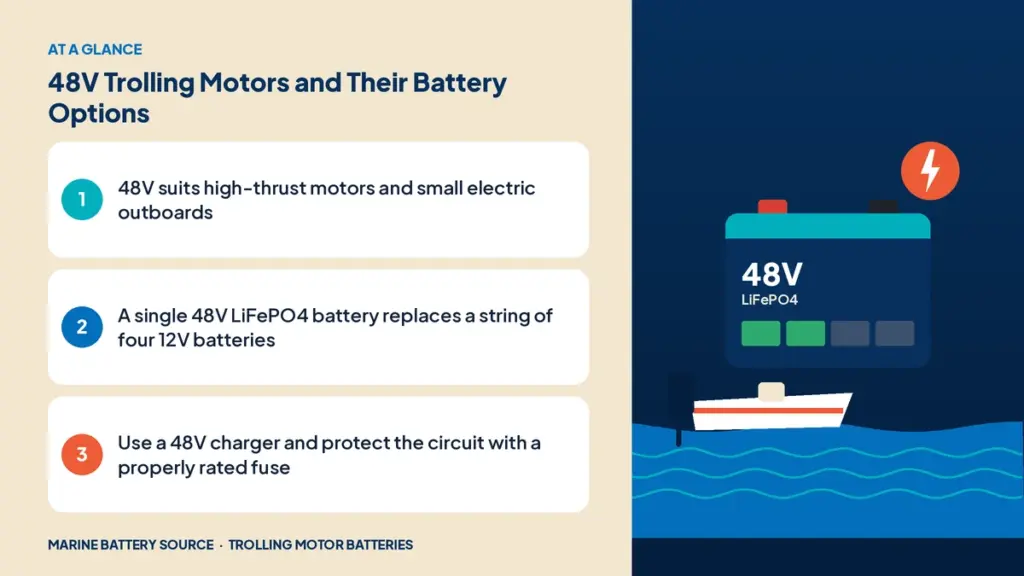
At around 5 kWh, these batteries hold roughly the energy of four 12V 100Ah lithium batteries in one box. The weight is concentrated, so plan the mounting location and secure the battery firmly with proper hold-downs.
Option 2: four 12V batteries in series
Four matched 12V batteries in series give 48V nominal. Dakota Lithium sells a matched 48V 100Ah set of four 12V Group 24 batteries for this purpose. The advantages are smaller individual cases you can spread around the hull, and the ability to use a four-bank charger. The drawbacks are three series jumpers, more terminals to maintain, and the need to keep four batteries balanced.
Our single-battery vs series comparison for 24V applies equally at 48V. The trade-offs scale up as you add batteries.
Sizing a 48V bank
Run-time math works the same way at any voltage. Find the motor’s average current draw at 48V (our amp draw guide explains how to estimate it) and multiply by your hours on the water.
Example: a motor averaging 25A at 48V for 4 hours uses about 100Ah. A 48V 100Ah lithium battery used to around 80% leaves you a bit short at the end of that day, so you would either fish slower, accept the margin, or add capacity.
Thinking in watt-hours helps when comparing electric outboards rated in watts. A 5.12 kWh battery delivering 1,000W runs for roughly five hours before accounting for inefficiencies and reserve.
Charging 48V batteries
A single 48V lithium battery needs a 48V lithium charger. Options in the store include:
- The Dakota Lithium 48V 22A onboard charger.
- The EPOCH 48V 15A lithium charger.
- The Allied Lithium 48V 15A waterproof charger.
A larger charger current shortens recharge time. A 100Ah battery taking about 80Ah back at 15A needs roughly five and a half hours; at 22A, roughly four. Always stay within the battery maker’s maximum charge current. Our guide to charging trolling motor batteries covers chargers in more depth.
12V accessories on a 48V boat
Electronics, lights and pumps still need 12V. Use a separate 12V battery for those loads, or a 48V-to-12V DC-DC converter sized for the accessory current. Avoid tapping one battery of a series string for 12V, since that unbalances the bank.
Wiring and safety at 48V
At 48V, current is lower but the system still stores a lot of energy, and a short circuit can deliver enormous current.
- Fuse the positive conductor close to the battery with a fuse rated for the system voltage and the motor’s current. A component like the Battle Born 58V 300A marine-rated fuse is an example of a part rated above 48V nominal; size the fuse to your wire and motor per the manufacturer’s guidance.
- Use marine-grade tinned copper cable sized for current and length.
- Install a battery switch or disconnect rated for the voltage and current.
- Insulate terminals and keep tools away from exposed lugs.
Ratings matter: many 12V-only components aren’t rated for a 48V nominal system. The broader wiring view is in our trolling motor power system guide.
48V lithium or lead-acid?
Building 48V from lead-acid means four heavy batteries. Four Group 31 AGMs can weigh well over 250 lb and give you only about half their rated capacity in regular use. That makes lithium the more common choice at 48V. If budget rules, the trade-offs in our AGM trolling motor battery guide still apply, multiplied by four.
Checklist before you buy
- Confirm the motor’s nominal voltage, voltage range and lithium approval.
- Calculate energy in watt-hours for your typical day.
- Measure the compartment and consider weight placement.
- Pick a 48V charger with the correct profile.
- Plan fusing, switching and cable sizing for the motor’s maximum current.
- Plan a 12V supply for electronics.
To compare options at every voltage, start with how to choose a trolling motor battery, or see how 48V fits different hulls in battery setups by boat type. Browse the full lithium battery collection for more sizes.
Frequently asked questions
Do 48V trolling motors exist?
Yes. Some high-thrust trolling motors and many small electric outboards run at 48V nominal. Check your motor’s manual for its exact voltage range.
Can I use four 12V batteries for a 48V motor?
Yes. Four matched 12V batteries in series give 48V nominal. Use identical batteries and charge them evenly, ideally with a four-bank charger or as recommended by the battery maker.
How long does a 48V 100Ah battery last?
It stores about 5.1 kWh nominal. Divide usable watt-hours by your motor’s average power draw for an estimate. At 1,000W average, that’s roughly four to five hours with reserve.
What charger do I need for a 48V lithium battery?
A 48V charger with a LiFePO4 profile that matches the battery maker’s voltage settings and stays within its maximum charge current.