


Marine Battery Warranties Compared: What’s Actually Covered
Battery warranties range from a few months to more than a decade, and the fine print varies just as much. A long warranty can be a good sign of a maker’s confidence, but only if you understand what it covers. This guide explains how marine battery warranty terms work, compares the warranty lengths listed on the store’s products, and shows what you can do to keep coverage valid.
Types of warranty coverage
Free replacement
If the battery fails within the period, you get a replacement at no cost. This is common for lead-acid batteries. Interstate’s marine listings, for example, state free-replacement periods.
Pro-rated
After any free-replacement period, some warranties credit part of the battery’s value toward a replacement, based on how much of the warranty period has passed. Read whether a long warranty is full replacement for the whole term or partly pro-rated.
Capacity-based
Lithium warranties may define failure by capacity, for example, coverage if the battery falls below a stated percentage of its rated capacity within the term. Check the threshold and how capacity is measured.
Limited lifetime
Some products carry a “limited lifetime” warranty. The limits matter more than the word lifetime, so read the terms.
Warranty lengths on the store’s listings
These figures come from the store’s product listings, which are based on manufacturer information. Check each product page and the maker’s terms before you buy.
| Brand and product line | Listed warranty |
|---|---|
| Dakota Lithium batteries | 11 years |
| EPOCH Essential and Elite series | 11 years |
| EPOCH Eco series | 6 years |
| Lithium Rhino marine conversion kits | 8 years |
| Battle Born base-series batteries | 5 years |
| ECO Battery 12V 120Ah | Limited lifetime |
| Interstate lithium marine batteries | 36 to 60 months free replacement, by model |
| Interstate AGM marine batteries | 24 to 36 months free replacement, by model |
| Interstate flooded starting and deep-cycle | Typically 12 months free replacement |
| Dakota Lithium 48V 22A charger | 1 year |
Some product pages don’t list a warranty, including Trojan’s batteries and Battle Born’s larger models. For those, check the manufacturer’s current warranty terms directly.
Comparing within a brand
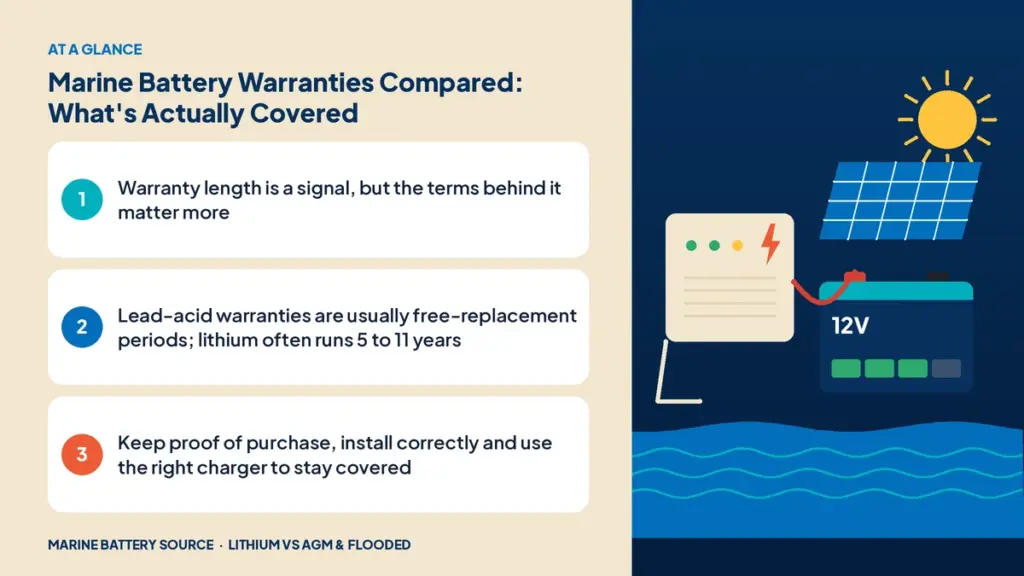
Warranty terms often vary by product line. Interstate’s listings show this clearly: the Interstate SRM-24 flooded battery lists 12 months, the 24M-EFB 24 months, the 27M-AGM 36 months, and the Li27M 12V 100Ah lithium 60 months. Within EPOCH, the Essential series lists 11 years while the Eco series lists 6. A longer warranty usually comes with a higher price, so weigh the two together.
Common exclusions
Warranty terms differ, but these exclusions are common:
- Improper installation, including missing fuses, loose connections or unsecured batteries.
- Wrong charger or charge settings, such as charging lithium on an equalization mode.
- Physical damage, such as cracked cases or damaged terminals.
- Water damage or submersion, even on sealed or rated batteries in some cases.
- Opening the case or modifying the BMS.
- Freezing or overheating beyond the stated limits.
- Commercial use, which some consumer warranties exclude or cover for a shorter time.
- Deep discharge damage on lead-acid batteries left flat.
Chargers and accessories have their own terms
Chargers, DC-DC converters and accessories usually carry shorter warranties than batteries, often one or two years. Keep their receipts too, and note that installing a charger incorrectly can void both its warranty and the battery’s.
How to keep your warranty valid
- Keep proof of purchase and note the install date.
- Register the battery if the maker offers registration.
- Install correctly: fuse the positive near the battery, secure the battery and torque the terminals to spec. Our drop-in replacement checklist covers the steps for lithium.
- Use the right charger and settings for the chemistry.
- Respect temperature limits, including the rule against charging non-heated lithium below freezing.
- Store properly between seasons, following the maker’s instructions.
- Keep records, such as app screenshots or charger logs, if a problem develops.
What warranty length tells you
A long warranty suggests the maker expects the battery to last, and it shifts some risk away from you. It’s not a guarantee of performance in every condition. Compare warranty length together with cycle-life ratings and their test conditions; our cycle life guide explains how. For lithium batteries, the BMS design and published current limits are also strong signals of quality, as our BMS explainer describes.
Warranty, price and value
It’s tempting to divide price by warranty years and call that the cost of ownership. That’s a reasonable starting point, but it misses two things. First, many batteries outlast their warranty when they’re well cared for, and some fail early when they’re abused, warranty or not. Second, a pro-rated warranty returns less value late in its term than a full-replacement one. A fairer comparison combines three questions: how long will this battery realistically last in my use, what does the warranty actually pay if it fails, and how easy is the maker to deal with? Ask other owners and your dealer about the third one. A long warranty from a maker who’s hard to reach is worth less than a shorter one that’s honored quickly.
Making a warranty claim
If you suspect a problem:
- Fully charge the battery on the correct profile and retest.
- Note the symptoms, any error codes from the battery app and the conditions when it happened.
- Contact the seller or the maker with proof of purchase.
- Follow their testing steps; many makers want specific tests before approving a claim.
Water resistance and how makers treat water exposure are covered in IP67 and waterproof ratings. For the full buying picture, see the lithium marine battery buyer’s guide, or read the store’s warranty information page for how we help with claims.
Frequently asked questions
Which marine battery has the longest warranty?
Among the store’s listings, Dakota Lithium batteries and EPOCH’s Essential and Elite series list 11 years, and the ECO Battery 12V 120Ah lists a limited lifetime warranty. Read the terms behind each.
Are lead-acid battery warranties pro-rated?
Many lead-acid warranties are a free-replacement period. Some add pro-rated coverage afterward. Check the maker’s terms for your model.
Does using the wrong charger void a battery warranty?
It can. Many warranties exclude damage from incorrect charging. Use a charger and settings that match the battery’s chemistry and the maker’s specifications.
Do I need to register my battery?
If the maker offers registration, it’s worth doing. Always keep your proof of purchase.