


What a BMS Does Inside a Lithium Marine Battery
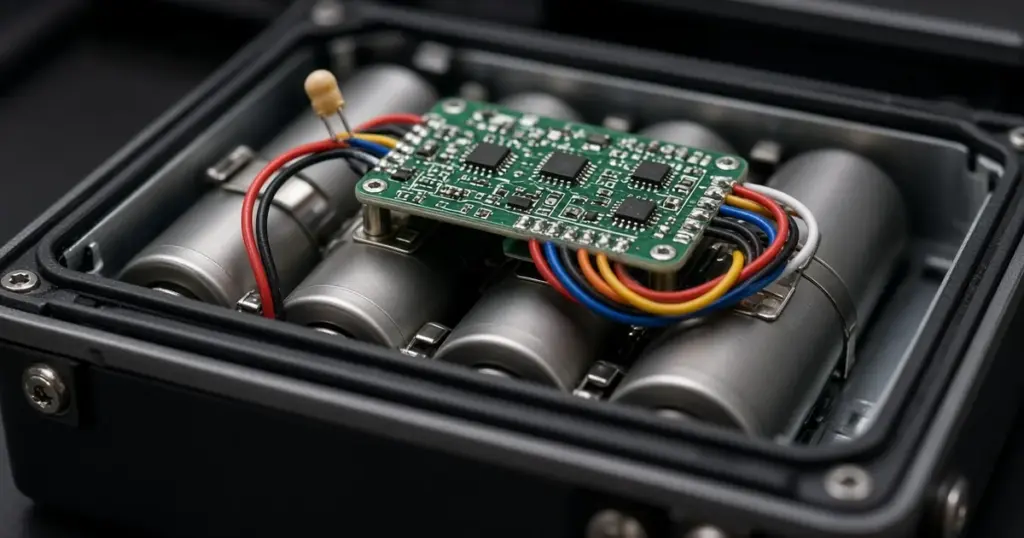
Every LiFePO4 marine battery has a small computer inside it called a battery management system, or BMS. You never see it, but it decides when the battery charges, when it delivers power and when it shuts itself off. Understanding what a lithium battery BMS does helps you choose the right battery, wire it correctly and diagnose problems when the power suddenly disappears. This guide explains BMS functions in plain terms for boaters.
Why lithium batteries need a BMS
A 12V LiFePO4 battery is made of four cells, or groups of cells, wired in series. Each cell must stay within a safe voltage window. If one cell is pushed too high during charging or drained too low, it can be permanently damaged. Lead-acid batteries tolerate small imbalances by gassing off excess charge; lithium cells don’t. The BMS prevents those conditions and protects the battery from short circuits and temperature extremes.
What the BMS monitors
- Cell voltages: each cell or cell group, not just the whole battery.
- Current: how many amps flow in and out.
- Temperature: usually at one or more points inside the case.
- State of charge: estimated from current and voltage, often reported over Bluetooth.
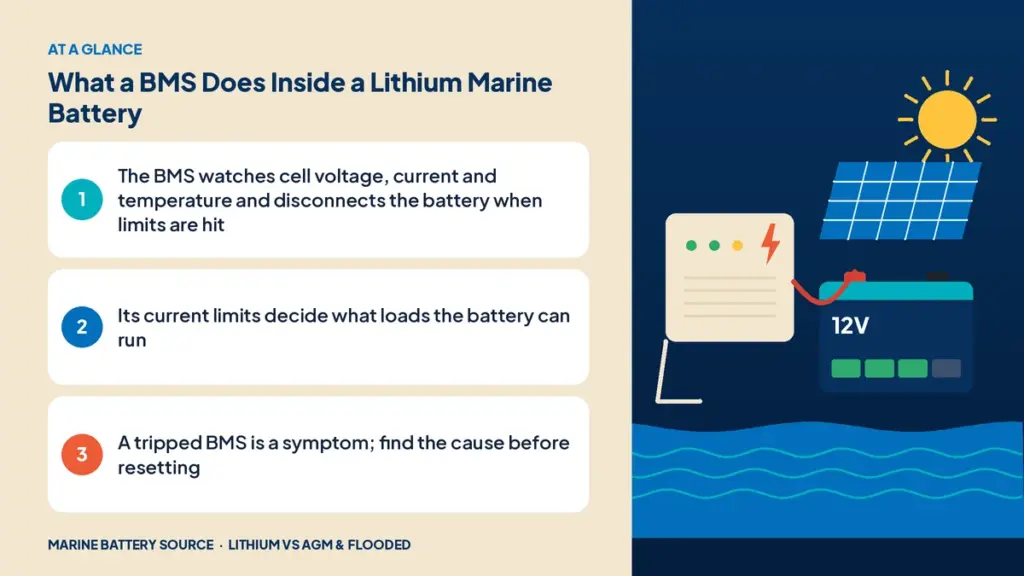
The protections, one by one
Overcharge protection
If any cell rises above its limit during charging, the BMS stops the charge current. This can happen if a charger’s voltage is set too high or if cells drift out of balance.
Over-discharge protection
When a cell drops to its low-voltage limit, the BMS disconnects the load. This is why a lithium trolling battery can seem to die all at once. The voltage stays steady until the end, then the BMS cuts off.
Overcurrent protection
Each battery has a continuous discharge rating and a short pulse rating. Exceed them and the BMS disconnects. The store’s listings show the range: the Dakota Lithium 12V 54Ah lists 60A continuous and a 100A pulse for 10 seconds, while the Dakota Lithium 36V 110Ah lists 200A continuous and a 400A pulse for 1 second. Charge current is limited too.
Short-circuit protection
A dead short can produce enormous current. The BMS reacts within a fraction of a second. That’s not a substitute for a properly rated fuse at the battery, which protects the cable and the boat.
Temperature protection
LiFePO4 cells must not be charged below freezing. The BMS blocks charging when the cells are too cold and may limit discharge at extreme temperatures. It also protects against overheating. In heated batteries, the BMS runs internal heaters before allowing charge.
Cell balancing
Over many cycles, cells drift slightly apart in charge level. Balancing circuits bleed a little energy from the highest cells near full charge so all cells finish together. That’s one reason lithium batteries benefit from periodically reaching full charge on a proper lithium profile.
How BMS limits affect what you can run
Before you buy, compare your loads to the BMS ratings:
- Trolling motors: check the motor’s maximum current draw against the battery’s continuous rating.
- Inverters: a 2,000W inverter on a 12V system can draw well over 150A at full load. The battery, or parallel batteries, must support that.
- Engine starting: cranking needs a high pulse rating. Batteries built for dual-purpose duty, like the Dakota Lithium DL+ series, publish cranking figures.
- Windlasses and thrusters: short, very high loads that need a high pulse rating.
Paralleling two identical batteries roughly doubles the available current and capacity, within the maker’s guidance.
When the BMS trips
A disconnected battery reads zero or near-zero volts at the terminals, or nothing turns on. Common causes:
- Low state of charge: the battery reached its cutoff. Recharge it.
- Overcurrent: a load drew more than the rating. Reduce the load or upgrade the battery.
- Cold temperature during charging: the BMS blocked the charge. Warm the battery or use a heated model.
- High charger voltage: the BMS stopped charging to protect a cell. Check the charger profile.
- Short circuit: find and fix the fault before reconnecting.
Many batteries reset automatically when the condition clears, and some need a charger connected to wake them. Follow the maker’s instructions. Our BMS shutdown troubleshooting guide goes into more detail.
BMS and Bluetooth
In many batteries the BMS also feeds data to an app, showing state of charge, current, cell voltages and temperature, plus fault logs. That makes troubleshooting much easier. See whether Bluetooth monitoring is worth it.
BMS and series or parallel banks
When lithium batteries are wired in series for 24V or 36V, each battery’s BMS works independently. If one battery’s BMS disconnects, the entire series string stops. That’s why makers recommend matched batteries at the same state of charge before you connect them, and why some publish limits on how many units you can wire together. In parallel banks, a battery that disconnects shifts its load onto the others, which can then trip in turn. Follow the maker’s series and parallel limits, and charge each battery fully before you first connect a bank.
BMS quality and warranty
BMS quality shows up in the published specs: realistic continuous and pulse ratings, clear temperature limits and long warranties. Treat a battery with vague or missing specifications with caution. Don’t open a battery case or try to bypass the BMS; doing so can be dangerous and voids warranties. Read our warranty comparison for what makers cover, and our IP rating guide for how cases protect the electronics inside.
The bottom line
The BMS is what makes a lithium battery safe and long-lived. Choose a battery whose BMS limits match your loads, charge it with a profile it expects, keep it within its temperature range, and treat any shutdown as a message to read. For the full set of buying criteria, see the lithium marine battery buyer’s guide, and if you’re new to lithium, the cycle life guide is a useful next read. Browse the store’s lithium batteries to compare current ratings.
Frequently asked questions
What does a BMS do in a lithium battery?
It monitors cell voltages, current and temperature, and disconnects the battery to prevent overcharge, over-discharge, excessive current, short circuits and charging at unsafe temperatures. It also balances the cells.
Why did my lithium battery shut off?
Most often the battery reached its low-voltage cutoff, a load exceeded its current rating, or charging was blocked because it was too cold. Check the app or the maker’s guide to identify the cause.
Does a BMS replace a fuse?
No. A fuse near the battery protects the cable and boat wiring from fire in a short circuit. The BMS protects the cells. You need both.
Can I use a lithium battery with a high-draw inverter?
Yes, if the battery’s continuous discharge rating, or the combined rating of parallel batteries, exceeds the inverter’s maximum draw with margin.