


Gel vs AGM Marine Batteries: What’s the Difference?
Gel and AGM batteries are both sealed, valve-regulated lead-acid batteries, and they’re often lumped together as “maintenance-free.” But they’re built differently and want to be treated differently. If you own an older boat with gel batteries, or you’re comparing sealed options for a new bank, it helps to know the differences. This guide covers gel vs AGM marine batteries: construction, charging, performance and where each still makes sense.
How each one is built
Both types start with lead plates and sulfuric acid electrolyte in a sealed case with pressure-relief valves.
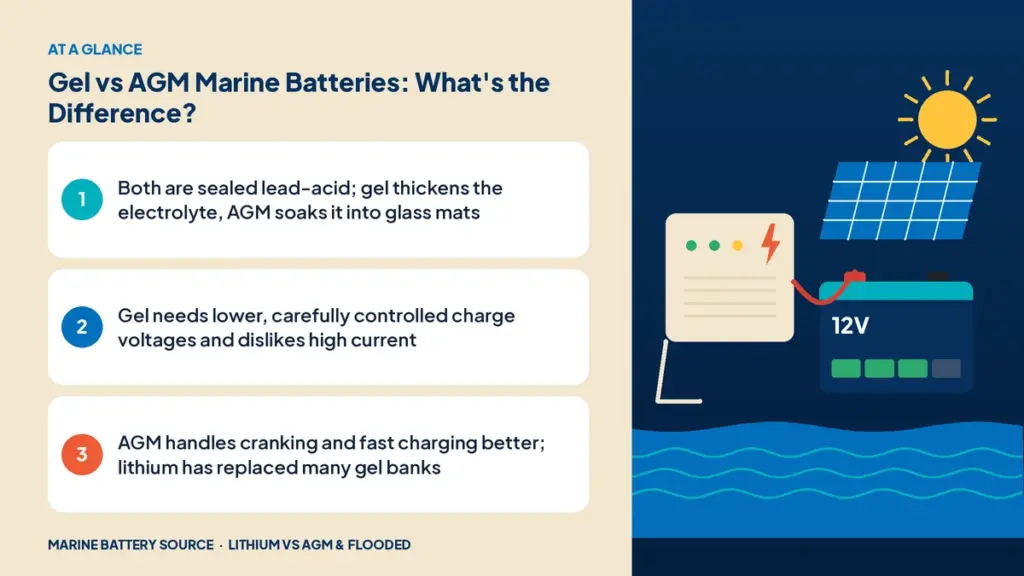
- Gel: the electrolyte is mixed with fumed silica, which turns it into a thick, immobile gel.
- AGM (absorbed glass mat): the electrolyte is absorbed into fine fiberglass mats compressed between the plates.
In both designs, oxygen and hydrogen produced during charging mostly recombine inside the battery, so you never add water. Both are spill-resistant and can be mounted in more orientations than flooded batteries, within the maker’s limits.
Gel vs AGM at a glance
| Trait | Gel | AGM |
|---|---|---|
| Electrolyte | Thickened gel | Absorbed in glass mat |
| High-current cranking | Weaker | Strong |
| Charge voltage | Lower and tightly controlled | Moderate, AGM-specific |
| Tolerance of overcharging | Poor; can form voids in the gel | Poor, but somewhat more forgiving |
| Charge acceptance | Slower | Faster |
| Deep-cycle durability | Good | Good |
| Heat tolerance | Often good | Good |
| Market availability | Shrinking | Widespread |
Charging is the big difference
Gel batteries are the most sensitive lead-acid type to charging voltage. Their recommended absorption voltage is typically lower than AGM or flooded batteries, and exceeding it can create pockets in the gel that permanently cut capacity. That means every charging source on the boat, including the onboard charger, alternator regulator and solar controller, has to be set to a gel profile. Many older boats with gel batteries quietly lost capacity because one source was set for flooded batteries.
AGM batteries also need correct voltages and shouldn’t be overcharged, but most modern marine chargers include an AGM setting, and AGM-compatible regulators are common.
Performance differences
Cranking
AGM’s low internal resistance lets it deliver big bursts of current, so AGM is common in starting and dual-purpose roles. Interstate’s 31M-AGM, for example, is listed at 925 CCA. Gel batteries generally aren’t designed for heavy cranking.
Charge speed
AGM accepts charge faster, which matters if you’re charging from an alternator during short runs or from a generator at anchor.
Deep cycling
Both types handle deep cycling well when charged correctly. Gel earned a reputation for long cycle life in house banks, but that depended on careful charging.
Why gel is less common today
Gel batteries were once a popular premium choice for sealed house banks. Today, AGM covers most sealed lead-acid needs at lower cost and with simpler charging, and LiFePO4 lithium has taken over many high-cycle house and trolling applications. The store carries flooded, AGM, EFB and lithium marine batteries rather than gel, reflecting that shift.
Replacing gel batteries
If your gel batteries are due for replacement, you have three main options.
Replace with AGM
For most owners, this is the simplest move. Change every charging source to an AGM profile: onboard charger, alternator regulator, solar controller and any inverter-charger. Deep-cycle AGMs such as the Trojan 27-AES and Trojan 31-AES come in common group sizes.
Replace with lithium
LiFePO4 offers far more usable capacity per pound and much longer cycle life. It needs lithium charging profiles, and alternator charging usually needs a DC-DC charger or a lithium-ready regulator. Our lithium conversion guide walks through the steps, and is lithium worth it? helps you decide.
Replace with gel
Possible if you can find them and your system is already set up for gel, but check availability for future replacements.
Whichever you choose, replace the entire bank at once. Don’t mix gel, AGM and flooded batteries in one bank.
Spotting a gel battery
Labels usually say “gel” or “gel cell” clearly. If a sealed battery’s label just says “VRLA” (valve-regulated lead-acid), it could be either type, so check the maker’s model information before you change charger settings.
Matching chargers when you switch
When you replace gel batteries, make a list of every device that charges them and confirm its setting:
- Shore-power charger or inverter-charger.
- Engine alternator and regulator, or any DC-DC charger.
- Solar or wind charge controller.
- Any battery maintainer used during storage.
It’s easy to change the onboard charger and forget the solar controller, which can quietly overcharge or undercharge a new bank for months.
Temperature and storage
Both gel and AGM batteries have low self-discharge compared with flooded batteries, so they hold charge reasonably well in storage. Both still lose capacity faster in high heat, and both should be stored fully charged and kept topped up with a maintainer set to the correct profile. Gel batteries are sometimes described as tolerating heat well, but no lead-acid battery enjoys a hot engine room. Mount batteries away from heat sources and keep compartments ventilated, which also matters for safety if a battery is ever overcharged.
Which sealed battery is right for you?
- Starting or dual-purpose: AGM.
- House bank, budget-conscious: AGM, or flooded if you can maintain it. See flooded vs AGM.
- House or trolling bank, heavy cycling: lithium.
- Existing gel system you want to keep: gel, charged on a strict gel profile.
For a broader comparison of chemistries, start with lithium vs AGM vs flooded. Our guide to EFB batteries covers another lead-acid option, and lithium vs lead-acid discharge curves explains how the chemistries behave under load. Browse AGM and lead-acid batteries in the store.
Frequently asked questions
Can I charge a gel battery with an AGM charger setting?
Only if the voltages match the gel maker’s recommendations, which they often don’t. Gel batteries usually need lower absorption voltages, so use a dedicated gel setting.
Is gel or AGM better for deep cycling?
Both handle deep cycling well when charged correctly. AGM is easier to charge correctly with common equipment and handles high-current loads better.
Can I replace gel batteries with AGM?
Yes, in most cases. Replace the whole bank and switch every charging source to an AGM profile.
Are gel batteries good for starting an engine?
They’re generally not designed for high cranking current. AGM or flooded starting batteries are a better choice for engine starting.