


Your house bank powers everything aboard that isn’t the engine: cabin lights, the fridge, water and bilge pumps, chartplotters, radios and fans, plus an inverter if you run AC devices. On a day boat it might be a single battery. On a cruiser or liveaboard it’s the heart of the electrical system, and its size decides whether you wake up at anchor with power to spare or with the low-voltage alarm going off.
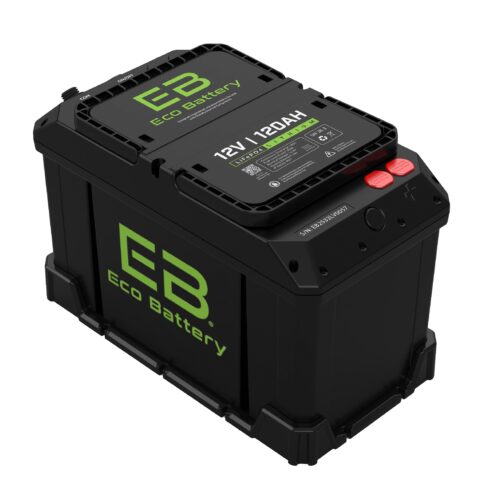
This collection includes house bank batteries in every major chemistry. There are high-capacity LiFePO4 batteries from EPOCH, Battle Born, Dakota Lithium, Lithium Rhino and ECO Battery, including GC2, GC3, Group 31 and 8D-style footprints. You’ll also find proven 6V and 12V flooded and AGM deep-cycle batteries from Trojan and Interstate for banks built the traditional way.
Compare usable capacity, weight, dimensions and series/parallel limits on each product page. We ship nationwide, and our team installs house bank upgrades anywhere from Venice to Gainesville, FL.
How to plan a house bank
Start with your daily energy use
List each load, its current draw in amps (or watts divided by voltage), and the hours it runs in a typical day. Add them up to get amp-hours per day. Then decide how many days you want to go between charges, and add a margin. Our step-by-step guide to sizing a house bank for overnights includes a worksheet approach.
Account for usable capacity
Rated capacity isn’t the same as usable capacity. Lead-acid batteries last longest when they aren’t discharged deeply, so you plan to use only part of their rating. LiFePO4 batteries tolerate much deeper discharge, so more of the rated capacity is usable day to day. That’s a big reason lithium house banks can be smaller and lighter for the same real-world runtime.
Choose 6V pairs, 12V batteries or a single large battery
- 6V deep-cycle pairs (such as golf-cart-size flooded or AGM batteries) wired in series make 12V, and they’re a classic, durable house bank. Browse AGM & Lead-Acid.
- 12V deep-cycle batteries wired in parallel add capacity while staying at 12V.
- Large single lithium batteries cut the number of connections and the weight. Some are built for 24V or 48V systems on larger vessels.
Whatever you choose, build a bank from identical batteries, and stay within the manufacturer’s series and parallel limits.
Plan charging
A bigger bank needs more charging. Look at your shore-power charger, your engine alternator, and solar if you have it. Lithium house banks usually need a lithium-profile charger, and they often need a DC-DC charger between the alternator and the bank. See charging lithium on a boat and shop Chargers.
Protect and monitor the system
Fuse the bank close to the battery terminals, size the cables for the loads, and use a battery switch to isolate the bank. A battery monitor or the battery’s own Bluetooth app keeps you honest about state of charge. You’ll find fuses, distribution blocks and trays in Accessories.
Heat and the house bank
House banks often sit in closed engine rooms or lockers. High temperatures speed up battery aging in every chemistry, so ventilation matters, especially in Florida. Read Florida heat and battery life.
House bank batteries FAQ
Can I add a new battery to an old bank?
It’s best not to. Mismatched age or capacity makes the batteries share load unevenly. Replace a bank as a set.
Should my starting battery be part of the house bank?
Keep it separate so house loads can’t stop you from starting the engine. A switch or charging relay can still charge both.
Do I need to change my charger to go lithium?
Usually you need a lithium profile. Some chargers have one built in; check the manual.
Can you design and install a house bank for me?
Yes, anywhere from Venice to Gainesville, FL. Contact us or see local installation.
Prices, stock and shipping options are confirmed in your cart and at checkout.