


Environmental Impact: Lithium vs Lead-Acid Boat Batteries

Boaters tend to care about the water they use, so it’s natural to ask which battery chemistry is better for the environment. The honest answer is that both lead-acid and lithium have trade-offs, and how you use and dispose of a battery matters as much as the chemistry. This guide compares them in plain terms.
What’s inside
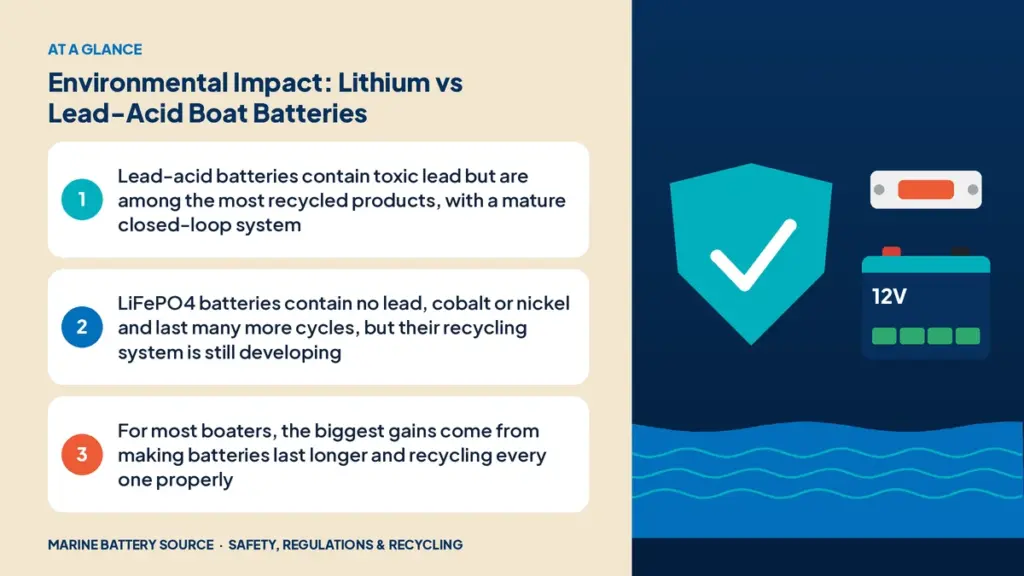
Lead-acid batteries, flooded and AGM, contain lead plates, sulfuric acid electrolyte and a polypropylene plastic case. Lead is toxic to people and wildlife, and acid is corrosive.
LiFePO4 lithium batteries contain lithium iron phosphate cathodes, graphite anodes, a liquid or gel electrolyte, copper and aluminum foils, a BMS circuit board and a plastic or metal case. LiFePO4 contains no lead, cobalt or nickel. Every lithium battery in our store uses LiFePO4.
Raw materials
Lead is mined, but much of the lead used in new lead-acid batteries comes from recycled batteries.
Lithium is extracted from brine or hard-rock mining, with environmental impacts including water use and land disturbance. Iron and phosphate, the other main cathode materials in LiFePO4, are abundant. Avoiding cobalt and nickel means LiFePO4 avoids some of the most problematic supply chains in battery manufacturing.
Recycling
Lead-acid recycling is one of the most successful recycling systems in the world. Most used lead-acid batteries in the U.S. are recycled, and the process recovers lead and plastic for new batteries. Laws like Florida’s landfill ban and retailer trade-in requirement, plus core charges, keep batteries in the system. When lead-acid batteries escape that system, though, they’re a serious hazard. See how to dispose of a boat battery.
Lithium recycling is newer and less convenient for consumers. Industrial recycling capacity is growing, and LiFePO4 batteries can be recycled to recover materials, but collection points for large lithium batteries are fewer. Returning lithium batteries through take-back programs, recyclers and county hazardous waste sites matters. See the marine battery recycling guide.
Lifespan
This is where lithium has a big advantage. A lead-acid deep-cycle battery typically delivers hundreds of cycles at 50% depth of discharge. LiFePO4 batteries in our store list thousands: Battle Born lists 3,000–5,000 cycles, EPOCH Eco lists 4,500+, and Dakota Lithium lists up to 5,000 cycles to 80% capacity. One lithium battery can outlast several lead-acid batteries in the same job, which means fewer batteries manufactured, shipped and recycled.
Weight and fuel
Lithium batteries weigh about half as much as lead-acid for the same rated capacity, and much less per usable amp-hour. On a boat, less weight can mean slightly better fuel economy and performance. For a bass boat that swaps three lead-acid trolling batteries for one 36V lithium battery, the weight saving can exceed 100 pounds.
Efficiency
Lithium batteries charge more efficiently than lead-acid, wasting less energy as heat and gassing. Over years of charging, that adds up to less electricity or fuel used to recharge.
Spills and pollution risk on the water
Lead-acid batteries can leak acid when cracked or overfilled, and flooded batteries can spill if tipped. A sunken or abandoned boat with lead-acid batteries can leach lead. Lithium batteries contain no liquid acid, but a damaged lithium battery in the water is still a hazard and should be recovered and recycled.
Fire risk and disposal
Lithium batteries in household trash can start fires in collection trucks and recycling facilities. That’s a real environmental and safety problem, which is why lithium must never go in the trash. Lead-acid batteries don’t usually cause trash fires, but they release lead and acid when crushed. See storing spare batteries at home for safe storage before disposal.
Manufacturing energy
Making any battery takes energy and materials. Studies of battery manufacturing generally find that lithium batteries take more energy to produce per unit than lead-acid batteries of similar capacity, but they deliver far more energy over their lifetime. The more cycles you actually use, the better lithium looks. A lithium battery that sits mostly unused for years doesn’t recover its manufacturing footprint as well as one that’s cycled every weekend.
A real-world example
A tournament angler who replaces three lead-acid trolling batteries every three seasons might go through a dozen batteries over twelve years. A single 36V lithium battery could cover the same period, if it’s sized and cared for correctly. That’s fewer batteries made, shipped and recycled, and a lighter boat every trip.
Comparison
| Lead-acid | LiFePO4 | |
|---|---|---|
| Toxic heavy metals | Lead | No lead, cobalt or nickel |
| Recycling system | Mature, widespread | Growing, less convenient |
| Cycle life | Hundreds | Thousands |
| Weight per usable kWh | High | Low |
| Charging efficiency | Lower | Higher |
| Spill risk | Acid in flooded types | No liquid acid |
| Trash fire risk | Low | High if discarded improperly |
Which is greener?
For deep-cycle use, such as trolling motors and house banks used often, lithium’s long life, efficiency and lack of lead usually give it the edge over its lifetime, provided it’s recycled at the end. For starting batteries and boats used rarely, a lead-acid battery that’s properly recycled is a reasonable choice, especially given its mature recycling system.
How to reduce your battery footprint
- Size batteries correctly so you don’t overbuy or wear out undersized ones.
- Charge properly with the right charger profile; overcharging and undercharging both shorten life.
- Store batteries well in the off-season. See winter storage for marine batteries.
- Keep connections clean and batteries secure.
- Test before replacing; see battery end-of-life signs.
- Recycle every battery, and return cores.
- Transport old batteries safely; see how to transport a marine battery safely.
More reading
The marine battery safety guide covers safe handling for both chemistries.
Shop
Browse LiFePO4 lithium batteries and AGM and lead-acid batteries, or compare EPOCH and Trojan.
Frequently asked questions
Are lithium batteries better for the environment than lead-acid?
For frequent deep cycling, lithium usually has the edge over its lifetime, if it’s recycled properly.
Are lead-acid batteries recyclable?
Yes. They’re among the most recycled products in the U.S.
Do LiFePO4 batteries contain cobalt?
No. LiFePO4 contains no lead, cobalt or nickel.
Why can’t lithium batteries go in the trash?
They can short and start fires in garbage trucks and facilities.
How can I make my batteries last longer?
Charge correctly, avoid deep lead-acid discharges, store them well and keep connections clean.