


Interstate Lithium vs Interstate AGM Marine Batteries
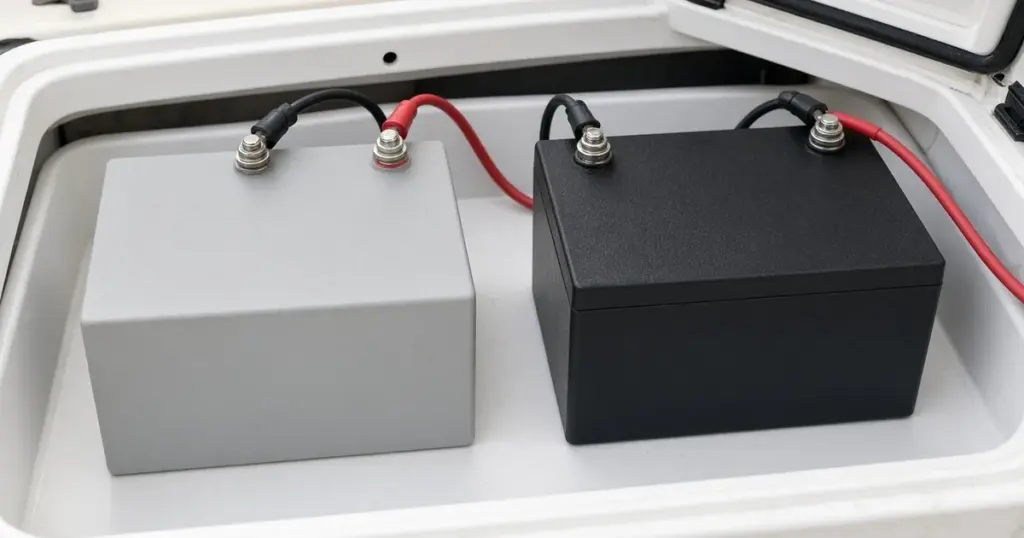
Interstate sells both sealed AGM and LiFePO4 lithium marine batteries in common group sizes. That makes it easy to compare the two chemistries without switching brands. This guide looks at Interstate’s lithium and AGM models side by side, using our product listings, and explains when lithium is worth the higher price. Check product pages for current specs, warranties and stock.
The short version
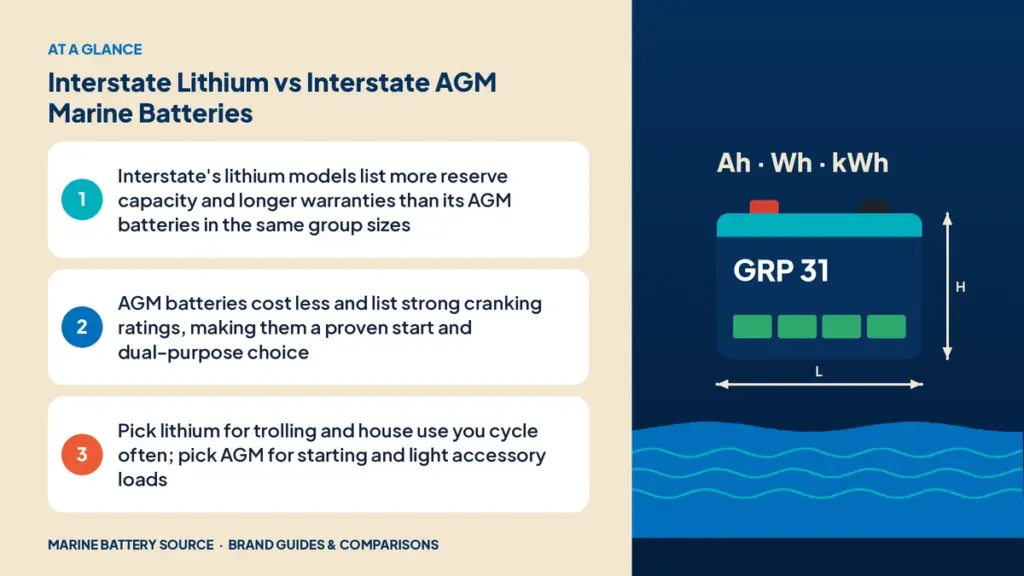
- Choose Interstate lithium for trolling motors and house banks you cycle often, where usable capacity, steady voltage and long warranty coverage matter.
- Choose Interstate AGM for engine starting, dual-purpose use on single-battery boats and budgets where upfront cost matters most.
Group 27: Li27M 12V 100Ah vs 27M-AGM
| Interstate Li27M (lithium) | Interstate 27M-AGM | |
|---|---|---|
| Capacity | 100Ah | 85Ah |
| Reserve capacity | 240 min @ 25A | 182 min @ 25A |
| Cranking rating | Not listed | 850 CCA, 975 MCA |
| Listed warranty | 60 months free replacement | 36 months free replacement |
The lithium model lists more capacity and reserve, and a longer warranty. The AGM lists strong cranking ratings and costs less. Because lithium delivers most of its rated capacity and AGM should stay above about half for long life, the practical difference in daily energy is larger than the table suggests.
Group 24: Li24M 12V 60Ah and Li24MDP 12V 100Ah vs 24M-AGM-A
| Li24M 60Ah | Li24MDP 100Ah | 24M-AGM-A | |
|---|---|---|---|
| Capacity | 60Ah | 100Ah | 70Ah |
| Reserve capacity | 135 min | 240 min | 140 min |
| Cranking | Not listed | 1000 CA | 750 CCA |
| Listed warranty | 60 months | 36 months | 24 months |
The Li24MDP is Interstate’s dual-purpose lithium: it lists cranking amps along with 100Ah capacity in a group 24 size, which makes it a candidate for single-battery boats that want lithium. The Li24M 60Ah is a deep-cycle battery for electronics and small trolling setups.
Group 31: 31M-AGM vs lithium 24V and 36V options
Interstate’s 31M-AGM lists 100Ah, 925 CCA and 200 minutes reserve with 36 months free replacement. It’s a strong start and house battery for center consoles. In the same 31M size, Interstate’s lithium offerings are higher-voltage trolling batteries: the Li31M 24V 60Ah and Li31M 36V 50Ah, each with 60 months free replacement. One of those can replace two or three AGM batteries in a 24V or 36V trolling bank.
Usable energy
Rated amp-hours don’t tell the full story:
- An 85Ah AGM used to about 50% delivers roughly 42Ah per cycle for good life.
- A 100Ah lithium battery used to about 80–90% delivers 80–90Ah.
So the Li27M can provide around twice the daily energy of the 27M-AGM, while holding voltage more steadily as it discharges.
Weight
Our Interstate listings don’t show weights, but LiFePO4 batteries typically weigh about half as much as lead-acid batteries of similar rated capacity, and far less per usable amp-hour. On a 36V trolling bank, replacing three AGM batteries with one Li31M 36V battery saves a lot of weight.
Charging
- AGM: use an AGM profile. Interstate AGM batteries charge well from outboard alternators and standard marine chargers.
- Lithium: use a LiFePO4 profile. For alternator charging, a DC-DC charger is often recommended to protect the alternator and charge the battery correctly.
Mixed boats commonly run an AGM start battery and a lithium trolling or house bank, each on its own charger bank.
Cold weather
LiFePO4 batteries generally shouldn’t be charged below freezing. Our Interstate lithium listings don’t mention internal heating, so plan cold-weather charging accordingly. AGM batteries charge in the cold, though cranking power drops as temperature falls.
Cost over time
AGM costs less upfront. Lithium costs more but lists more usable energy, a longer warranty and, typically, many more cycles. If you use the boat often and cycle the battery deeply, such as a trolling bank used every weekend, lithium usually costs less per trip over its life. If the battery mainly starts the engine and runs a few accessories, AGM is the economical choice.
Example decisions
Bass boat: 31M-AGM start battery plus a Li31M 36V 50Ah trolling battery.
Pontoon with a stereo: 27M-AGM for starting, or a Li24MDP if you want lithium for both jobs.
Center console house battery: Li27M 12V 100Ah charged through a DC-DC charger, with an AGM start battery.
Weekend jon boat with electric start: 24M-AGM-A.
Converting from AGM to Interstate lithium
If you’re switching a trolling or house battery from AGM to lithium, follow these steps:
- Confirm the fit. Check that the lithium model fits your tray and that the terminals line up with your cables.
- Update the charger. Set your onboard charger to a LiFePO4 profile, or replace it with one that has one.
- Plan alternator charging. Add a DC-DC charger if the lithium battery will be charged by the engine.
- Fuse the battery. Fit a fuse sized for the load close to the positive terminal.
- Keep the start battery separate. If you keep an AGM start battery, make sure each battery has its own charger bank.
Which is easier to live with?
Both chemistries are sealed and maintenance-free compared with flooded batteries, so there’s no watering. AGM batteries prefer to be recharged soon after use and stored fully charged, because sitting partly discharged shortens their life. Lithium batteries tolerate partial charge well and self-discharge slowly, which suits boats that sit between trips. Either way, keep terminals clean and tight, and check voltage or state of charge before every outing.
More reading
For other brands’ lithium options, see Lithium Rhino vs EPOCH 36V and EPOCH Eco vs Essential vs Elite. If you’re choosing a single dual-purpose lithium battery, see Dakota Lithium DL dual-purpose. For lead-acid alternatives, read Trojan vs Interstate. The hubs at marine battery comparisons and marine battery brands compared cover the rest, and how to choose a trolling motor battery helps with sizing.
Products mentioned
- Interstate Li27M 12V 100Ah
- Interstate Li24MDP 12V 100Ah
- Interstate Li31M 36V 50Ah
- Interstate 27M-AGM
- Interstate 31M-AGM
Frequently asked questions
Is Interstate lithium worth it over AGM?
For batteries you cycle often, like trolling and house banks, usually yes. For starting and light use, AGM is the economical choice.
Can Interstate lithium start my engine?
The Li24MDP lists 1000 cranking amps as a dual-purpose model. Check your engine’s requirements and the maker’s guidance.
Which has the longer warranty?
Most Interstate lithium models list 60 months free replacement; AGM models list 24 or 36 months.
Can I charge Interstate lithium with my AGM charger?
Only if it has a LiFePO4 profile. Otherwise, use a lithium-compatible charger.
Do Interstate lithium batteries have heating?
Our listings don’t mention heating. Avoid charging below freezing unless the maker allows it.