


Onboard Charger Fault Lights: What They Usually Mean
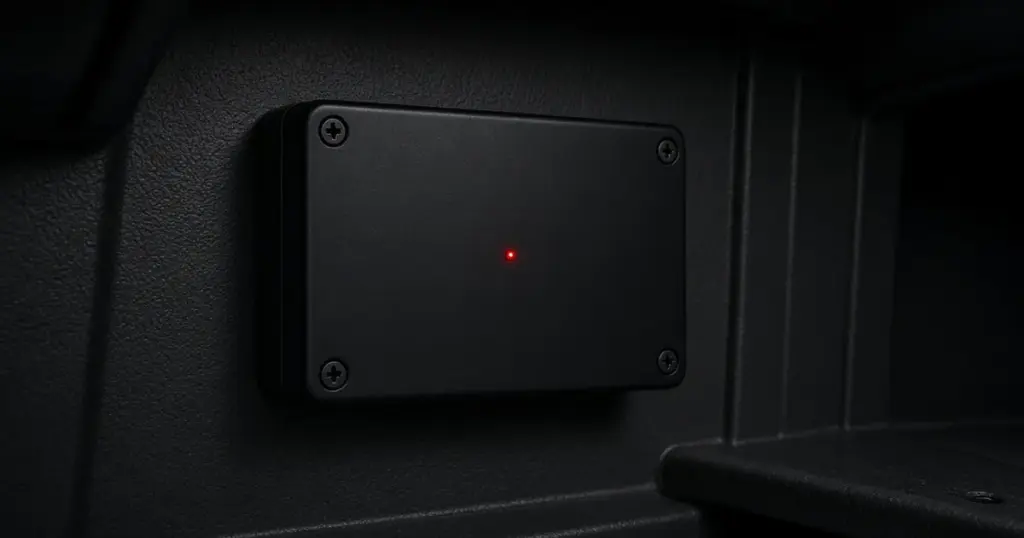
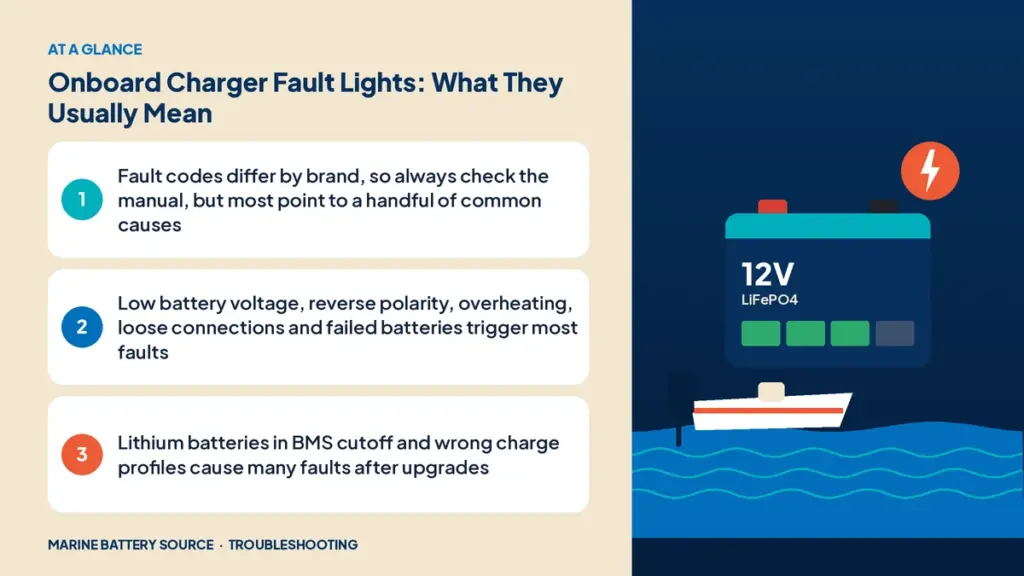
A flashing red light on your onboard charger is a message, not just an annoyance. Marine chargers monitor battery voltage, current, temperature and charge time, and they shut down or warn you when something is outside normal limits. The exact meaning of each light or code varies by brand and model, so your charger’s manual is the final word. But most faults fall into a few common categories. Here’s what they usually mean and how to fix them.
First steps for any fault
- Read the manual for your charger’s specific codes.
- Note which bank shows the fault on a multi-bank charger.
- Unplug AC power, wait a minute, then plug back in. Some faults clear on restart.
- Check connections at the charger and the battery for that bank.
- Measure battery voltage with a multimeter.
Common fault categories
1. Battery voltage too low
Many chargers won’t start if the battery voltage is below a minimum, often several volts below normal, because they can’t confirm a battery is connected or because the battery may be damaged.
- Lead-acid: a deeply discharged battery may need a charger with a recovery mode, or a brief boost from another source, before the onboard charger will start. If it won’t recover, it may be sulfated.
- Lithium: a battery in BMS low-voltage cutoff may read zero. Use a lithium charger with a wake-up function. See lithium battery won’t charge.
2. Reverse polarity
Positive and negative swapped on a bank. Most chargers detect this and refuse to charge. Disconnect AC, correct the connections and check the output fuse, which may have blown.
3. Overheating
Chargers in hot, enclosed compartments reduce output or shut down when they get too hot. Make sure the charger has clearance for airflow, isn’t mounted next to the engine and isn’t covered by gear.
4. Battery not accepting charge
If the charger runs for its maximum time without reaching full, it may flag a fault. Causes:
- A sulfated or failing lead-acid battery
- A shorted cell
- A load running on the battery while charging (livewell, bilge pump, electronics)
- Wrong profile for the battery type
5. Open circuit or no battery detected
A blown output fuse, a loose terminal or a broken wire between the charger and the battery. Measure voltage at the charger output and at the battery.
6. High battery voltage
The charger detects voltage above its limit, often because another charging source (alternator, DC-DC charger, solar) is also charging the bank, or the battery profile is wrong.
7. Battery temperature sensor faults
Chargers with remote temperature sensors may fault if the sensor is disconnected or damaged.
8. AC input problems
Low or unstable AC voltage at the dock, or a generator with poor output, can trigger faults. Check the pedestal and try another outlet if possible.
Faults after switching to lithium
Upgrading to lithium is a common time to see faults:
- Wrong profile: lead-acid profiles may push voltages lithium doesn’t want, or stop before lithium is full. Set the charger to its LiFePO4 profile or replace it.
- BMS disconnect during charging: if charging voltage or current exceeds the battery’s limits, the BMS opens, and the charger sees the battery disappear.
- Low-voltage cutoff: the charger can’t detect a battery in cutoff. Use a lithium charger with wake-up.
- Cold: lithium won’t accept charge below a set temperature unless heated.
Chargers built for lithium avoid most of these. The EPOCH 12V/36V onboard lithium charger and the EPOCH 4-bank charger support LiFePO4 charging.
Multi-bank chargers
On a multi-bank charger, each bank works independently. A fault on one bank usually means a problem with that bank’s battery or wiring. Swap bank connections (with AC off) to see whether the fault follows the battery or stays with the charger bank.
Mixed systems
In boats with an AGM start battery and lithium trolling or house batteries, make sure each bank’s profile matches its battery. Multi-bank chargers with per-bank profile selection handle this. Unbalanced banks, where one battery in a series string is weaker, can also confuse chargers; see unbalanced battery bank.
When the charger is the problem
- Faults persist on a known-good battery with good wiring
- No output on a bank
- Water intrusion or physical damage
- Burning smell or melted connectors
Replace it with a charger matched to your batteries. Browse marine battery chargers.
Troubleshooting checklist
- ☐ Manual checked for the specific code
- ☐ AC power confirmed at the charger
- ☐ Output fuses checked
- ☐ Connections tight and correct polarity
- ☐ Battery voltage measured
- ☐ Loads off during charging
- ☐ Profile matches battery type
- ☐ Charger has airflow and isn’t overheating
- ☐ Fault follows battery or stays with bank?
Electronics interference
Some chargers can create electrical noise. If your fish finder shows interference while the charger runs, that’s usually not a fault, but it’s worth separating charger and electronics wiring. See fish finder interference from the trolling motor.
Related problems
If your trolling motor won’t run after charging, see trolling motor won’t turn on. If the start battery is low after charging, see boat won’t start, just clicks. For the bigger picture, read boat electrical problems troubleshooting and the marine battery troubleshooting guide.
Example
A bass boat’s onboard charger shows a fault on bank 3 every night. With AC off, the owner swaps the bank 2 and bank 3 leads at the batteries. The fault moves to bank 2, so it’s following the battery, not the charger. A load test confirms the third battery is weak. Replacing the trolling bank clears the fault.
Frequently asked questions
What does a flashing red light on my boat charger mean?
It depends on the brand, but commonly low battery voltage, reverse polarity, overheating or a battery not accepting charge. Check your manual.
Why won’t my charger charge my lithium battery?
The battery may be in BMS cutoff, too cold, or the charger may be on the wrong profile.
Can a bad battery cause a charger fault?
Yes. Sulfated, shorted or failing batteries often trigger “battery not accepting charge” faults.
How do I reset my marine charger?
Unplug AC power, wait a minute and plug back in. Fix the cause first or the fault will return.
Can I use my old lead-acid charger with lithium?
Only if it has a LiFePO4 profile. Otherwise, replace it with a lithium-compatible charger.