


Relocating Boat Batteries: Weight, Cable Runs and Access
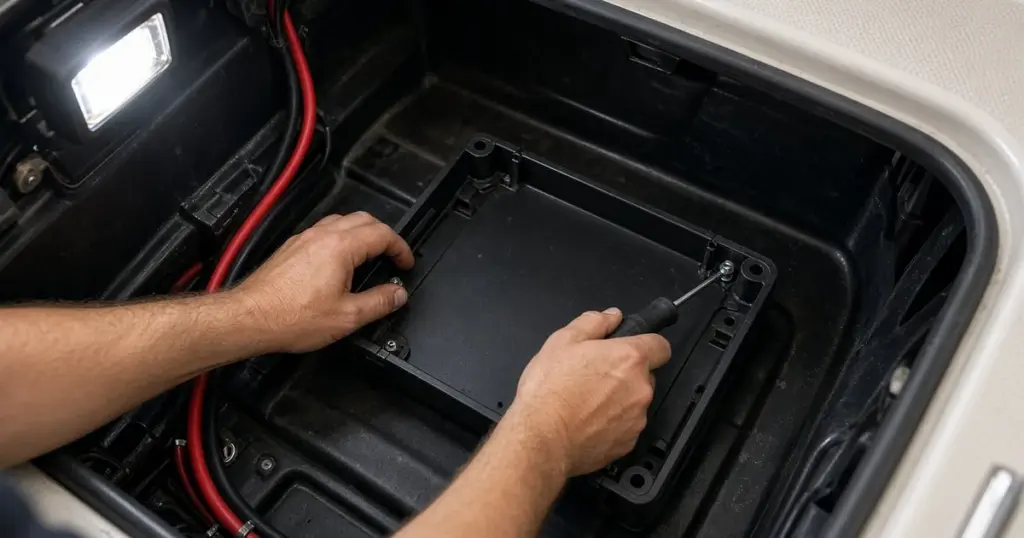
Sometimes the battery isn’t where it should be. It might sit in a cramped spot that’s impossible to service, add weight to the wrong end of the boat, or take up space you need for storage. Relocating a boat battery can fix all of those, but it changes cable lengths, fusing and mounting, and the details matter. This guide explains how to relocate a boat battery safely.
Why relocate a battery
- Weight balance. Moving heavy batteries forward or to the centerline can improve hole shot, trim and ride.
- Access. A battery under a heavy hatch or behind equipment is hard to maintain.
- Space. Freeing up a compartment for storage or a livewell.
- Adding batteries. Making room for a second battery or a trolling bank.
- Lithium conversion. A smaller lithium battery may fit somewhere the old lead-acid wouldn’t.
- Protection. Moving the battery away from bilge water or heat.
Choosing the new location
- Dry and protected from spray and standing water
- Ventilated, especially for flooded batteries
- Solid mounting surface that can hold the battery and its hold-down
- Accessible for inspection and service
- Away from fuel tanks and fuel lines
- As close as practical to the loads it powers, to keep cables short
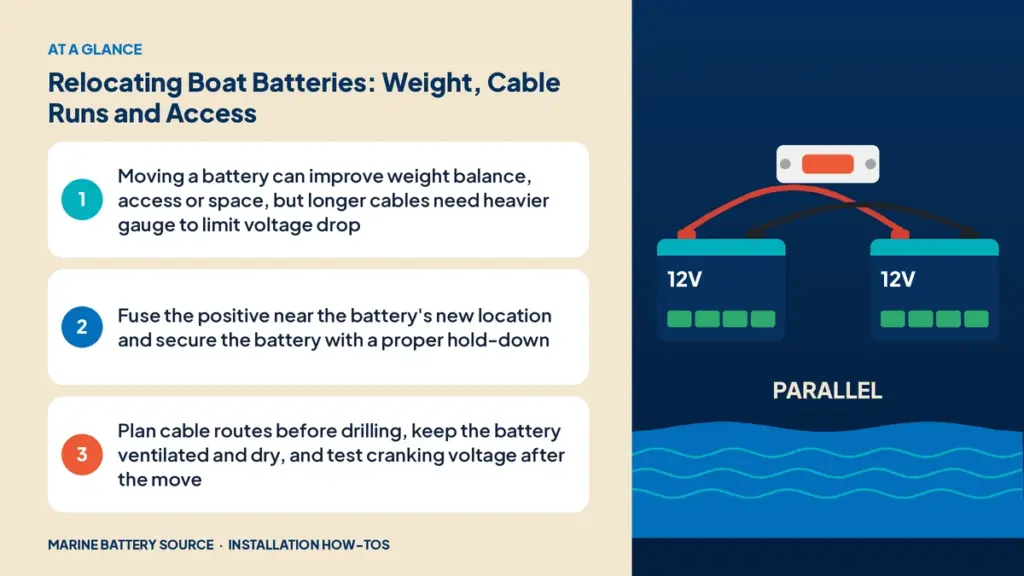
The cable length problem
The biggest challenge in relocating a battery is the longer cable run, especially for starting batteries. Engine cranking draws hundreds of amps, and every extra foot of cable adds resistance. A starting cable that’s fine at 4 feet may cause hard starts at 12 feet.
To size cables for the new run:
- Measure the round-trip length: battery to starter and back through the negative.
- Use the engine’s cranking current (or the engine maker’s cable recommendation).
- Choose a gauge that keeps voltage drop within about 10% during cranking.
Our cable size guide has tables for this. Often, moving a battery to the bow means going from 4 AWG to 2 AWG or 1/0.
Fusing at the new location
The positive cable must be fused close to the battery’s new location. If the cable runs through several compartments, it must be protected along its length and secured every 18 inches. A terminal-mounted fuse like the marine-rated 300A battery fuse keeps the unprotected cable as short as possible. Starter cables are a common exception under some standards; follow your engine and boat builder’s guidance.
Mounting the battery
Secure the battery so it can’t move more than about one inch. Use a tray or box fastened to structure, not thin deck skin. Trays like the EPOCH battery tray fit common lithium batteries.
Step-by-step relocation
- Plan. Choose the location, measure cable runs and calculate cable sizes.
- Disconnect the battery, negative first, and remove it.
- Install the tray or box at the new location.
- Route new cables through the boat. Use existing chases where possible, protect cables through bulkheads with grommets and avoid sharp edges.
- Install the battery switch near the new location, or extend the existing switch’s cables.
- Install the fuse close to the battery positive.
- Connect the negative to the engine negative or negative bus with a cable of the same size as the positive.
- Move accessory feeds to the new location or a fuse block nearby.
- Install the battery and connect positive first, then negative.
- Test voltage at the battery and at the starter while cranking.
Moving batteries for weight balance
On bass boats and small center consoles, moving batteries forward can help the boat get on plane faster and reduce bow rise. On pontoons, distributing weight evenly between the tubes helps level the ride. Lithium batteries make this easier because they weigh so much less; browse our lithium marine batteries to compare weights. See pontoon lithium installation and 36V lithium install on a bass boat.
Relocating trolling batteries
Trolling banks are often moved forward to shorten the cable run to the bow motor, which reduces voltage drop and lets you use lighter cable. Make sure the starting battery and engine cables stay properly sized.
Charging after relocation
If you have an onboard charger, extend or reroute its leads to the new location. If the battery is now far from the alternator, consider a DC-DC charger to make up for voltage drop on the long run.
Common mistakes
- Using the old cable gauge on a longer run.
- No fuse near the new battery location.
- Weak mounting surface that lets the battery move.
- Cables unsupported through compartments.
- Forgetting the negative needs the same size and length as the positive.
Tools for the job
A relocation job needs a cable cutter, a heavy-duty lug crimper, a heat gun and a multimeter. See marine electrical tools.
Checklist after the move
Use our marine battery installation checklist to confirm everything is done correctly before you head out.
When to call a pro
If the new route passes through fuel compartments, requires cutting structure or involves AC wiring, consider a professional. See DIY vs professional installation. For basic installation steps, see how to install a marine battery.
Example: moving a starting battery to the console
A center console owner wants to move the starting battery from the transom to the console to free space and improve balance. The cable run grows from 6 feet round trip to 24 feet. With a cranking current around 300A and a 10% drop target, the cables go from 4 AWG to 1/0. The owner adds a fuse near the battery, a switch in the console, protected cable runs along the stringers and a new tray. After the move, cranking voltage at the starter is checked and found healthy.
Frequently asked questions
Can I move my boat battery to the front?
Yes, but you’ll need longer, heavier cables to limit voltage drop, and a fuse near the battery’s new location.
What size cable do I need for a relocated battery?
It depends on the round-trip length and cranking current. Longer runs often need one or two gauges heavier.
Does moving the battery affect performance?
It can improve balance and hole shot by putting weight where it helps. Undersized cables can cause hard starts.
Where should the battery switch go after relocation?
Near the battery’s new location, or wherever it’s easy to reach in an emergency, with proper cable sizes.
Do I need to move the charger too?
Not necessarily, but the charger leads must reach the battery and be fused near it.