


Can Solar Keep Your Trolling Motor Batteries Topped Up?
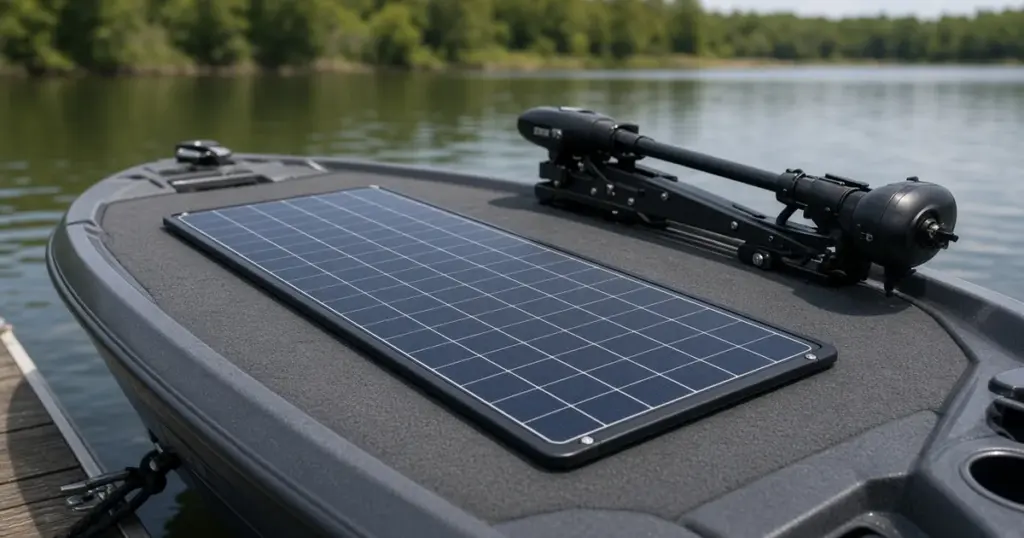
Solar panels can top up trolling motor batteries while you fish and keep them charged while the boat sits. They’re especially useful for boats kept on lifts, at docks without power or on multi-day trips far from an outlet. But it’s important to understand what solar can and can’t do for a trolling bank. This guide covers solar for trolling motor batteries: realistic output, wiring for 12V, 24V and 36V, mounting and the best uses.
What solar can realistically replace
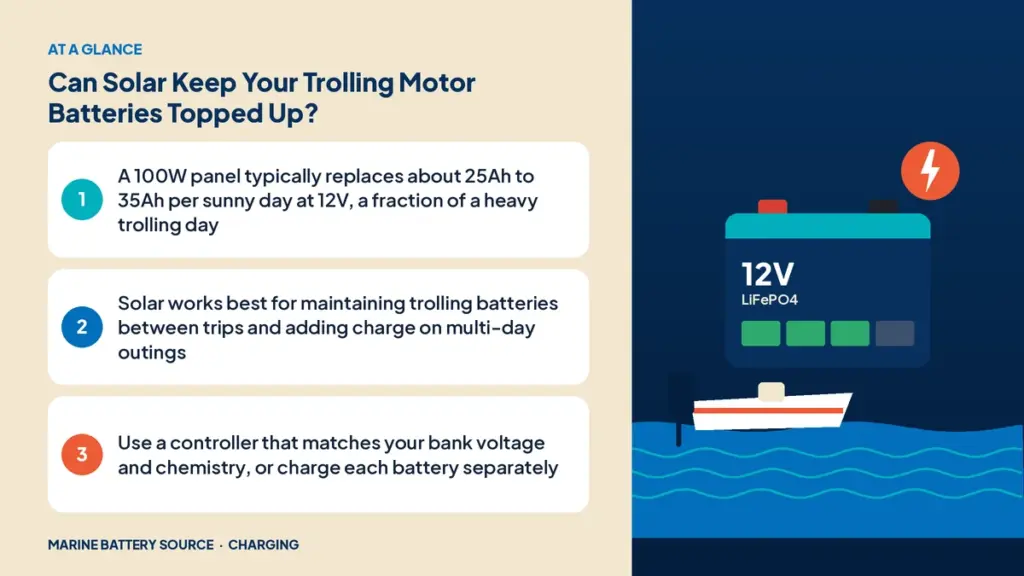
A trolling motor working hard can use 50Ah to 100Ah or more per day. A solar panel produces far less:
| Panel size | Approx. daily output at 12V in good sun |
|---|---|
| 30W | 7–10Ah |
| 50W | 12–18Ah |
| 100W | 25–35Ah |
| 200W | 50–70Ah |
Space on a fishing boat is limited, so most anglers fit 50W to 100W. That won’t fully recharge a drained bank in one day, but it can:
- Keep batteries full between weekends.
- Replace a meaningful share of a light trolling day.
- Extend multi-day trips with partial daily recharges.
See boat solar panel sizing for the full method.
Charging 12V trolling batteries
For a single 12V battery, connect a panel through a charge controller set to the battery’s chemistry. Simple and effective. See MPPT vs PWM controllers for controller choice.
Charging 24V and 36V banks
Series trolling banks are trickier:
- Controller for the bank voltage: many MPPT controllers support 24V; 36V support is less common. Choose a controller rated for your bank voltage with panels arranged to suit.
- Single high-voltage lithium battery: a 36V lithium battery with a controller supporting 36V LiFePO4 is the cleanest setup.
- Charge each 12V battery separately: use one controller per battery, or a multi-output unit, to keep series batteries balanced.
- Charge the starting battery with solar and use a DC-DC charger to transfer energy to the trolling bank when running.
Mounting options on fishing boats
- Flexible panels on the console, casting deck or hatch lids. Light, but they can be stepped on and run hot.
- Rigid panels on a T-top, bimini or poling platform. More durable and efficient.
- Portable folding panels set out at the dock or campsite and stowed while running.
- Lift canopy panels for boats stored on lifts.
Secure everything for running speeds and wave impacts. Avoid locations where anglers walk.
Shading and angle
Rods, people, T-tops and trolling motor mounts all shade panels. Even partial shading reduces output significantly. Mount panels where they see open sky, and if using portable panels, aim them toward the sun.
Lithium trolling batteries and solar
Lithium batteries accept solar charge efficiently at any state of charge, so they get the most out of small panels. Use a controller with a LiFePO4 profile. Cold-weather charging limits still apply: most lithium batteries shouldn’t charge below about 32°F unless heated. Heated options like the EPOCH 36V 50Ah Essential help in cold climates.
Lead-acid trolling batteries and solar
Lead-acid batteries benefit from solar maintenance, which prevents sulfation between trips. But they accept charge slowly near full, so solar works best as a maintainer or to replace partial discharge.
Combining solar with other charging
- Shore charging: still the main way to fully recharge after a hard day. An onboard multi-bank charger handles the bulk.
- On-the-run charging: a DC-DC charger like the EPOCH 12V to 36V DC-DC charger adds charge while the outboard runs. See charging trolling batteries while running.
- Alternator regulators on larger boats; see external alternator regulators.
Multi-day trips and remote waters
On camping and fishing trips without shore power, solar can be the difference between motoring every day and paddling home. Combine a 100W to 200W panel with a lithium trolling battery and conservative trolling motor use to extend trips. Wind and hydro generators, covered in wind and hydro generators, are rarely practical on small fishing boats. Large cruising boats are a different case; see the liveaboard sailboat battery guide.
Wiring checklist
- Fuse between the controller and each battery, near the battery.
- Use tinned marine wire sized for low voltage drop.
- Seal any deck penetrations.
- Label solar circuits clearly.
- Add a disconnect for service.
Example: lake boat on a lift
A bass boat on a lift has a 36V lithium trolling battery and an AGM cranking battery. A 100W panel on the lift canopy, with a controller for the cranking battery, keeps it full. A DC-DC charger moves energy to the trolling battery during runs, and an onboard charger at the house handles full recharges. The owner rarely finds a low battery at the start of a trip.
Keeping panels working
Salt spray, dust, pollen and bird droppings reduce panel output. Rinse panels with fresh water when you wash the boat, and check connectors for corrosion each season. Flexible panels on decks can be scratched by hooks, sinkers and shoes, so inspect them for damage and keep tackle off them.
Common mistakes
- Expecting a small panel to replace a full day of heavy trolling.
- Using a 12V controller on a 24V or 36V series bank.
- Mounting panels where they’re shaded or stepped on.
- No fuse at the battery.
Is solar worth it for your trolling batteries?
If your boat sits for days between trips without shore power, solar is almost always worth it as a maintainer. If you fish multi-day trips far from outlets, it can meaningfully extend your range. If you always charge at home after every trip, solar adds less value. Read charging on the water and charging lithium batteries on a boat for the complete picture.
Browse trolling motor batteries in the store.
Frequently asked questions
Can a solar panel charge a trolling motor battery?
Yes, but a typical 50W to 100W panel replaces only part of a heavy trolling day. It’s ideal for maintenance and top-ups.
What size solar panel do I need for a trolling motor battery?
For maintenance, 20W to 50W. For meaningful daily charging, 100W or more.
Can I charge a 36V trolling bank with solar?
Yes, with a controller that supports 36V, or by charging each 12V battery separately.
Do I need a charge controller for a small panel?
Any panel larger than a tiny trickle maintainer should use a controller.