


Charging Lithium from an Outboard or Inboard Alternator
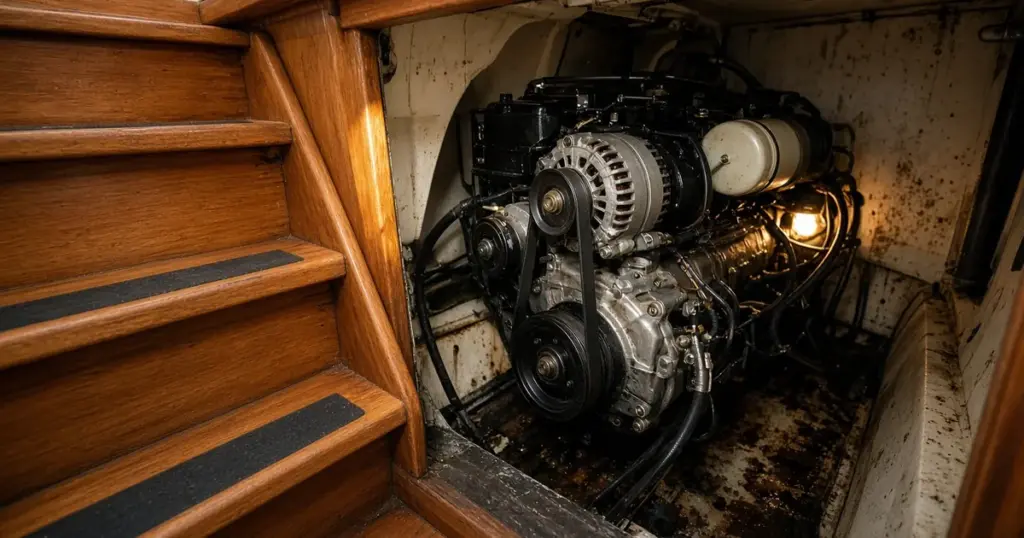
One of the first questions after a lithium upgrade is whether the engine can charge it. The short answer: yes, but not always directly, and not always safely without extra equipment. Alternators were designed around lead-acid batteries, and lithium behaves very differently. This guide explains how alternator charging lithium works on outboards and inboards, the risks, and the right equipment for each kind of boat.
How alternators are designed
A marine alternator produces current and a regulator controls its voltage, usually around 14.0V to 14.6V for 12V systems. With lead-acid batteries, current falls naturally as the battery fills because internal resistance rises. The alternator runs hard for a short time, then eases off.
Outboard engines usually use a stator and rectifier-regulator rather than a belt-driven alternator, with outputs from a few amps on small engines to 50A or more on large ones. Inboard engines typically have belt-driven alternators of 50A to 150A or more.
Why lithium is different
Lithium (LiFePO4) batteries have very low internal resistance and a flat voltage curve. They accept high current almost until they’re full. That causes several issues:
- Sustained full output: an alternator charging a large, discharged lithium bank may run at maximum current for an hour or more. Many alternators aren’t designed for that and can overheat.
- Voltage mismatch: some regulators are set too low to fully charge lithium, or include float behavior that isn’t ideal.
- BMS disconnects: if a lithium battery’s BMS disconnects while the alternator is charging it, the sudden loss of load can cause a voltage spike that may damage the alternator or electronics.
- Outboard limits: outboard charging systems often have strict limits and may not tolerate continuous high draw.
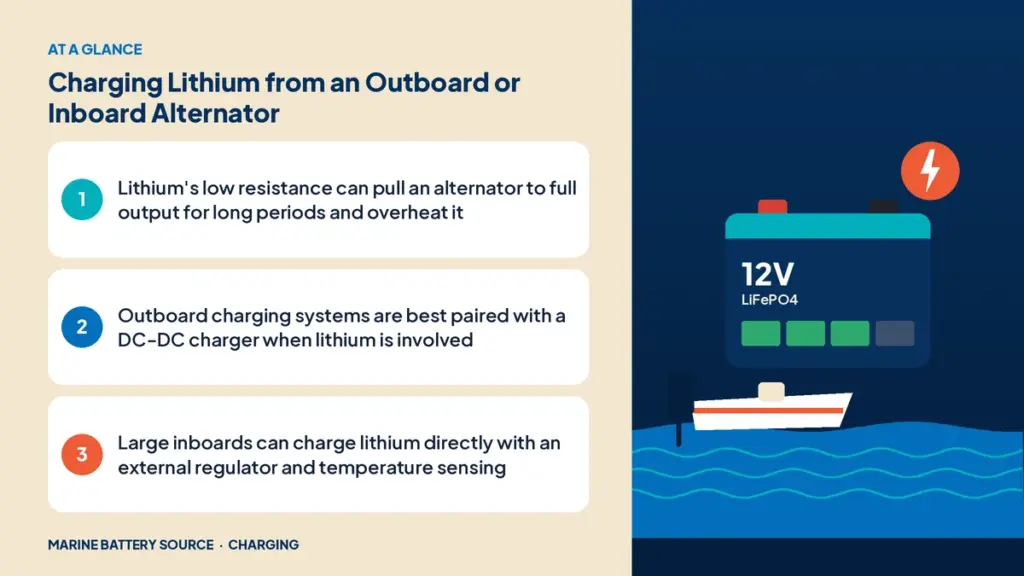
Outboards: use a DC-DC charger
For most outboard-powered boats, the recommended setup is:
- Keep a lead-acid or AGM starting battery, or an engine-maker-approved lithium starting battery, connected directly to the outboard’s charging output.
- Charge lithium house or trolling batteries through a DC-DC charger fed from the starting battery.
The DC-DC charger limits current to what the outboard can supply and applies a lithium profile. A unit like the EPOCH 12V to 36V DC-DC charger also steps voltage up for 36V trolling batteries. See what a DC-DC charger is and charging trolling batteries while running.
Lithium starting batteries on outboards
Some lithium batteries are designed for starting, such as dual-purpose models with high cranking ratings like the EPOCH 12V 172Ah dual-purpose (1,000 CCA). Before using lithium as a starting battery, check that your outboard maker allows it and whether any regulator or wiring changes are recommended.
Inboards: DC-DC or external regulator
On inboard engines and cruising boats with large house banks, there are two main approaches:
- DC-DC charger: the alternator charges the starting battery, and a DC-DC charger feeds the lithium house bank at a controlled rate. Simple and protective, but limited to the charger’s rating.
- External regulator: a smart regulator controls the alternator directly with lithium voltages, alternator temperature sensing and current limiting. That can deliver much more charging current to a large bank. See external alternator regulators for lithium.
Protecting against BMS disconnects
If the BMS opens while the alternator is charging, the alternator suddenly loses its load. Good practice includes:
- Keeping a lead-acid starting battery connected to the alternator as a buffer.
- Using a DC-DC charger so the alternator never connects directly to lithium.
- Using an alternator protection device where recommended.
- Choosing a lithium battery or BMS that signals the regulator before disconnecting, on advanced systems.
Sharing output with ACRs and isolators
ACRs and isolators work well for same-chemistry lead-acid banks but generally aren’t the right choice for connecting lithium to an alternator. See ACR vs isolator vs DC-DC charger for a full comparison.
How much charging to expect
Charging current is limited by the smallest link: alternator spare output, DC-DC charger rating, cable size and battery acceptance. A 20A DC-DC charger running for 3 hours adds about 60Ah at 12V. An inboard with a 100A alternator and external regulator might add 70A to 80A continuously, depending on temperature and engine speed.
Example setups
| Boat | Approach |
|---|---|
| Bass boat with 36V lithium trolling | AGM starting battery on the outboard; 12V-to-36V DC-DC charger |
| Pontoon with lithium house battery | AGM starting battery; 12V DC-DC charger to the lithium battery |
| Cruising sailboat with lithium house bank | DC-DC charger or alternator with external regulator; lead-acid starting battery |
| Trawler with large lithium bank | High-output alternator, external regulator, temperature sensing |
Common mistakes
- Connecting a large lithium bank directly to a small alternator.
- Paralleling lithium and lead-acid through a battery switch while running.
- Ignoring BMS disconnect risks.
- Undersized cables between the alternator, DC-DC charger and batteries.
Checklist before connecting lithium to an engine
- Find your engine’s charging output and any lithium guidance from the engine maker.
- Decide between a DC-DC charger and an external regulator.
- Confirm the lithium battery’s maximum charge current and BMS behavior.
- Plan fuses, cable sizes and a starting battery buffer.
- Monitor the first few runs with a battery monitor.
Temperature matters
Alternators lose output and can be damaged when they run hot for long periods, and engine compartments get hot, especially in summer. External regulators with alternator temperature sensors reduce output when the alternator gets too hot. DC-DC chargers protect the alternator by limiting current. On the battery side, most lithium batteries shouldn’t be charged below about 32°F unless heated, and their BMS may block charging in the cold, which is another reason to keep a lead-acid starting battery on the alternator.
Planning a system
Think of the alternator as one charging source among several. On trailered boats, most charging still happens at home with an onboard charger, and the engine only tops up. On cruising boats, solar and a generator often share the load. See charging on the water and charging lithium batteries on a boat for the full picture, and browse chargers and DC-DC chargers in the store.
Frequently asked questions
Can my outboard charge a lithium battery?
Usually through a DC-DC charger. Directly connecting lithium to an outboard’s charging system isn’t recommended unless the engine maker approves it.
Will lithium damage my alternator?
It can if the alternator runs at full output for long periods or if the BMS disconnects suddenly. DC-DC chargers and external regulators help prevent this.
What’s an external regulator?
A smart regulator that controls the alternator with lithium-appropriate voltages, temperature sensing and current limits.
Do I still need a lead-acid starting battery?
It’s a common and safe approach, acting as a buffer for the alternator. Some boats use approved lithium starting batteries instead.