


Multi-Bank Marine Chargers Explained
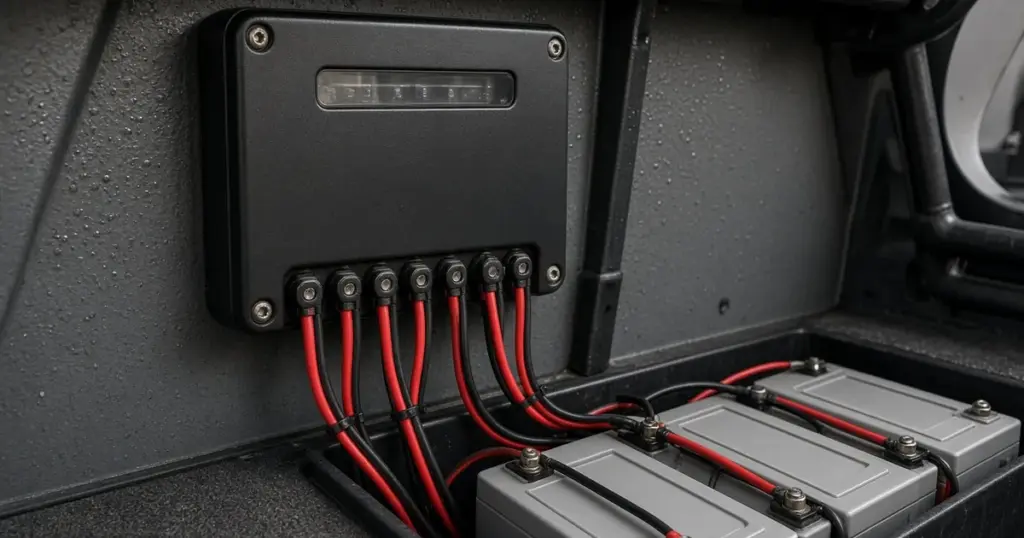
If your boat has more than one battery, a multi-bank marine charger is the cleanest way to keep them all charged. But the wiring, especially for series trolling motor batteries, confuses many boat owners. This guide explains how multi-bank chargers work, how to wire them, how to handle mixed chemistries and how to choose the right one.
What a bank is
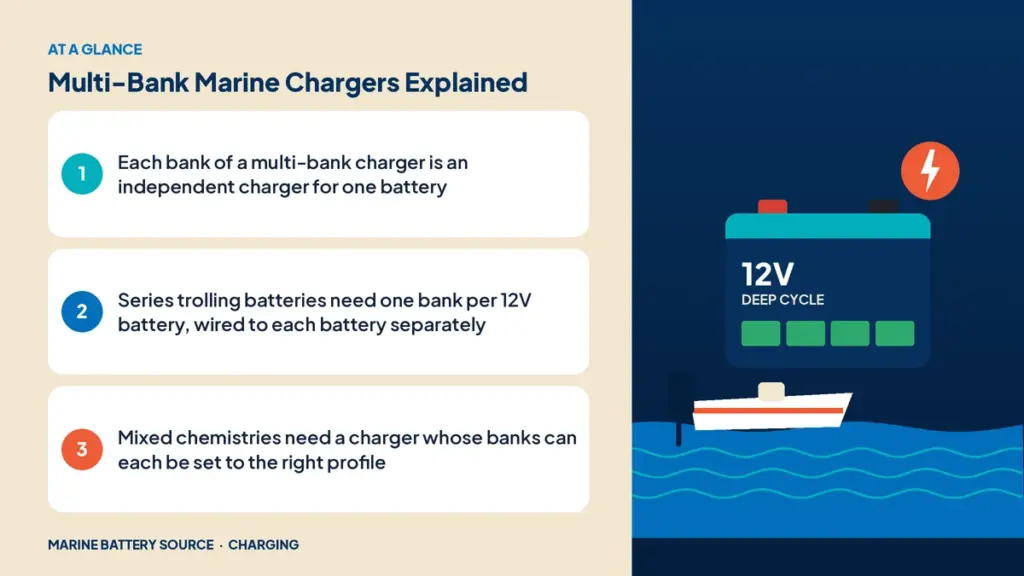
A bank is one independent charging output, essentially a separate charger inside the same case. A three-bank charger contains three chargers, each with its own positive and negative leads. Each bank charges one battery on its own, monitoring that battery’s voltage and adjusting current and stages to suit it.
That independence is the main benefit. Batteries in different states of charge, ages or sizes each get exactly what they need.
Why not just charge in series?
For a 24V or 36V trolling bank made of 12V batteries in series, you could charge the whole string with a single 24V or 36V charger. But if one battery is weaker or less charged, the string charges unevenly: some batteries overcharge while others never reach full. Over time, this imbalance shortens battery life. A multi-bank charger with one bank per 12V battery charges each battery individually and keeps the string balanced.
Wiring series trolling batteries to a multi-bank charger
For a 36V system with three 12V batteries in series:
- Leave the series jumpers connecting the batteries in place.
- Connect bank 1’s positive and negative leads directly to battery 1’s positive and negative terminals.
- Connect bank 2 to battery 2, and bank 3 to battery 3, the same way.
- Fuse each bank’s positive lead near its battery.
Because each bank’s output is isolated from the others, connecting each one across a single battery is safe even though the batteries are in series. Confirm your charger has isolated outputs; most marine multi-bank chargers do.
A four-bank charger such as the EPOCH 4-bank 12V charger, with four independent 10A outputs, handles a 36V trolling system plus a cranking battery.
Single lithium batteries at higher voltages
When you replace three 12V batteries with a single 36V lithium battery, you need a 36V charger output, not three 12V banks. Options include a dedicated 36V lithium charger like the EPOCH 36V 15A or a mixed-voltage charger such as the EPOCH 12V & 36V onboard charger with one 12V bank for the cranking battery and one 36V bank for the trolling battery.
Mixed chemistries
Many boats combine a lead-acid cranking battery with lithium trolling batteries. Each bank must use the profile for the battery it’s connected to. Some chargers set the profile per bank; others apply one profile to all banks, which won’t work for mixed systems. Check before buying. Our guide to charge profiles explains the differences.
Choosing bank count and amps
- Bank count: one per 12V battery in series systems and one per independent battery.
- Amps per bank: typically 10A to 20A on boats under about 25 feet. Higher current shortens charge time if the batteries accept it.
- See the charger amp rating guide for details.
Example configurations
| Boat system | Charger |
|---|---|
| Cranking + 12V trolling | 2-bank 12V |
| Cranking + 24V (two 12V) trolling | 3-bank 12V |
| Cranking + 36V (three 12V) trolling | 4-bank 12V |
| Cranking + single 36V lithium | 12V + 36V two-bank or two chargers |
| Cranking + house + 36V (three 12V) | 5-bank or two chargers |
Unused banks
If your charger has more banks than batteries, follow the maker’s guidance. Many chargers simply ignore unused banks; some recommend connecting spare banks in parallel with another bank on the same battery for faster charging, but only if the manual allows it.
Installation tips
- Mount the charger in a dry, ventilated compartment with clearance for cooling.
- Run each bank’s leads directly to its battery, keeping lengths reasonable.
- Label leads by bank and battery.
- Fuse every positive lead close to the battery.
- See the onboard charger guide for full installation steps.
Charging on the water
Multi-bank chargers work on shore power. Underway, alternators, DC-DC chargers and solar keep batteries topped up; see charging on the water.
Troubleshooting
- One battery never reaches full: check that bank’s leads, fuse and battery health.
- Batteries out of balance: confirm each bank is connected to the correct battery, not across the series string.
- Fault light: reversed polarity, a blown fuse or a failed battery.
Lithium notes
Lithium trolling batteries in series also benefit from individual charging if each is a separate 12V battery. Ensure every bank uses a lithium profile. For background on lithium charging, see charging lithium batteries on a boat.
Example: upgrading a 24V bass boat
Consider a boat with a lead-acid cranking battery and two 12V AGM trolling batteries in series for 24V, charged by an old single-output 24V charger. Over a few seasons, one trolling battery keeps dying first, a sign the string is out of balance. Replacing the charger with a three-bank 12V charger, one bank per battery, lets each battery charge fully on its own. The owner also gains a bank for the cranking battery, which no longer needs a separate charger. If the trolling batteries are later replaced with a single 24V lithium battery, the owner can switch to a 24V lithium charger for that battery and keep a 12V bank for the cranking battery.
Keeping track of banks
On boats with four or more batteries, label everything: each battery, each bank’s leads and each fuse. A simple diagram taped inside the console makes troubleshooting much easier, for you or for a technician. When you replace a battery, check that the right leads go back on the right terminals.
Also consider a maintainer for off-season storage if your charger doesn’t offer a maintenance mode. Browse marine chargers in the store.
Frequently asked questions
What is a multi-bank marine charger?
A charger with several independent outputs, each charging one battery separately.
How do I connect a multi-bank charger to series batteries?
Connect each bank’s leads directly to one battery’s positive and negative terminals, leaving the series jumpers in place.
Can a multi-bank charger charge lithium and lead-acid at the same time?
Only if each bank can be set to its own profile.
How many banks do I need for a 36V trolling motor?
Three banks for three 12V batteries, plus one for the cranking battery: four total. A single 36V lithium battery needs one 36V output.