


Shore Power, Chargers and Your House Bank
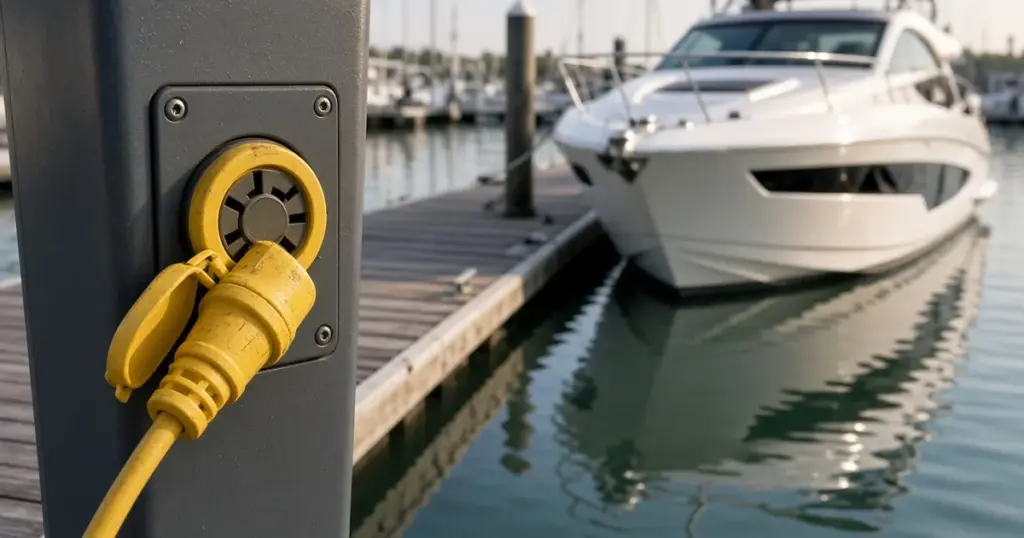
Most boats spend more time at the dock than at anchor, and shore power is what keeps the batteries healthy between trips. A good shore power battery charger or inverter/charger restores the house bank, maintains the starting battery and protects against the slow discharge that kills lead-acid batteries. This guide explains how to choose and set up a shore charger and keep shore power safe.
Types of shore chargers
Dedicated onboard battery chargers
A permanently mounted charger connected to the boat’s AC system. Multi-bank models have separate outputs for different batteries, such as a starting battery, a house bank and a trolling bank. The EPOCH 4-bank 12V charger provides 10A per bank, for example.
High-output chargers
For large house banks, a single-output charger with high current, such as the EPOCH 12V 50A lithium charger, recharges faster.
Inverter/chargers
Combine an inverter, a charger and an automatic transfer switch. On shore power, they pass AC to the boat and charge the bank; when unplugged, they invert. They’re the standard choice on cruising boats with significant AC loads.
Sizing charger output
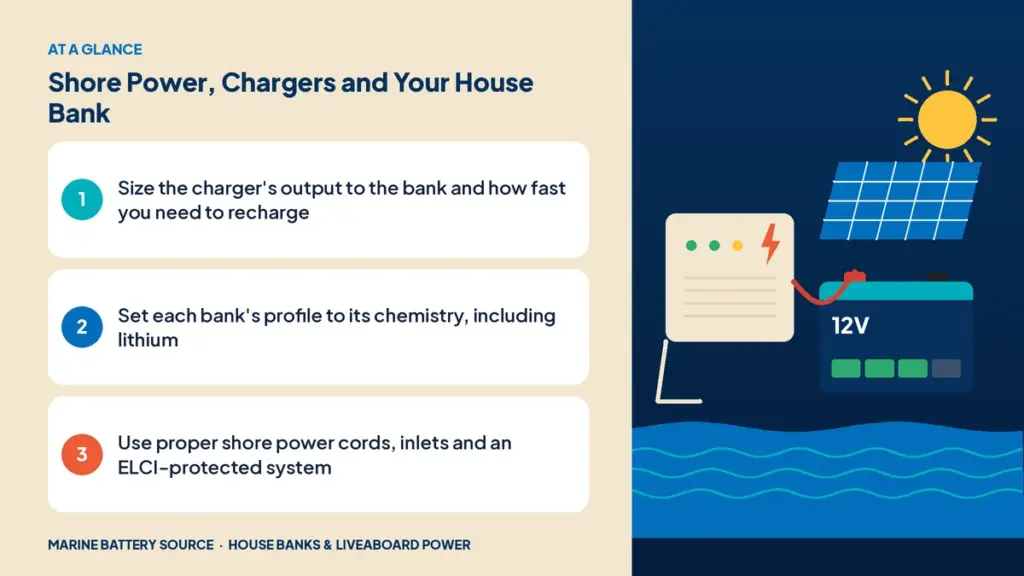
A common rule of thumb for lead-acid is a charger rated at roughly 10% to 20% of the bank’s amp-hour capacity, though battery makers specify recommended ranges. Lithium accepts higher charge rates; check the battery maker’s maximum charge current.
Charge time ≈ amp-hours to replace ÷ charger current (plus extra time for lead-acid absorption)
Example: replacing 200Ah with a 50A charger takes about 4 hours for lithium, and noticeably longer for lead-acid because of the slow absorption stage.
At the dock, charging speed usually matters less than at anchor, where generator time is precious. But if you take short trips with quick turnarounds, a larger charger helps.
Charge profiles
| Chemistry | Profile notes |
|---|---|
| Flooded | Bulk, absorption and float; periodic equalization per maker |
| AGM | AGM voltages; generally no equalization |
| Lithium (LiFePO4) | Constant current then constant voltage to the maker’s voltage; float low or off per maker |
Set each bank’s profile to its chemistry. On multi-bank chargers, make sure each output can be set independently if banks use different chemistries.
Should you leave the charger on all the time?
For lead-acid batteries, a quality charger with a proper float or maintenance mode can stay connected at the dock. For lithium, follow the battery maker’s guidance; many recommend a low float voltage or no float, and some prefer the charger to stop once full. Some owners keep lithium banks at a partial state of charge for long dock stays.
Wiring the charger
- Follow the charger maker’s instructions for DC cable size and fusing on each output.
- Fuse each DC output near the battery.
- Connect negatives to the system side of any battery monitor shunt so charging is measured.
- Mount the charger in a dry, ventilated place, away from fuel and battery off-gassing.
Shore power safety
Shore power brings 120V or 240V AC aboard, which is dangerous in a marine environment.
- Use marine-rated shore power cords and inlets, and keep them in good condition.
- Inspect plugs and inlets for discoloration or heat damage, a sign of a loose or corroded connection.
- Connect the cord to the boat first, then to the pedestal; disconnect in reverse.
- ABYC standards call for equipment leakage circuit interrupter (ELCI) protection on boat AC systems in newer installations, and many marinas have ground fault protection at the pedestal. Electric shock drowning is a real hazard near docks with faulty wiring.
- Have AC work done by a qualified marine electrician.
Galvanic isolation
Connecting to shore power links your boat’s underwater metals to every other boat on the dock through the shore ground. That can accelerate galvanic corrosion. A galvanic isolator or isolation transformer reduces the risk.
Shore power and lithium upgrades
When you upgrade a house bank from lead-acid to lithium, the shore charger’s profile almost always needs to change. Older chargers may lack a suitable lithium setting and may need replacing. See upgrading a sailboat from AGM to lithium.
Generators as a shore power substitute
At anchor, a generator feeding the charger or inverter/charger provides the same function. If you’re considering replacing generator time with a bigger battery bank, read generator vs big lithium bank.
Large lead-acid banks
Big lead-acid banks, such as L16s, need substantial charger output to get through bulk charging. See L16 and large-format batteries for sizing context.
Using a power budget to choose a charger
If you spend weekends away and come back to the dock with a depleted bank, size the charger so it can restore the bank between trips. Our sample liveaboard power budget shows how daily use adds up.
Multi-bank chargers on mixed systems
Many boats have batteries in different roles and sometimes different chemistries: an AGM starting battery, a lithium house bank and a lead-acid trolling bank, for example. A multi-bank charger with independent outputs can serve them all, if each output can be set to its own profile. If the charger applies one profile to every bank, it can’t correctly charge mixed chemistries. In that case, use separate chargers or a charger designed for mixed banks. Label each output and its battery so a future owner or technician doesn’t change a setting by mistake.
Troubleshooting
- Charger not charging: check AC breakers, the shore cord and the DC fuses.
- Bank never reaches full: check profile settings and DC cable size; voltage drop can fool chargers.
- Batteries hot while charging: stop and investigate; check profile, connections and battery health.
For the full system picture, read sailboat and liveaboard battery systems and house bank sizing for overnight boating. Browse battery chargers in the store.
Frequently asked questions
What size battery charger do I need for my boat?
Size it to the bank and how quickly you want to recharge. Lead-acid makers often recommend roughly 10% to 20% of capacity; lithium can accept more, within the maker’s maximum.
Can I leave my boat battery charger on all the time?
For lead-acid, a quality charger with a proper float mode is designed for it. For lithium, follow the battery maker’s guidance on float or maintenance charging.
What is an inverter/charger?
A combined unit that charges the batteries and passes shore power through when connected, and inverts battery power to AC when disconnected.
Do I need a galvanic isolator?
It’s recommended for boats connected to shore power, to reduce galvanic corrosion through the shore ground.