


Drop-In Lithium Replacement: What to Check Before You Swap
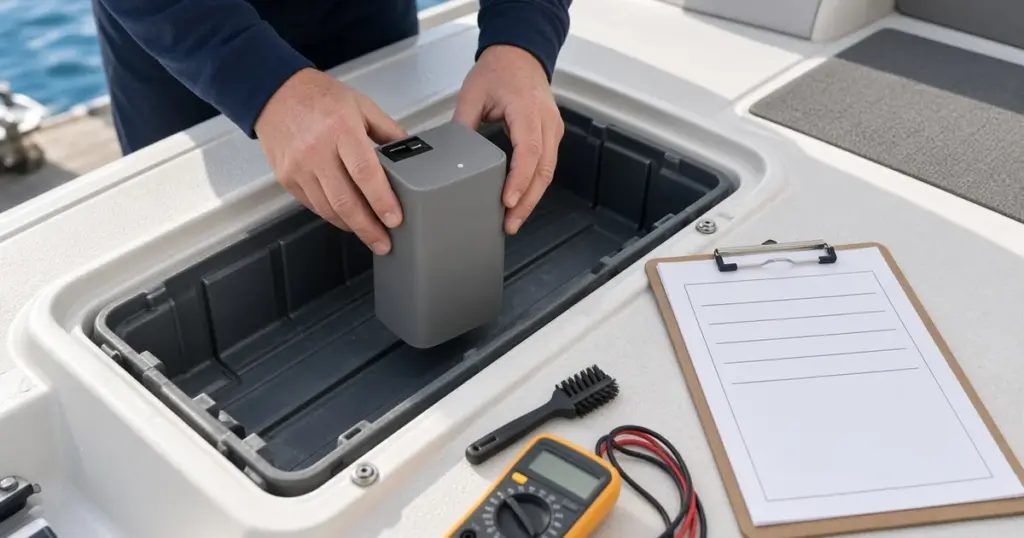
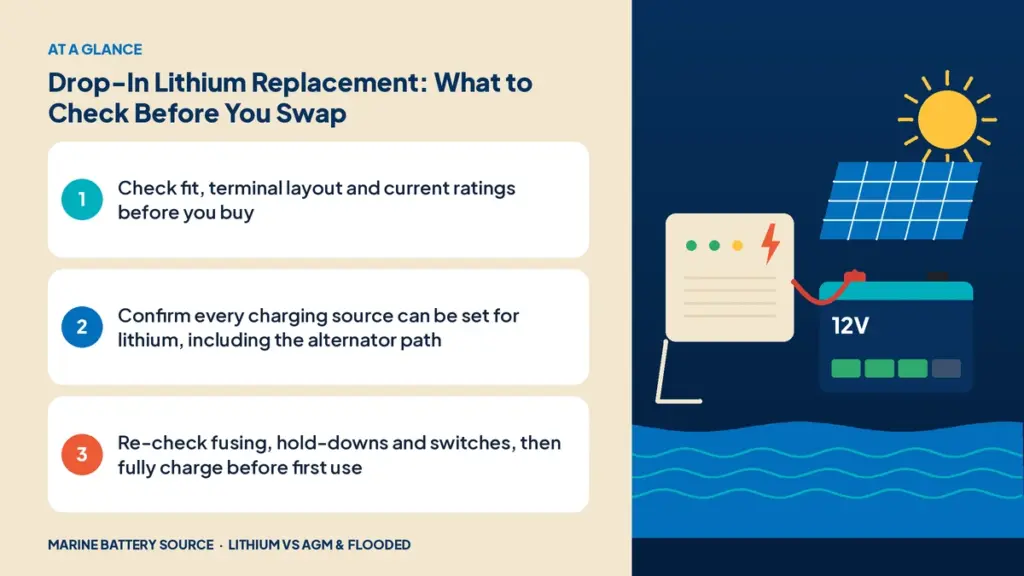
“Drop-in” lithium batteries are designed to fit standard battery spaces and run 12V equipment without changes. That’s often true for the battery itself. Whether the rest of your boat is ready for lithium is a different question. This checklist walks through what to verify before, during and after a drop-in lithium battery replacement, so the swap goes smoothly and the new battery lasts.
Before you buy
1. Identify the battery’s job
Starting, trolling, house or dual-purpose? Each job has different requirements. For starting duty, confirm that the battery is rated for cranking and that your engine maker supports lithium starting batteries. Dual-purpose lithium batteries such as the Dakota Lithium DL+ 12V 60Ah, listed at 1,000 CCA, are built for both.
2. Measure the compartment
Measure length, width and height, including clearance above the terminals for cables and lids. Compare with the listed dimensions. Many lithium batteries follow BCI footprints such as 24, 27 and 31, but heights vary.
3. Check terminal type and position
Note which corner the positive terminal is on and whether your cables will reach without stretching. Check terminal style and bolt size. Some lithium batteries use threaded inserts such as M8 bolts rather than posts, so your lugs need to match.
4. Compare current ratings to your loads
Find your heaviest load: trolling motor maximum draw, inverter maximum draw, windlass, or engine cranking. Compare it with the battery’s continuous and pulse discharge ratings. If the load exceeds the rating, the BMS will shut the battery off.
5. Confirm capacity
Lithium delivers more of its rated capacity than lead-acid. A smaller lithium battery may match your old battery’s runtime, but don’t guess. Estimate your daily amp-hour use and add margin.
6. Decide on heating and monitoring
If you’ll charge below freezing, choose a heated battery. If you want accurate state of charge, choose Bluetooth or plan for a shunt monitor.
Charging system checks
7. Shore-power charger
Does it have a LiFePO4 or lithium profile? If not, plan to replace it. Set the profile before the first charge. Multi-bank chargers should allow independent profiles if you’re keeping lead-acid on other banks.
8. Engine alternator
If the alternator will charge the lithium battery, decide how. Options include a DC-DC charger, an alternator and regulator approved for lithium, or relying on shore charging only. Some small outboards charge so little that it barely matters; larger alternators can be overworked by lithium’s high charge acceptance.
9. Solar and other sources
Set solar controllers, wind generators and any inverter-chargers to lithium-appropriate voltages. Disable equalization.
10. Battery maintainers
Old lead-acid maintainers may float at voltages that aren’t right for lithium or may run desulfation pulses. Replace or reconfigure them.
Wiring and protection
11. Fusing
LiFePO4 can deliver very high short-circuit current. Fit a fuse close to the positive terminal with an amp rating that protects the cable and an interrupt rating suitable for lithium. Terminal fuses and blocks like the Battle Born MRBF fuse block are a common solution.
12. Cable condition
Replace corroded or undersized cables. Lithium’s steady voltage won’t fix voltage drop in a poor cable.
13. Battery switches and combiners
If your boat uses a 1-2-Both switch or an automatic combiner between lithium and lead-acid banks, rethink it. Paralleling mixed chemistries isn’t appropriate. Our mixing guide explains the options.
14. Series and parallel banks
For 24V or 36V series banks, use identical batteries at the same state of charge, and follow the maker’s limits on series and parallel connections. Charge each battery fully before you connect the bank.
Installation
15. Hold-downs and trays
Lithium batteries are lighter and sometimes a different shape. Make sure the tray and strap or bracket hold the battery firmly. Brands sell matching trays, such as the EPOCH tray for its 12V 105Ah and 100Ah Eco batteries.
16. Terminal protection
Cover positive terminals with boots and keep tools and loose metal away. In saltwater, apply a suitable protectant after tightening.
17. Torque connections
Tighten terminal bolts to the maker’s torque specification. Loose connections create heat; overtightening can damage threaded inserts.
After installation
18. First full charge
Charge the battery fully on the correct profile before first use. This lets the BMS calibrate its state-of-charge estimate and balance cells.
19. Verify charging from every source
Watch the battery app, a monitor or a meter while charging from shore, then while running the engine and in sun if you have solar. Confirm each source charges as expected.
20. Learn your real-world draw
Use the app or a monitor on your first few trips to see what your loads actually take.
21. Update your notes and labels
Write down the battery’s model, install date, charger settings and fuse ratings, and keep them with the boat’s paperwork. Label the new bank at the switch and at the charger. The next time you or a technician works on the system, nobody has to guess which battery is lithium or what profile it needs.
Common mistakes to avoid
- Leaving a lead-acid charger on an equalization or desulfation mode.
- Paralleling lithium with lead-acid through a switch.
- Undersized fuses, or no fuse at the battery.
- Trusting a lead-acid voltage gauge to show lithium state of charge.
- Charging a non-heated battery below freezing.
Where to go next
For the full set of buying criteria, see the lithium marine battery buyer’s guide. Water resistance is covered in IP67 and waterproof ratings, warranty terms in our warranty comparison, and common misconceptions in lithium myths, fact-checked. Browse the store’s lithium batteries when you’re ready, and if you’re between Venice and Gainesville, FL, our local installation team can handle the swap.
Frequently asked questions
Is a drop-in lithium battery really plug and play?
The battery usually fits and runs 12V equipment. Your charger, alternator charging, fusing and switches may still need changes for lithium.
Do I need to change my battery cables for lithium?
Not if they’re the right size and in good condition. Replace corroded or undersized cables, and make sure lugs match the new terminals.
Should I fully charge a new lithium battery before using it?
Yes. A full charge on the correct profile lets the BMS calibrate its state-of-charge reading and balance the cells.
Can I keep my old battery switch with lithium?
Often yes, as long as it doesn’t parallel lithium with lead-acid banks and is rated for your current.