


8 Lithium Marine Battery Myths, Fact-Checked

Lithium batteries have changed boating, and with change comes a lot of dock talk. Some of it is outdated, some of it is marketing, and some of it is simply wrong. Here are eight common lithium marine battery myths, what’s actually true, and what to do about each one.
Myth 1: “Lithium boat batteries are a fire hazard”
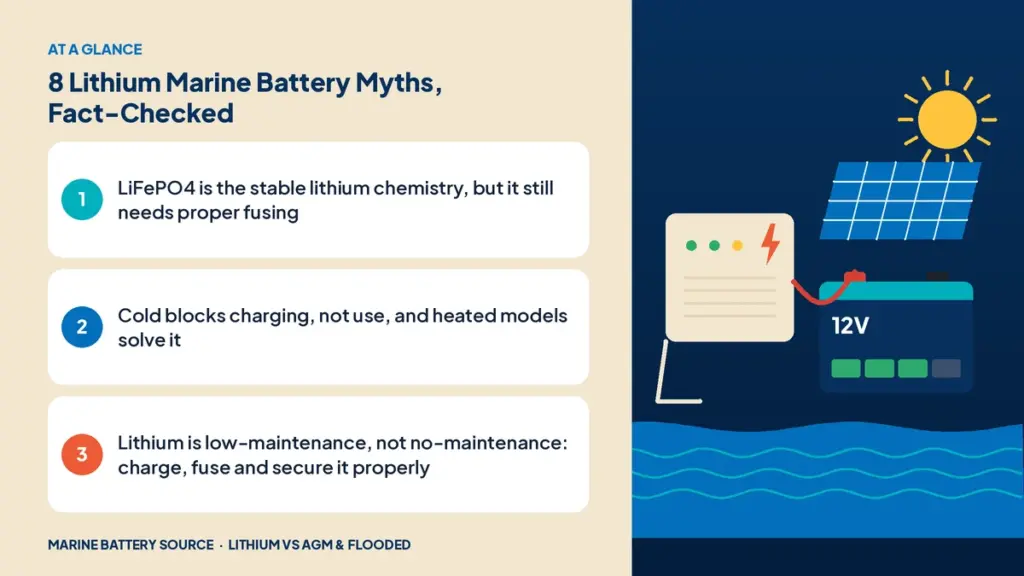
What’s true: “Lithium” covers several chemistries. The batteries in many phones, laptops and e-bikes use nickel- or cobalt-based cathodes, which are more prone to thermal runaway when damaged or abused. Marine drop-in batteries almost always use lithium iron phosphate (LiFePO4), which is far more thermally stable. Every battery in the store’s lithium range is LiFePO4.
What to do: Stable doesn’t mean invincible. Install with a properly rated fuse close to the positive terminal, secure the battery, protect terminals from shorts and use a charger with a lithium profile. Our LiFePO4 vs lithium-ion guide explains the chemistry difference.
Myth 2: “Lithium can’t handle saltwater”
What’s true: Saltwater is hard on every battery’s terminals and wiring, but the chemistry inside a sealed lithium case doesn’t care whether the boat floats in fresh or salt water. Many marine lithium batteries publish ingress protection ratings; Lithium Rhino’s marine kits and the ECO Battery 12V 120Ah, for example, are listed as IP67.
What to do: Keep terminals clean and protected, use tinned marine wire and corrosion-resistant hardware, and keep the battery out of standing water. Our IP rating guide explains what those ratings do and don’t mean.
Myth 3: “Lithium doesn’t work in cold weather”
What’s true: LiFePO4 can usually discharge well below freezing within the maker’s stated range, with some loss of capacity. The real limit is charging: standard LiFePO4 must not be charged below 32°F (0°C). Heated batteries solve that by warming the cells before charging.
What to do: If you’ll charge in the cold, choose a heated model like the Dakota Lithium 12V 100Ah heated, or charge indoors. See heated lithium and cold charging.
Myth 4: “Any charger will work”
What’s true: Lithium needs a charge profile matched to the battery maker’s voltages, usually constant current then constant voltage, with no equalization. Some lead-acid chargers lack a lithium mode, and equalization or desulfation modes can be harmful. Other chargers simply stop short and leave the battery undercharged.
What to do: Use a charger with a LiFePO4 setting, or a dedicated lithium charger such as the EPOCH 12V 15A lithium charger.
Myth 5: “My alternator will charge lithium just like lead-acid”
What’s true: Sometimes it will, but lithium’s low internal resistance means it can accept very high current for a long time. Some alternators, especially smaller ones, can overheat under that sustained load. Some regulators also don’t charge lithium to the right voltage.
What to do: Follow your engine and battery makers’ guidance. A DC-DC charger between the starting battery and the lithium bank limits current and applies a lithium profile.
Myth 6: “Lithium is maintenance-free, so I can forget about it”
What’s true: There’s no watering or equalizing, and that’s a big improvement. But lithium still needs tight, clean connections, correct charging, sensible storage and an occasional look at its health.
What to do: Check terminals and cables periodically, charge to full now and then so the BMS can balance cells, and store the battery as the maker recommends.
Myth 7: “You can’t mix lithium and lead-acid on the same boat”
What’s true: You can’t mix them in the same bank. Separate banks on the same boat are common: a lead-acid starting battery with a lithium trolling bank is one of the most popular setups.
What to do: Keep banks isolated, charge each on its own profile, and don’t parallel them with a “Both” switch position. Our mixing guide covers the details.
Myth 8: “Lithium lasts forever”
What’s true: LiFePO4 batteries are rated for thousands of cycles, and many carry long warranties: the store lists 11 years for Dakota Lithium and EPOCH Essential models and 8 years for Lithium Rhino kits. But capacity still fades with use, heat and time, and abuse can shorten life sharply.
What to do: Treat cycle ratings and warranties as useful guides, not promises of immortality. Keep the battery cool, charge it properly and don’t run it at its current limits all day. Our cycle life guide explains what the ratings mean.
Bonus: “Lithium is too expensive to make sense”
This one depends on you. For a battery cycled deeply and often, lithium’s cost per usable kWh over its life is often lower than lead-acid’s. For a lightly used starting battery, lead-acid is usually better value.
Where the myths come from
Many lithium myths started with early products or with other lithium chemistries. Some first-generation batteries had basic management systems with low current limits, and some cheap imports still do. Phone and e-bike fires make headlines, but they rarely involve LiFePO4. And a lot of advice comes from lead-acid habits that don’t translate, such as using voltage as a fuel gauge or leaving every battery on float all winter. When you hear a claim at the ramp, ask which chemistry and which product it’s about, and check the maker’s published specs.
Myth-proof buying tips
- Buy from brands that publish full specs: continuous and peak current, cycle-life test conditions, temperature limits and warranty terms.
- Size capacity and current for your real loads.
- Plan charging from every source: shore power, alternator and solar.
- Install with correct fusing and secure mounting.
- Use the drop-in replacement checklist before you swap.
For a complete overview, read the lithium marine battery buyer’s guide. Browse the lithium collection to compare specs side by side.
Frequently asked questions
Are lithium boat batteries dangerous?
LiFePO4 marine batteries are among the most stable lithium chemistries and include a BMS. Like any battery, they need correct fusing, secure mounting and proper charging.
Do lithium batteries work in saltwater boats?
Yes. Saltwater mainly affects terminals and wiring, so use corrosion-resistant hardware and keep connections clean. Check the battery’s IP rating for water resistance.
Can lithium batteries freeze?
They can be stored and discharged in cold weather within the maker’s range. Standard LiFePO4 should not be charged below freezing unless it has built-in heating.
Do lithium batteries need maintenance?
Much less than lead-acid. Keep connections tight and clean, charge correctly and store the battery as recommended.